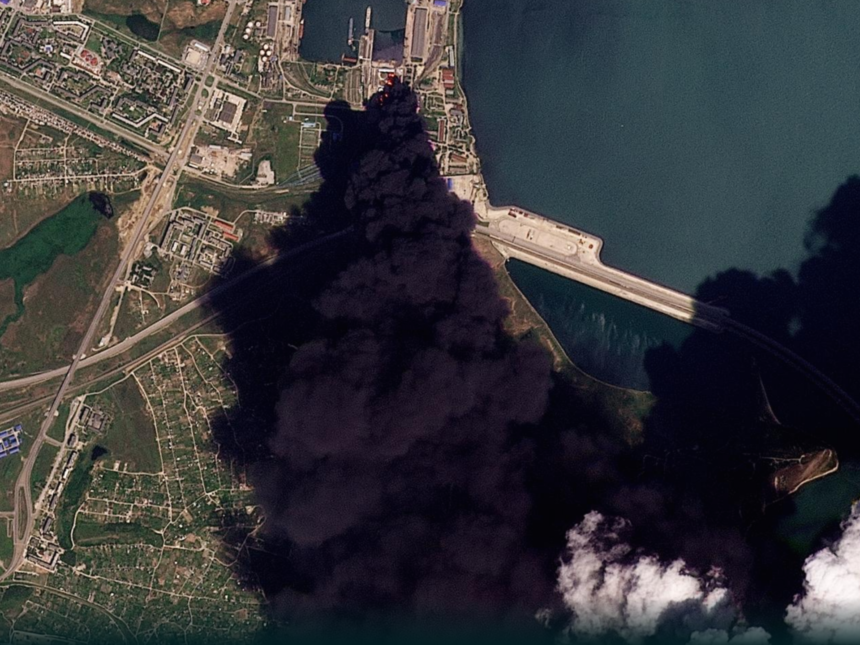
Satellite images taken this morning, Sunday, June 21, showed thick plumes of smoke rising from the vicinity of fuel tanks located within the range of the Kerch sea crossing, following a Ukrainian drone attack that targeted logistical and oil facilities in the Crimean Peninsula and the Krasnodar region in southern Russia.
The images, obtained by the Al Jazeera Network’s open source unit, show smoke continuing to rise from the fuel tank area near the town of Chuchka, near the Kerch crossing, which constitutes one of the vital connecting points between the Crimean Peninsula and Russian territory.
Read also
list of 4 itemsend of list
What the satellite images showed intersects with announcements by the Russian authorities about a fire breaking out at an oil station in the region, and the suspension of ferry traffic through the crossing until further notice.
Fire at an oil station
The operations headquarters in the Krasnodar Territory said that a drone attack targeted the “Panagia” ferry at the Kerch sea crossing, resulting – according to preliminary results – in the death of one person and the injury of another.
The headquarters added that the attack also caused a fire to break out inside an oil station in the town of Chushka, where the authorities sent fire and rescue teams to the site to deal with the fire.
Later, the Krasnodar authorities announced the suspension of ferry traffic through the Kerch crossing until further notice, calling on truck drivers to use the alternative land route via Rostov on Don, Taganrog, Mariupol, and Melitopol, all the way to Simferopol.
The suspension of ferry traffic indicates the sensitivity of the crossing in the transport movement between Crimea – which Russia annexed from Ukraine in 2014 – and Russian territory, especially in light of the dependence of trucks and heavy vehicles on this point as part of the supply and transportation routes.
Fuel restrictions
For his part, the Moscow-appointed President of Crimea, Sergei Aksyonov, announced the cessation of the sale of fuel at gas stations to individuals and companies as of nine in the morning local time, while limiting supplies to government agencies and vital and security services.
Aksyonov called on residents to rely on official sources and not to cause panic, indicating that the authorities fear that the attack will affect fuel supplies inside the peninsula, or that there will be sudden pressure on gas stations.
In a later update, Aksyonov announced that the death toll from the attacks that targeted the Kerch region had risen to 4 dead and 28 injured, expressing his condolences to the families of the victims, and stressing that the competent authorities are following developments on the ground.
Hitting logistical facilities
On the other hand, Ukrainian President Volodymyr Zelensky announced that Ukrainian forces carried out long-range strikes targeting Russian logistical, military and oil facilities on both sides of the Crimean Bridge.
Zelensky said that the strikes hit oil shipping facilities in the Krasnodar Territory, and a fuel depot in Kerch, in addition to targeting 4 S-400 radar stations and two Pantsir systems.
He added that these strikes came in response to Russian attacks against Ukrainian civilians, praising what he described as the capabilities of Ukrainian forces to carry out operations about 300 kilometers from the front line.
Evidence from Earth and space
Satellite images reinforce what was shown by video clips published by local platforms, which documented the continued rise of plumes of smoke from locations in the city of Kerch and the vicinity of the crossing following the attacks.
Satellite images provide additional visual evidence that the attack targeted sensitive infrastructure related to fuel storage and maritime transport, which explains the quick decisions taken by the Russian authorities, whether to suspend ferry traffic or impose restrictions on the sale of fuel in Crimea.
Strategic anchor point
The attack comes in light of the escalation of exchanged strikes between Russia and Ukraine, as the Kerch region and its sea crossing are among the most important points of connection between the Crimean Peninsula and Russian lands, and they also constitute an essential part of the supply and transportation lines on which Moscow depends.
Since the outbreak of the Russian-Ukrainian war in February 2022, the Crimean Peninsula and the areas surrounding the Kerch Strait have turned into a frequent arena for mutual attacks, given their strategic importance in linking the peninsula to Russian territory and securing the movement of transport and supplies.
While firefighting and rescue operations continue in the region, images of thick smoke rising from oil tanks reveal that the latest attack was not a limited local event, but rather a strike that affected an influential logistical and oil node at the eastern gateway to Crimea.