Published on 6/21/2026
In the Atuf Plain, east of Tubas in the West Bank, drought alone was not the reason for the wilting of grape vines and the end of an entire crop season, according to Palestinian farmers. Rather, it was thirst imposed by cutting off the water lines supplying the region, at a time when restrictions on agricultural land continue and large areas of it are confiscated.
Among the withered grape branches, farmer Dergham Bisharat stands in front of his crop, which has turned into a huge loss, after he waited an entire season in vain. He told Al Jazeera that tens of tons of grapes were lost after farms were deprived of water, stressing that cutting off supply lines decided the fate of the crop early.
Bisharat added to Al Jazeera’s correspondent in the West Bank, Laith Jaar, that his loss is not limited to one season, explaining that the grape trees are capable of producing for many years, but stopping irrigation for three months led to a loss of production for the coming years, noting that his loss per dunum amounts to about one million shekels (about 270 thousand dollars).
The suffering of the residents of the Jordan Valley does not stop with the water crisis. In the Ras al-Ahmar region, farmer Lutfi Bani Odeh lives in a more complex reality, as the ability to graze livestock has declined with the closure of large areas of land, the lack of pastures, and the high costs of raising sheep.
Bani Odeh says that the difficulty of life did not push his family to leave, despite dozens of families leaving the area, but he faces increasing pressures daily, including the difficulty of accessing the mountains and pastures that used to constitute a basic source of livelihood for the population.
He points out that the closure of large areas as military zones, in addition to the settlers’ persecution of the Palestinians and preventing them from accessing their lands, led to a change in the reality of life in the Jordan Valley, and prompted many families to leave the area.
Agricultural production declined
The water crisis in the Jordan Valley does not appear to be a separate agricultural issue, but rather part of a broader reality that affects the land and sources of life, as it coincides with the construction of new roads and projects on the land that local officials say threaten large areas of agricultural and pastoral lands.
A local official says that one of the roads being built extends for about 22 kilometers, with a width of up to 50 meters, in addition to security zones on both sides of it, which, according to his estimate, may lead to the loss of thousands of acres of agricultural land and the confiscation of other areas of land.
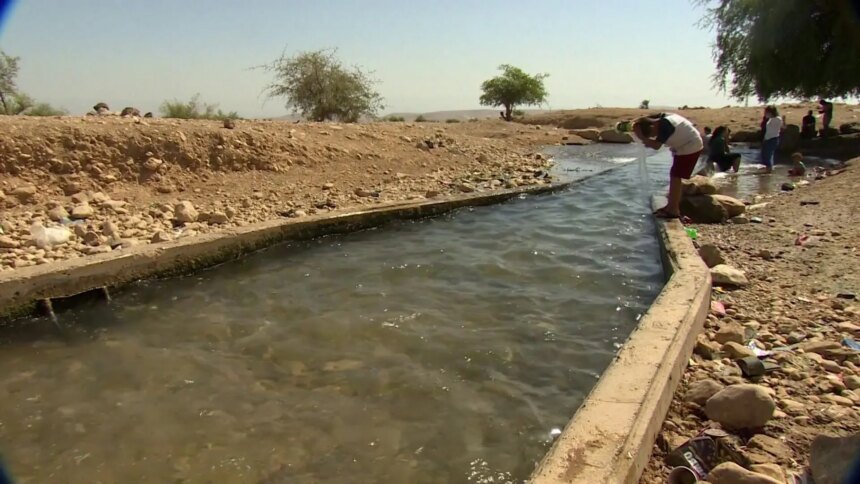
In the Al-Auja area in the Jordan Valley, the decline in water pumping has affected Palestinian agricultural production, as the area includes dozens of wells that provide large quantities of water, but residents say that the distribution is unbalanced, and that the settlements receive a share far greater than what reaches the Palestinians.
Between withered crops, closed pastures, and lands threatened with confiscation, the residents of the Jordan Valley live in a reality in which the water crisis intersects with the struggle for land and survival. From Atuf in the east to Tammoun and other areas of the Jordan Valley, the features of the place are gradually changing under the pressure of continuing restrictions, while farmers cling to their lands despite the harsh conditions.