Published on 6/21/2026
|
Last update: 14:56 (Mecca time)
The traditional alliance between Washington and Rome witnessed one of its most violent diplomatic crises in recent times, after the scenes of the Group of Seven (G7) summit in France turned into a battlefield of public and exchanged statements between US President Donald Trump and Italian Prime Minister Giorgia Meloni.
The crisis that began with an apparent personal dispute over a photo request quickly revealed deep geopolitical rifts linked to issues of national sovereignty, the war in the Middle East, and the position on the Vatican, which portends the end of Meloni’s historical role as a “bridge” linking the right-wing American administration and the European Union.
Read also
list of 2 itemsend of list
The international press paid attention to the chapters of this crisis, as the Swiss newspapers L’Hôten and the French newspaper Libération described the sudden deterioration in the relationship of the two leaders as an “avalanche.”
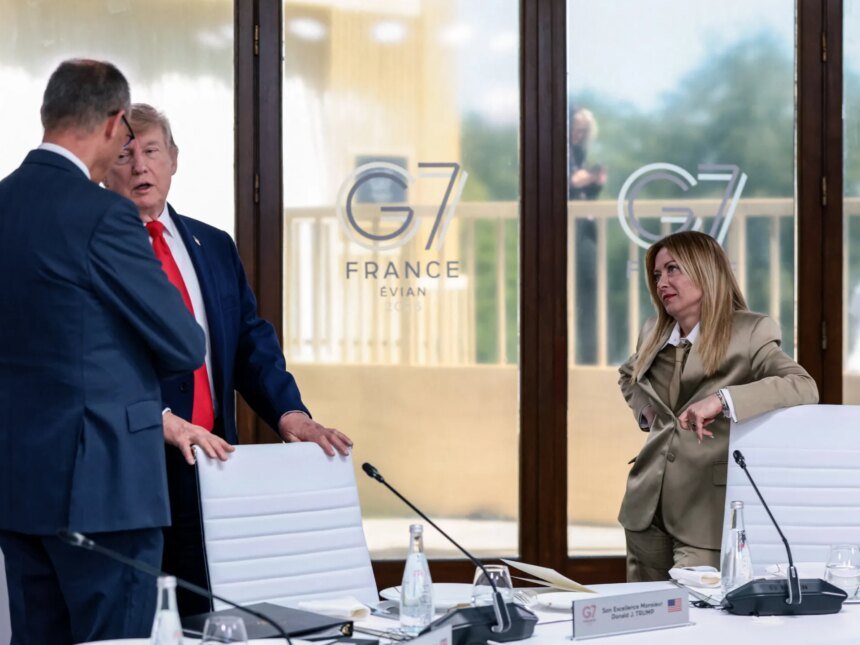
After right-wing Italian newspapers rushed to celebrate what they called the “romantic return” and the thaw between the two leaders on the sidelines of the Evian Summit in France, Trump added fuel to the fire through an interview with the Italian network La Ste (La7), claiming that Meloni “repeatedly begged him” to take a picture with her.
![US President Donald Trump speaks with Italian Prime Minister Giorgia Meloni at a working lunch with G7 leaders in Evian-les-Bains, France, June 16 [Evelyn Hockstein/Pool via Getty Images]](https://www.aljazeera.net/wp-content/uploads/2026/06/trump-1782031982.jpeg?w=770&resize=770%2C514&quality=80)
Meloni angrily confronted Trump’s statements in a video clip, describing them as “completely fabricated and astonishing,” and asserting in firm language: “Italy and I are not begging anyone.”
However, the American President did not back down, but rather doubled the attack through his “Truth Social” platform, this time targeting the Italian Prime Minister’s popularity, which was damaged following her loss of a massive local referendum last March.
He wrote in Truth Social in a sarcastic comment: “She is doing poorly in Italy, perhaps because she has turned her back on America, which loves and protects Italy.”
He added: “Meloni repeatedly asked to take a picture with me during the G7 meeting in France…and now that the United States has defeated Iran militarily, it wants us to become friends again to increase its popularity? No thanks!”
The Italian response came quickly and in sharp English via Meloni’s Instagram account, where she threw the ball in his court and said: “Being your friend has never helped my popularity, and my popularity does not depend on you, but on my defense of Italy’s interests. I advise you to focus on your own popularity.”
She posted a post on Instagram saying: “These continuous and unprovoked attacks are a form of madness… As Prime Minister, I will not allow security agreements to be violated, as Italy remains a sovereign nation.”
In a statistical gesture highlighted by the British newspaper The Independent, opinion polls (YouGov) confirm that Trump himself is facing an internal popularity crisis that does not exceed 35% due to his economic and military policies.
Despite the superficial media approach that tried to confine the dispute to the image, identical reports by Lutan, the American Politico, and other international newspapers unanimously agreed that the true depth of the dispute lies in the “war bill against Iran.”
She argued that the origin of the diplomatic rift goes back to last March and April, when Rome (along with NATO) refused to provide direct military support for the US-Israeli air campaign against Tehran.
Trump expressed this logistical frustration bitterly, saying: “You wouldn’t even let us use the Italian runways or the tarmac, which was a huge logistical inconvenience, even though we’re paying hundreds of billions of dollars to protect these quasi-allies in NATO.”
Meloni interpreted this position strictly by national sovereignty, stressing that the use of American bases in Sicily and Italy “is governed by joint agreements that Rome has always respected and cannot be violated, as Italy is a sovereign state.”
According to the American newspaper The Hill, the Italian refusal was not only technical, but was linked to Meloni’s fears of the repercussions of a strike that targeted an Iranian school, and its adoption of the Vatican’s position against the conflict and the expansion of the war.
The Vatican and the opposition
Religious and political authorities in Italy entered the front line. At the height of the controversy, Pope Leo
Internally, the Italian opposition exploited the incident to settle political scores, as former Prime Minister and leader of the Five Star Movement, Giuseppe Conte, mocked the scene, saying that Meloni had received the penalty for “running after Trump” and presenting him as a Nobel Peace Prize candidate, citing the “insult and blackmail” to which Rome was subjected at the hands of its supposed ally.
The repercussions did not stop at the verbal borders, but rather quickly translated into an unprecedented diplomatic paralysis between the two countries, as Italian Foreign Minister Antonio Tayani announced the cancellation of his scheduled official visit to the United States.
He described Trump’s statements as “an insult that affects all of Italy,” saying in a tweet on his X account: “President Trump’s dangerous and offensive words against the Prime Minister insult every Italian, and therefore we canceled our visit to Washington.”
Meloni: This is my final response, and I will not return to this topic again, because I still believe in the unity of the Western ranks, and I do not think that this banal scene is worthy of our real tasks.
This cancellation directly caused – according to the US State Department – the cancellation of a high-level economic conference on trade relations that was supposed to be held in Miami with US Secretary of State Marco Rubio, coinciding with leaks about a comprehensive boycott by Italian ministers of US Independence Day celebrations in Rome.
In an effort to close this worsening issue, Meloni published a new tweet in which she said: “This is my final response, and I will not return to this topic again, because I still believe in the unity of the Western ranks, and I do not believe that this banal scene is worthy of our real tasks.”
Observers believe that this resounding “political divorce” puts Meloni’s right-wing government in the position of abandoning the guise of “mediator” and ideological bargaining with Washington, and paying full attention to strengthening its position within the European camp, especially after European leaders – led by Spanish Prime Minister Pedro Sanchez – declared their full solidarity with Rome in the face of the American attack.