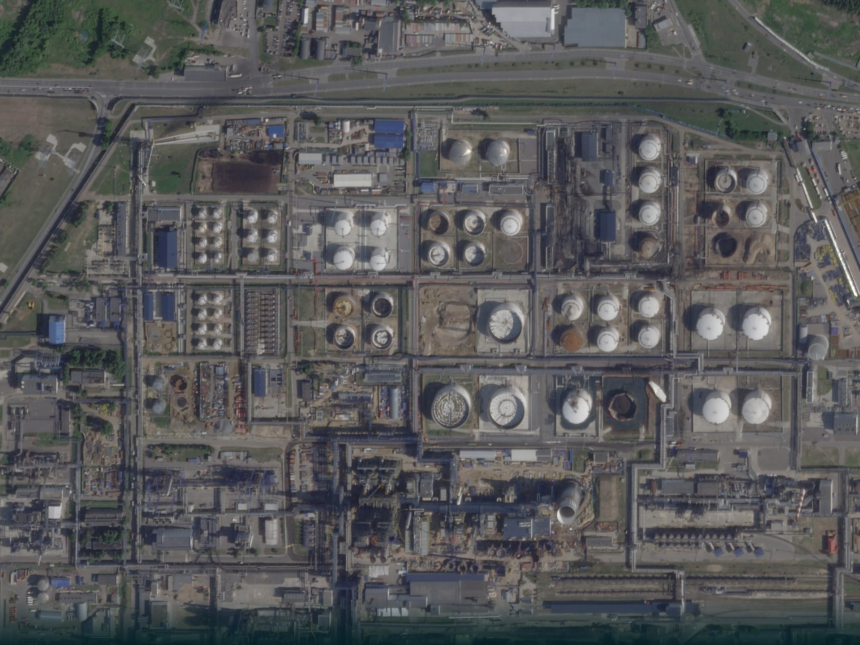
Recent satellite images showed clear signs of damage to a vital energy facility inside the Russian capital, Moscow, in addition to damage to one of its largest commercial complexes, after a massive Ukrainian attack on the heart of the capital and its environs.
Satellite images obtained by the Al Jazeera Network’s open source unit revealed the extent of the damage to the Moscow oil refinery in the Kapotnya area, southeast of the Russian capital, in addition to traces of damage to the “Sadovod” commercial complex near the refinery, following the recent Ukrainian attacks.
Read also
list of 3 itemsend of list
This comes as part of a widespread wave of drone attacks that affected several locations in and around Moscow on June 18, in one of the largest drone attacks that the Russian capital has been exposed to since the start of the war.
Charred tanks
A visual comparison of the latest satellite images taken by the American company “Planet” showed the destruction of the Moscow oil refinery, which is one of the vital targets of the energy infrastructure in the vicinity of Moscow.
Satellite images taken on June 20 reveal that specific energy facilities were affected, and visible charring and damage appeared to a number of fuel tanks located in the eastern part of the complex.
This damage gains additional importance because it comes days after a previous targeting of the same refinery, as part of an escalating Ukrainian campaign against Russian energy facilities, which Kiev says aims to weaken Moscow’s ability to finance its war.
“Sadovod” commercial complex
Close to the strategic energy facility, satellite providers took pictures of the “Sadovod” commercial complex, which is classified as one of the largest markets and commercial centers in the capital, Moscow, after it was damaged by the Ukrainian marches.
A visual comparison of images taken on June 20 shows the appearance of dark spots, resulting from structural damage to the roof of the complex’s concrete structure, and the continuation of a slight escalation of smoke columns for the third day in a row.
The satellite images intersect with the official version issued by the Moscow Municipality, as the Russian authorities reported that the debris of one of the intercepted drones fell in the vicinity of the mall, resulting in minor material damage to the building, but no human casualties were recorded.
Diversify the target bank
In addition, residential buildings were not spared from the attack, as circulating scenes documented the moment drones collided with residential towers, resulting in an explosion and dense columns of smoke rising in some buildings.
The Al Jazeera Network’s Open Source Unit analyzed video clips published by social media platforms and drew a map of 7 targets, most of them in close proximity to simultaneous strikes with marches.
The geographical identification of the Ukrainian strikes revealed the diversity of targets in 4 areas of Moscow: Kapotnya, Kotelniki, Zhukovsky, and Dzerzhinsky, including the Moscow refinery, the “Sadovod” commercial complex monitored by satellite images, other residential buildings, and an auto supplies store.

Moscow is under pressure
Ukraine says that its strikes inside Russia come in response to repeated Russian attacks against Ukrainian cities and facilities. Zelensky, in a statement published on the
On the other hand, Moscow says that its air defenses shot down hundreds of Ukrainian drones during the attack, and accuses Kiev of targeting civilian areas inside and around the capital.
Between the charred tanks and damaged ceilings, images of Moscow from space reflect a shift in the course of the war. The Russian capital, which remained relatively far from direct damage during many stages of the conflict, is today within the range of long-range Ukrainian strikes.