The Muses are more fun than the Roman Empire
Published at 04:00


Ylva Snöfrid: House of the Muses at Liljevalchs
“1. Enter into the room. 2. Look at the paintings and objects. 3. Lie down on the floor. 4. Close your eyes. 5. Rest. 6. Know your atoms. 7. Breathe.”
Affordable, right? It is the “Meditation Ritual”, in room 12 of Ylva Snöfrids works of art “House of the Muses”. The art audience, which for years has had to see itself transformed from viewer to co-creator, can play loose. A tarot deck with invitations is part of her exhibition and we are not the only ones who activate the rooms. This is also done by actors in some places in the exhibition, which is based on a collaboration with Rebecca Hemse and The drama.
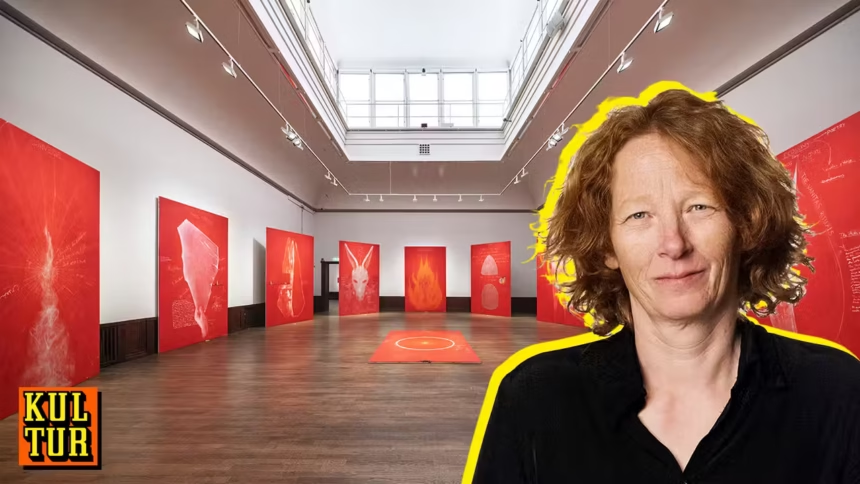
“The House of the Muses” is both easy and elusive as an art exhibition. Think opulence, painting, drawing and objects that actually literally fill the halls. It’s an explosion, an embrace, a bombastic/impressive expression of creativity (take your pick).
The theme for one exhibition that emphasizes an ancient idea of the muses and their inspiring power is right in time. This Odyssey summer, when you risk having a handsome dude explain ancient tales to you every other day, you can safely lean on the inspirational and protective powers of the muses.
The magical summer solstice has been chosen for the exhibition’s opening, and ideas about the connection of everything swirl in it all. The art, life and ritual that sort of alloy and come together during the longest day of the year.
Lily Valchs have one room structure that tells you what is important, where to go. The most important and most load-bearing is in the central shaft itself, the other in the side galleries. Perhaps the greatest concentration of hierarchically colored value is even found in the room facing the Blue Gate. There you can see a collection of red paintings vaguely reminiscent of Hilma of Klints “The ten biggest”, with their circles and shapes that attract other knowledge.

Here, however, the number is more understandable from a religiously harmonious perspective, namely twelve. A thirteenth painting is on the floor. The room is said to be Earth’s room, and the painting, one can read, has the theme of dance. Right next door, it’s a little more fun because there’s a make-up ritual there. It’s Thalia’s room, the muse that inspires the comedy. Mirrors and dressing tables, and at least occasionally actors shouting at each other what appear to be completely random, sometimes “ugly” words. The contrast feels humorous and disarming.
The number of mice was nine, none of whom were responsible for the visual arts. They concentrated on such things as dance, history writing, song, poetry and epics. Ylva Snöfrid’s approximately four hundred paintings that take up space also become more like backdrops for what is important: the rituals and co-creation inspired by the muses. The processes, even those that have already been carried out, i.e. the painting and drawing processes, count the most.
So when I see the individual motifs, the individual works, and mostly see something that is skillfully executed but whose motif usually doesn’t interest me because it also pulls a bit in a kitschy direction, it doesn’t really matter for how I perceive the whole.
In a room towers build up, building material for the free imagination. Of course, the tarot card for this room is a call to build. That is to say: the visitor is included in the ritual, but is free to interpret it. Or: the visitor is forced into a ritual through a completely ordinary and simple act.
“The House of the Muses” floats between action and ritual, but the co-creation is free and largely I have to surrender – to the power of the abundance, to the disarming tone, because the Muses are infinitely more fun to think about than the Roman Empire.
Ulrika Stahre is editor and critic at Aftonbladet Kultur, responsible for art coverage.
ART
» Ylva Snöfrid: House of the Muses
Liljevalchs, Stockholm
Through January 10