Published on 6/19/2026
|
Last update: 21:19 (Mecca time)
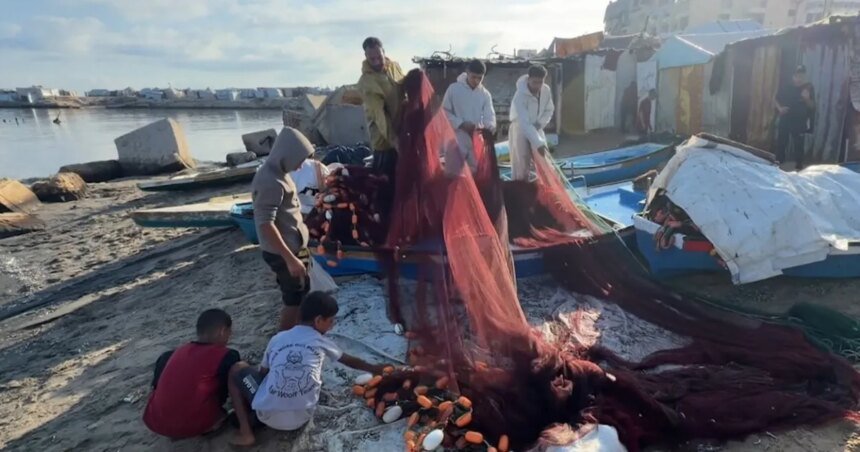
In the heart of the ports of the Gaza Strip, a heavy silence prevails, broken only by the regrets of the men as they look at a sea whose riches have become far away, and their boats that have turned into evidence of a war that has crushed green and dry land.
Between torn nets and destroyed ports, the fishing segment in Gaza stands as one of the groups most affected by the recent war. The trip to the sea is no longer just a pursuit of livelihood, but it has become an adventure fraught with death, and a journey that its owners describe as “whoever enters it is lost, and whoever emerges from it is born.”
Abu Muhammad, one of the old fishermen in the Gaza port, remembers with great sadness what their situation was like before the war. He says, “Before the war, fish were abundant, and we exported the surplus to neighboring markets. We had developed our profession and used modern technologies such as satellites and GPS devices to locate fish, and our naval fleet was one of the most beautiful and most advanced.”
However, this prosperity has completely evaporated. The war did not leave any port or ship without causing destruction. The equipment was burned, and the launches and large boats were destroyed. Today, fishermen find themselves forced to navigate the sea using “very primitive refrigerators and stakes” (cork boards used to preserve food), on which they place small flashlights, and row with oars in the hope of earning their living.
Even fishing nets and boat spinning were not spared, as their prices rose insanely; A roll of yarn, which was sold for 100 shekels (about 34 dollars), today its price exceeds 2,500 shekels (about 844 dollars), while fishermen lack money to rebuild what was destroyed by the war.

Scarcity of fishing and exorbitant increase in prices
The absence of large, equipped boats, and the ban on entering the depths of the sea, led to fishing operations being limited to a very narrow coastal strip that does not exceed hundreds of meters. This narrow space has made fishing limited to very small fish, which fishermen call “seed” fish. Before the war, fish were used as agricultural fertilizer for trees due to their lack of economic feasibility. Today, they have become a basic staple food that is sold in the markets to satisfy the livelihood of citizens.
This severe scarcity was reflected in a huge jump in prices, amounting to between 4 and 7 times the old price. A box of fish, which was sold for 3 to 5 shekels before the war, is sold today for 20 to 35 shekels.
As for luxury species, such as “malita, suez, and locus,” they have become a luxury that even the fisherman himself cannot afford to taste or buy for his children, as the head of the family needs between 70 shekels and 100 shekels to buy a modest meal of fish, an amount that has become unattainable in light of the complete lack of job opportunities.

The danger of death and arrest lurks
The suffering of Gaza fishermen does not stop at the limits of material losses, but rather extends to a direct threat to their lives. Israeli gunboats lie in wait for anyone trying to make a living from the sea. The fishermen confirm that fire is opened on them without warning, resulting in many martyrs and wounded among their ranks, in addition to ongoing arrests and confiscation of what remains of their primitive boats.
One of the workers at the port speaks warmly about his comrades, saying, “Only recently, a young fisherman was martyred, and more than 15 others were arrested at sea. We do not take risks; we throw ourselves into the arms of death so that our children do not die of hunger.”
Amid this bleak picture, Gaza fishermen feel extremely isolated and marginalized by international and relief institutions. Since the beginning of the war, no party has paid any significant attention to rehabilitating this vital sector that supports thousands of families.
Today, from among the rubble of their ports, the fishermen of the Gaza Strip are calling on all living consciences in the world and countries that respect human rights, to intervene and put pressure to lift the naval blockade on them, and to supply them with basic equipment such as boats, launches, and nets, so that the sea returns to what it once was… a source of life, not a death trap.