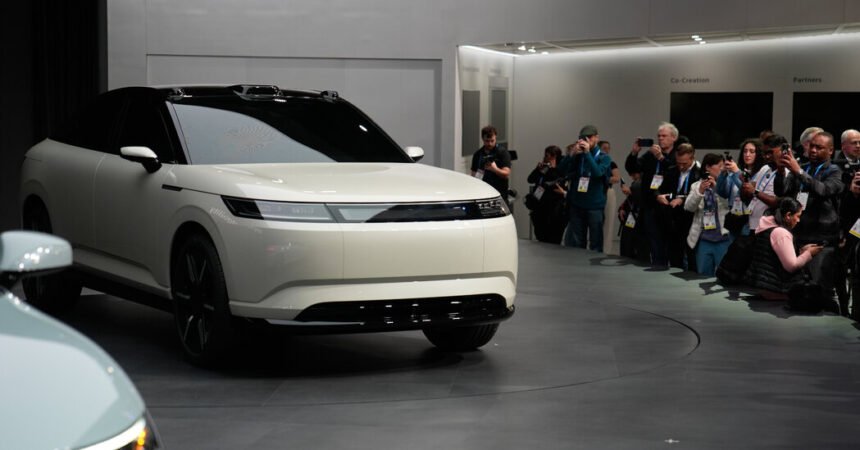
In March, with hundreds of millions of dollars sunk into the project, trial production completed and showrooms already opened, Honda and Sony pulled the plug on their joint electric-vehicle brand, Afeela, pinning the blame on weakening demand for E.V.s.
Add Afeela to the pile of subbrands from major automakers that experienced some success, until they didn’t. These famous flameouts and flops include Think from Ford, Scion from Toyota and Saturn from General Motors.
With an out-the-door price above $100,000 and a sedan body style competing in an S.U.V.-dominant market, Afeela was starting out with several strikes against it. “A car with a 300-mile range is not mind-blowing,” said Randy Barone, vice president of ACV Auctions, a wholesale automotive auction company. “And at prices up to $120,000, you’re not listening to the consumer.”
Jim Johnson, a vice president at VDX.TV, a provider of online advertising, said, “The name Afeela sounds like a tech company, and it turned some people off. Consumers asked, ‘Would the company be around in five years? Am I willing to invest in this?’ They would have needed a long-term branding push.”
By contrast, brands including Acura, Infiniti, Lexus and, more recently, Genesis are perceived as unique marques rather than just spinoffs of their parent companies. To reach this point, they’ve had to invest billions in product development, product differentiation and heavy marketing to establish a value proposition for consumers.
“It would have been cheaper for G.M. to have purchased Toyota than it was to create Saturn,” said Jake Fisher, the senior director for auto testing at Consumer Reports.
The thriving brands lean toward luxury, creating a perceived value that allows, for example, Lexus to charge a premium over what it could if the same vehicle were badged as a Toyota.
“Lexus has Toyota quality but also a fun-to-drive refinement,” said Susan Helper, who worked as a chief Commerce Department economist during the Obama administration.
“At the time of its establishment, Toyota was restricted by U.S. sales quotas, so the company needed to sell vehicles that had a high profit margin,” said Ms. Helper, now a Carlton professor of economics at Case Western Reserve University in Ohio.
Saturn, G.M.’s now-defunct subbrand, initially succeeded in the 1990s, positioning itself as “a different kind of company, a different kind of car.” Manufacturing techniques using plastic body panels were different from G.M.’s traditional vehicles — “no-haggle” pricing was the rule — and the company’s vehicles were a breed apart from its Buick, Cadillac, Chevrolet, Oldsmobile and Pontiac divisions.
The company became so successful in the eyes of the public that, to some, it resembled a cult, with G.M. sponsoring gatherings attended by tens of thousands of owners.
Saturn’s association with G.M. was downplayed or even omitted. “I was a very happy Saturn owner,” Ms. Helper said. “G.M. had a negative brand equity at the time. The Saturn dealer even denied to me that there was any connection between it and G.M.”
Saturn died when it lost its uniqueness, as G.M. cut back its investment, and the division began selling vehicles that were simply rebadged models from its European Vauxhall and Opel subsidiaries.
“G.M. starved Saturn,” said Mark Wakefield, a top automobile analyst for the consulting firm AlixPartners. “They took money away from Saturn and used it to develop new Oldsmobile models.”
Toyota’s Scion division also had a strong start but was discontinued 13 years later, after sales had plunged by almost 70 percent. The division sold vehicles aimed at younger buyers, and one, the iA, was a rebadged Mazda. But younger owners lost interest, eschewing Scion’s smaller vehicles; with sales down, the division was shuttered, and some models were absorbed back into Toyota and renamed.
The bottom line: “A subbrand has to have a customer rationale,” Mr. Wakefield said.
Genesis, Hyundai’s luxury subbrand, intends to have a different fate. First available in the United States in 2017, the company sells a range of gasoline and electric sedans and S.U.V.s. While the vehicles are sold in Hyundai dealers, it also has 85 independent shops in the United States. It expects to open 15 more in the coming years.
The division believes it will succeed because it’s selling vehicles that are not re-engineered versions of Hyundais. With one exception — its first E.V. — all models are built on their own unique platforms.
“We’re not Hyundai Plus,” said Tedros Mengiste, the chief operating officer for Genesis Motor North America. “We have no compromises on our powertrains, materials or design.”
The division is adding perks that have become essential for the luxury buyer: valets who pick up and return cars for service, fancy showrooms and unsolicited gifts, such as a set of home speakers from Bang and Olufsen sent to the first owners of its $100,000-plus G90 sedan.
Introducing a new brand has become even trickier in the age of artificial intelligence. No longer are websites the go-to internet destination to research vehicles. Instead, consumers are increasingly turning to chatbots to find vehicle specifications, reviews and pricing.
As a result, it’s imperative for entrants to learn how to harness these new research tools. “Consumers no longer need to click on links, so automotive brands need a strong, positive presence on review sites, consumer forums like Reddit, and with influencers,” Mr. Johnson said. “Reputation management is so important as a result.”
Mr. Johnson cited Genesis’ work sponsoring the Genesis Invitational golf event and showcasing vehicles at ski resorts as good examples of experiential marketing. The company lent cars to PGA Tour players and, after the Los Angeles fires in January 2025, donated 100 vehicles to the Los Angeles Fire Department and various wildfire relief organizations.
Next up in the subbrand arena: Scout, a new division from Volkswagen that will sell a pickup and S.U.V., in hybrid and E.V. versions specifically geared to the American buyer, manufactured at a new $2 billion plant being built in South Carolina.
That investment is in addition to the $300 million it will spend to build a logistics and production hub. Both will enable the company to produce up to 200,000 vehicles a year.
Whether the demand will be there is, of course, unknown, as previous high-flying brands can attest. To create cachet, the company licensed the Scout name, which graced popular International Harvester off-road vehicles from 1960 to 1980.
While the name may invoke warm, nostalgic feelings from Boomers, it’s an open question whether it resonates more broadly. “I don’t know how many people say, I remember that vehicle,” said Jessica Caldwell, head of insights for the automotive website Edmunds.com. “It’s not like a Ford Bronco where people say, Oh yeah, O.J. Simpson.”
The company begs to disagree. “The Scout name has 35 percent brand awareness, and other people will discover the name,” said Scott Keogh, the president and chief executive of Scout Motors.
Mr. Keogh said the parent company had given it strong backing. That’s evidenced by Volkswagen’s multibillion-dollar investment, its ability to keep parts pricing down through its VW affiliation and its clean-sheet approach to designing vehicles that fit into the most profitable vehicle segment.
In addition, as a new company, it’s not incurring any legacy expenses. “Pension costs can be killer,” Mr. Keogh said.
Subbrands also face another, psychological obstacle: indifference or outright antagonism from entrenched employees, unhappy about the special treatment given to the new kid on the block.
I witnessed this firsthand when I wrote a book about the creation of the Ford Taurus, a revolutionary vehicle for its time. To avoid interference from jealous employees, the team was intentionally separated geographically and organizationally. Yet the Taurus developers still faced opposition from executives who bristled at the Taurus group’s special treatment and desire to adopt styling cues from Ford of Europe.
Mr. Keogh points to the deep financial and personnel investment from its parent company as proof that this will not happen to Scout.
Nor does Mr. Mengiste of Genesis believe that the Hyundai brass are secretly trying to sabotage his success.
“All the Hyundai executives drive our cars,” he said.