Published on 6/19/2026
|
Last updated: 6/20/2026 09:49 (Mecca time)
Rome chose to respond diplomatically to a dispute that began with US President Donald Trump’s statements about Italian Prime Minister Giorgia Meloni. Italian Foreign Minister Antonio Tayani canceled a scheduled visit to Washington, in a move that moved the problem from the level of statements to political relations between the two countries.
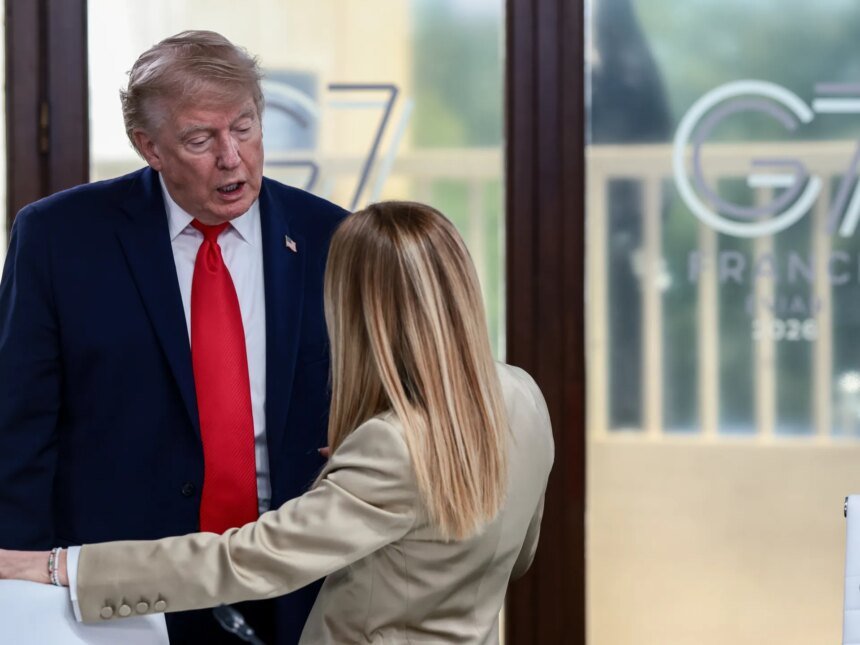
Meloni said, after the G7 summit in France, in which the two parties appeared talking together, that Trump completely fabricated a story in which he talked about how she “begged him” to take a picture with him on the sidelines of the summit, stressing – in a video message – that “Italy and I never beg.”
Meloni not only denied Trump’s story, but rather placed it within a broader framework related to the way Trump deals with allies.
She said that she did not understand why the President of the United States behaved in this way towards his allies, adding that he did not show the same firmness towards those she described as enemies of the West, so the response went beyond the limits of personal defense, towards the nature of the relationship between Washington and its European allies.
Meloni’s response came after a phone interview Trump conducted with the Italian television channel “No 7”, in which he said, according to a text published by the channel, that the Italian Prime Minister very much wanted to take a picture with him, and that he did not want that, but he did “pity her.”
The channel did not publish the original audio recording of the interview, but the statements sparked widespread reactions within Italy, and prompted the Italian Foreign Minister to cancel a visit scheduled to the United States on June 21 and 22.
After the G7 summit in Evian, France, on Wednesday, Meloni spoke of a “very positive atmosphere,” denying the existence of “any disagreement” between Trump and the leaders of other countries, explaining that she and the American president share a “strong personality.”
Tayani described Trump’s statements as “dangerous and offensive” against Meloni and Italy, while the Prime Minister received support from figures in the government and internal political forces, an indication that the crisis is no longer just a personal dispute between two leaders, but rather has turned into an issue of national dignity and Italy’s image before its American ally.

An ally was nearby
Until recently, Meloni seemed one of Europe’s leaders most capable of dealing with Trump. She came to power in October 2022 at the head of a conservative right-wing coalition, and then attended Trump’s inauguration in 2025, in a move considered evidence of political and personal closeness between the two leaders.
According to Reuters, Meloni took advantage of this position to present herself within Europe as a leader capable of opening a channel with Washington, at a time when many European capitals were cautiously dealing with Trump’s policy towards allies, especially in the files of trade, the North Atlantic Treaty Organization (NATO), and the war in Ukraine.
The rapprochement with Trump also gave her a special status within the European right, which was betting that the return of Republicans to the White House would give its parties a greater space of influence.
But the relationship began to be subjected to successive tests. Last April, Trump criticized Meloni after she refused to involve her country in the war against Iran.
Then the tension increased after his criticism of Pope Leo
Before the recent crisis, footage from the G7 summit in France showed Trump and Meloni speaking in what appeared to be a friendly atmosphere.
Press reports stated that their meeting on the sidelines of the summit carried the character of a “clarification” after months of apathy. However, the subsequent interview with the Italian channel shattered the image of calm, after Trump presented the meeting in an insulting manner to the Italian Prime Minister.

A relationship under pressure
The recent crisis puts Washington’s relationship with Rome before a new test. The relationship between the two countries is based on a security, military, and economic partnership and does not stop at the personal relationship between an American president and an Italian prime minister. However, the way public disagreements are managed could affect the margins of the political movement before the Italian government.
Italy is an essential partner of the United States within NATO, hosts American military facilities, and occupies an important position in Washington’s calculations related to the Mediterranean, North Africa, immigration, and energy files.
This incident also presents Trump’s relationship with the European right with a new complication. Forces on the European right welcomed Trump’s return to the White House as a political opportunity.
At a summit held by the “Patriots for Europe” party in Madrid in February 2025, leaders including the leader of the French National Rally, Marine Le Pen, the leader of the far-right League party in Italy, Matteo Salvini, the leader of the far-right “Vox” party in Spain, Santiago Abascal, and the Dutch right-wing politician Geert Wilders, participated and praised Trump’s agenda.
But this rapprochement did not prevent the emergence of discrepancies within the European right itself. The public clash between Trump and Ukrainian President Volodymyr Zelensky in March 2025 revealed divisions among European right-wing forces regarding Trump’s approach to the war in Ukraine, as some of them supported his line while others expressed reservations or criticism.
This discrepancy also appeared during the war on Iran, when reservations were not limited to Meloni alone. The leader of the French National Rally, Marine Le Pen, described Trump’s goals in the war as “volatile,” while the head of the Alternative for Germany party called for the withdrawal of American forces from German bases, an indication that some European right-wing forces that intersected with Trump politically did not keep pace with his military approach to the Middle East.
However, Meloni’s position differs from that of other European right-wing forces that are betting on Trump from outside power.
It leads a government in a member state of the European Union and NATO, and deals with files that impose official positions, not just partisan ones, from the war on Iran to the relationship with the Vatican and European allies. Therefore, her sharp tone in response to Trump was also linked to the image of the country she represents, not just her personal image.