Published 13.05

Russia is judged to be taking increasingly greater risks both politically and militarily in Sweden’s immediate area.
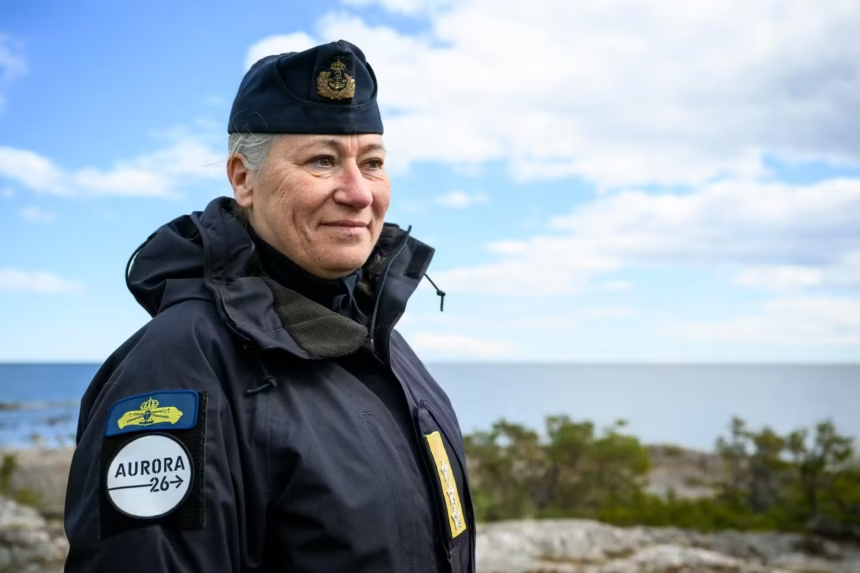
– We have prepared for the scenario in the entire escalation ladder, says Ewa Skoog Haslum, head of the Swedish Armed Forces’ operations management.
ÖB Michael Claesson has warned several times that Russia may test NATO, for example by occupying a small, uninhabited island in the Baltic Sea.
One purpose may be to see if the NATO countries can stick together and agree to trigger the defense guarantee in Article 5 of the NATO Treaty in such a situation. This requires a decision at political level in the North Atlantic Council, NAC.
– But while waiting for that, we don’t sit and wait for the collective decision to be made, says Skoog Haslum.
She emphasizes that all NATO countries have a responsibility as a nation to plan against and prevent attacks on their own territory.
– And if we have a neighboring country that is exposed, then we will support that neighboring country, says Skoog Haslum.
Trust NATO
She points out that Sweden has an agreement with Finland, which also applies outside of peacetime and collaborations with several other countries. In addition, there is the EU’s defense clause.
Skoog Haslum is confident that NATO will act quickly in such a pressured situation in order to activate Article 5.
– If we didn’t trust it, we wouldn’t trust NATO at all.
Skoog Haslum assesses that the probability today is low that Russia would dare to test NATO by taking a piece of land.
– But given how troubled and unpredictable the global situation is, what I say today can change completely in a week’s time, she says.
– I am very keen that we be prepared.
“Is phenomenal”
The defense committee writes in its recent report about recurring sabotage, cyber attacks, GPS interference, violations and other incidents in the Baltic Sea region with various kinds of Russian connections.
In the coming years, Russia is expected to stick to such hybrid operations in order not to exceed the threshold for armed attack.
For The Armed Forces is it important to always have a good situational picture around the Baltic Sea.
– I would say that our situational picture is phenomenal, says Skoog Haslum.
She states that it is the responsibility of the Armed Forces to be prepared for an escalation or unexpected action.
– Then it is always difficult to predict exactly what will happen.
Risk of confrontation?
The Russian navy’s activities have increased in the Baltic Sea since it began escorting the merchant ships in its shadow fleet.
Skoog Haslum is not worried that it will lead to confrontations, as long as laws and justice are followed in international and Swedish waters.
– If you do that, then there really shouldn’t be any risks.
In the English Channel, a Russian frigate has fired warning shots at a civilian yacht that came too close.
Skoog Haslum points out that warning shots are part of the warning chain that all warships use.
– But of course it is an incredibly unusual event, she says.
Her advice if you happen to sail close to a Russian warship is to just follow the maritime traffic rules that apply.
– So I’m not saying that just because you see a warship, that you should have any particular fear of it.