
Published On 4/5/2026
|
Last update: 07:32 (Mecca time)
Accounts on social media circulated a video clip showing a large cargo ship surrounded by several armed speedboats. Others also published a scene claiming to document the targeting of the largest warship in the United States of America by an Iranian bombing.
The video publishers said that it documents an Iranian attack on an American warship and a commercial ship near the Strait of Hormuz, specifically off the coast of Sirik in southern Iran.
Read also
list of 2 itemsend of list
These clips received hundreds of thousands of views within a short time, driven by an escalating context in the region, which gave them additional momentum and contributed to their spread across multiple platforms, including X and Telegram.
The video publishers said that the attack comes as part of an Iranian response to what is described as a “maritime blockade” led by the United States, and the clips were presented as a “dangerous field development” that threatens international navigation.
The British Maritime Trade Operations Authority reported receiving a report that a bulk carrier was attacked by several small boats while it was sailing north, about 11 nautical miles west of the Iranian city of Sirik.
The circulation of these clips comes in the context of escalating tension in the Gulf region, coinciding with what Washington describes as measures to restrict the movement of ships linked to Iran, as part of a pressure policy aimed at reducing its oil exports and isolating it economically.
Since last April, there have been indications of tightening control over ships flying the Iranian flag or heading to its ports, especially in the Strait of Hormuz, which is one of the most important sea lanes for energy transport in the world.
In the context of the maritime escalation in the region, US President Donald Trump announced that the United States would begin efforts to free ships stuck in the Strait of Hormuz on Monday morning Middle Eastern time, indicating the continuation of “positive talks” with Iran, amid confirmation of the US Central Command (Centcom) of its participation in the operation.

The US Central Command also announced the start of support for Operation “Project Freedom” as of May 4, with the aim of securing freedom of navigation for commercial ships through the Strait of Hormuz, through which about a quarter of the world’s seaborne oil trade passes.
According to what was confirmed by the Commander of Central Command, Brad Cooper, this defensive mission comes to enhance the security of the region and the global economy, in parallel with the continuation of what Washington describes as naval blockade measures.
The operation includes the deployment of guided missile destroyers, more than 100 land and sea aircraft, along with unmanned multi-disciplinary platforms and about 15,000 military personnel, as part of a broader initiative led by the US State Department to enhance international coordination under the umbrella of the “Freedom of Navigation Architecture.”
What does verifying trending videos reveal?
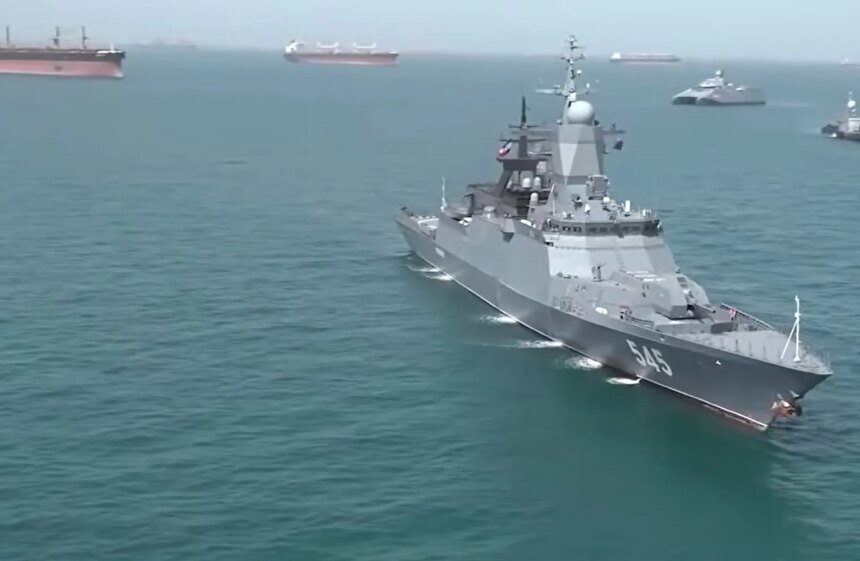
Verification of the circulating videos showed that the accompanying claims are misleading, as they do not document an attack on a cargo ship as claimed.
Using reverse image and video search tools, it was found that the scenes had been posted since February 19, that is, weeks before talk of the recent naval blockade escalated.
A review of the original content also showed that the scenes return to joint naval maneuvers between Russia and Iran in the Gulf of Oman, and are not an incident targeting a civilian ship.
This result is confirmed by official reports, as the Russian Ministry of Defense announced that the military cruiser “Stoiki” participated in joint exercises with the Iranian Navy on February 18, with the aim of coordinating efforts to ensure the security of civilian navigation.
According to the Russian statement, the activities included exercises in joint maneuvering and communications, in addition to measures related to the protection of commercial ships.
He also pointed out that the Russian crew supplied its ship in the port of Bandar Abbas with fuel and supplies, and participated in protocol activities with the Iranian side.
In the same context, verification of the other circulating clip, which claims to document the targeting of an American warship, showed that it was generated using artificial intelligence techniques, and does not reflect a real event.
Reviewing the frames one by one revealed frequent visual distortions in details of the ship’s hull and sea waves, as well as inconsistent explosions in light and shadow, which are common indicators in digitally produced content.
It was also noted that there was no cross-documentation of the incident through official sources, navigation tracking platforms, or reliable media, despite the sensitivity of such an event.