
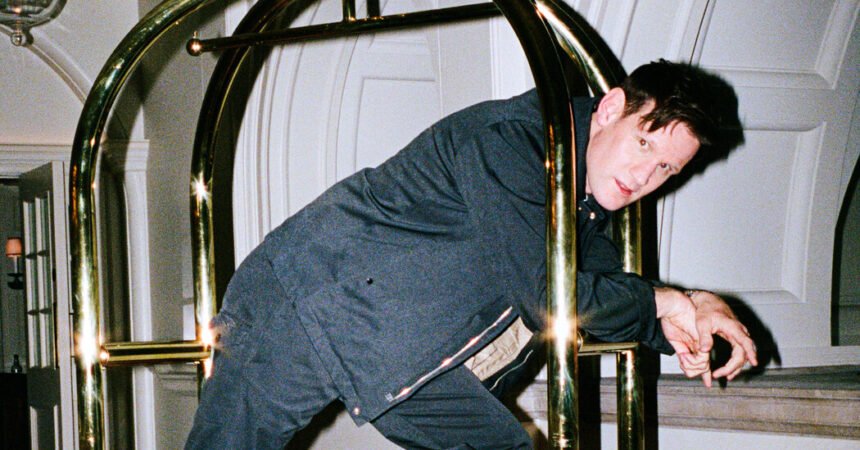
On a May morning in the garden of his London home, Matt Smith played the perfect host — offering tea, switching chairs so that I could sit in the shade, apologizing every time he sprang up to tend to his dog, a terrier just returned from the vet.
I’d been prepared for the charm of Smith, a star of “Doctor Who” and “The Crown,” this easy seduction. The writer Steven Moffat, who has known Smith for two decades, described his ability to work a room — or a garden — as borderline ridiculous.
“Everyone that Matt ever talks to thinks that they are probably Matt’s best friend,” he said. “Nah, you just got Matt Smithed.”
Even forewarned, the gallantry was irresistible, if a little surprising. After breaking out in 2010 as the 11th incarnation of the Doctor on the beloved BBC fantasia “Doctor Who,” a role of almost insane likability, he has spent the intervening years playing murderers, misanthropes and men in squirmy submission to their powerful wives.
He has taken his blinding appeal — a wide grin, that swoosh of brown hair — and applied it to the kind of men who might snip off a rival’s lips with blunt scissors, as he did in the macabre thriller “Lost River.” (“Actually, quite good fun,” Smith said of the scene.) When he plays these men, Smith’s big eyes narrow to slits, his natural warmth goes icy. No tea is offered.
And yet, he makes you care for these baddies, to see them as wounded even as they wound. He has a way of playing the injury, of burrowing into the rawest parts of any role. (Moffat again: “If he’s a serial killer, you’ll think he probably had a good reason.”)
On “House of the Dragon,” the “Game of Thrones” prequel that returns to HBO for its third season on June 21, he plays Daemon Targaryen, a silver-haired prince who kills with ease and unconcern. Blood spatter looks great on him. In Smith’s hands, Daemon is nearly sympathetic.
Certainly, Smith sympathizes with him. He feels for all the men he plays, despite the terrible things they do. “I do definitely fight their corner,” he said. (He noted one reasonable exception: Charles Manson, whom he portrayed in the 2018 film “Charlie Says.”)
“We need our villains,” Smith said, his eyes hidden by sunglasses, adding, “It’s not like I only want to play that for the rest of my life.” But it is what he plays now, for reasons he couldn’t quite articulate.
Before Smith was an actor, he was a teen soccer player with professional aspirations. When an injury ended all that, he landed, with some reluctance, in a school production of “Twelve Angry Men.” This was far from the field, but Smith found the intense preparation and the sense of risk and release not so different from game play. He remains drawn to precarity, to what he called a sort of precipice.
“When you watch the Olympics and someone wins by the space of a fingernail, you’re trying to recreate that feeling in drama,” he said.
The passion he once brought to soccer he infused into performance, creating what Karen Gillan, his “Doctor Who” co-star, described as “an absolutely relentless approach to acting, almost athletic.” Duncan Macmillan, a playwright who has known Smith for decades, noted his distinct physicality.
“He can be very, very still, but you don’t want to take your eyes off him,” Macmillan said. “Because he’s got this kinetic energy to him.”
Smith soon joined the National Youth Theater, a training ground for generations of English actors. He began working professionally while studying drama and creative writing at the University of East Anglia, appearing in a play at the Royal Court and another, by Simon Stephens, that transferred eventually to the National Theater. A role in the 2007 BBC drama “Party Animals” followed. A year or two after that, he was brought in for the first of many auditions for the Doctor in “Doctor Who.”
Smith inherited the role from David Tennant, one of the franchise’s most adored stars — he had big, time-jumping shoes to fill. He was significantly younger than any previous Doctor and less experienced, but Moffat, the show’s writer, saw him as a natural fit for the ageless character.
“There was something ancient in the eyes,” Moffat said. “I used to say that he looked like a young man built by old men from memory.”
Gillan noticed that quality in their first chemistry read. “It was like meeting the coolest young guy and the oldest, weirdest alien,” she said.
Smith, who was just 26 when his casting was announced, felt overwhelmed by the role, but he held his nerve. “Doctor Who,” which can veer from comedy to drama to fantasy, was both a showcase and a finishing school, giving him a taste of nearly every genre. It also made him, at least in England, very famous and very loved.
Days after his final season wrapped, he began dismantling his heroic reputation. His first post-“Who” project was a musical adaptation of “American Psycho” — he starred as Patrick Bateman, the titular psycho.
“I definitely, actively went, ‘I want to go and play bad guys,’” he said. He is not a transformational actor. He has a face and an affect that don’t alter easily, but he wanted to push his inherent likability to its limits.
“I’ve always been interested in the element of surprise, even to yourself,” he said.
His next major role was as a young Prince Philip on “The Crown,” Netflix’s upmarket monarchy drama. Philip, the royal consort to Queen Elizabeth II, was not perhaps a villain or a psycho. But he had a reputation in his later years as a bumbler, a racist. Still, Smith found him not so different from the Doctor or even Patrick Bateman.
“They’re all sort of misunderstood outsiders,” he said. This seems a stretch, for Philip in particular, but sitting in that garden, having been thoroughly Matt Smithed, I believed it.
I also believed him when he said this attraction to these darker characters was artistic, rather than specifically personal, even as the personal is something Smith does not care to discuss. There’s a kernel of something private, even somber, under that suave exterior, and there are elements of his work that he would prefer remain occult.
“It’s important to keep those things secret,” he said when asked about the specific emotions he brings to Daemon.
The role, another antihero and a very insider-y outsider, didn’t immediately interest him. Once the presumed successor to his brother as king, Daemon is passed over in favor of his niece Rhaenyra, whom he later marries. Smith had already been part of one huge fantasy franchise, and he wasn’t seeking another. He also worried that Daemon, who must submit to Rhaenyra, might seem too close to Philip. (He still worries about this.)
But after meeting with the showrunner Ryan Condal and discussing the scale of the series, he agreed to a screen test. He was attracted to what he called Daemon’s gift for “poetry and destiny and fatalism and romance, and I suppose a sort of psychopathic lust for violence.”
For Condal, the screen test was pro forma. He’d had Smith’s picture up in the writers’ room as Daemon inspiration. (Condal also saw the Philip similarities.) And in meeting with Smith, Condal felt that he could take this character — a violent dragon rider in an incestuous marriage — and make him relatable.
“He was charismatic and had this dark edge to him but was also very vulnerable,” Condal said. “He can bring this quality that will keep you interested and invested, even when he is ordering the killing of a child.”
In Daemon, Smith felt that sense of risk, that precipice. Daemon is a killing machine who sees himself as sane and loyal, a man of complete conviction.
“The job is to make people recognize all of these things — not just this slight version of him, the bad guy,” Smith said. “He’s selfish, he’s violent, he’s sadistic at times. But he’s also a human being.”
Emma D’Arcy, who stars opposite him as Rhaenyra, was already a fan, having once waited all day (unsuccessfully) for “American Psycho” tickets. Even so, D’Arcy was struck by the gravitas Smith brought to the role, the magnetism. Daemon “seems to be the custodian of an ancient knowledge — how Matt does that, I don’t know,” D’Arcy said. “There is a kind of mystic part to our job. Matt has that in spades.”
Shooting a show of the scale of “House of the Dragon” isn’t always easy. The days are long, and spending them in a murderous head space, doused in fake blood, can exact a toll. But this season, Smith pushed for the fighting to seem more realistic, shading the show’s darkness even darker. “If you’ve ever seen a proper fight, it’s so quick, boom, and then someone can be really badly injured,” he said. “It’s a mad thing; it is so unsettling.”
“I want it to feel less swashbuckler-y and more violent,” he added. “Because through that we understand a bit about the character.”
Smith couldn’t say whether Daemon will survive into next season, the show’s last. Once his promotional obligations for this one are complete, he hopes to take some time off, “take each day as it comes, try and water my roses,” he said, which he seemed to mean literally.
That’s an escape from the bad men he plays, but the bad men are a kind of escape, too, a release from the everyday work of consistency and kindness and a turn toward risk, toward that precipice.
“It’s such a gift,” he said. “What a great job that you get to go on put a wig on swing your sword about and call it [expletive] work.”