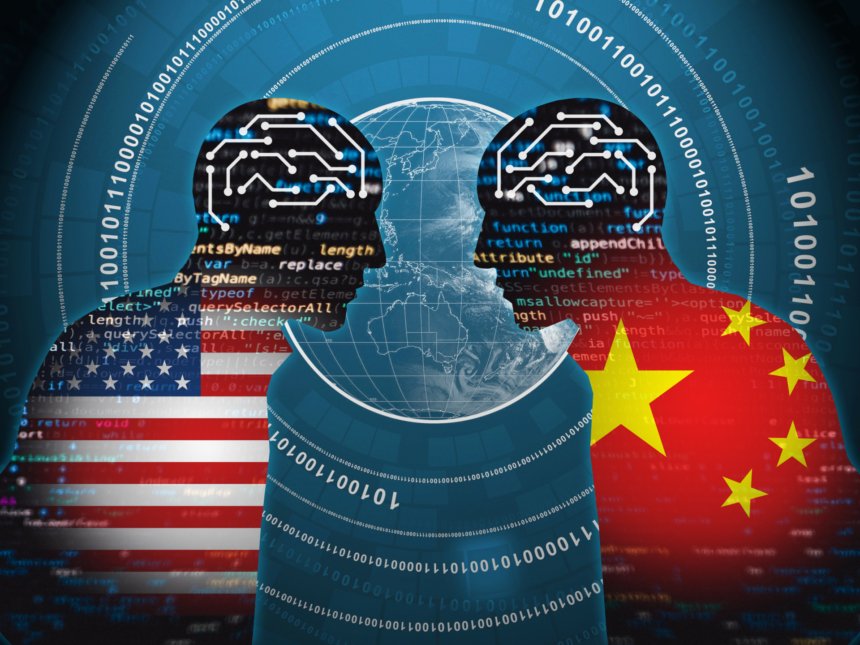
The ongoing war for the forefront of artificial intelligence between China and the United States is no longer a theoretical debate about scientific superiority, but rather has turned into a complex battle in which huge funds, regulatory controls, price wars, and the image of each party are intertwined in the eyes of global public opinion.
With the rise of new open Chinese models to the ranks of the majors in the face of the closed American models, the features of a “digital cold war” are taking shape, entitled: Who rules the backbone of artificial intelligence in the global economy?
Read also
list of 4 itemsend of list
Chinese finance and letters
The Beijing Daily newspaper reveals an exceptional injection of capital into the Chinese company DeepSeek, which received Series A financing worth approximately 51 billion yuan (about 7.5 billion dollars), with a valuation of approximately 4 trillion yuan (about 591 billion dollars), with the participation of local Internet giants such as Tencent, JD, and NetEase, along with Ning De, the CATL company. (CATL) is a leader in new energy.

The report indicates that the National Investment Fund for the Artificial Intelligence Industry has entered the list of financiers, which places “Deep Sec” at the heart of an official strategy that sees artificial intelligence as a national infrastructure and not just a digital product.
This marriage between huge private capital and quasi-sovereign capital reveals a Chinese vision for a long-term race. Beijing believes that it is not only chasing market opportunities, but also mobilizing the resources of a major country to reduce the gap with the United States and turn its open models into strategic assets in the long term.
A model that scares Washington
On the other hand, an article published by NetEase presents the story of Anthropic’s Claude Fable 5 model as the closest thing to artificial general intelligence.
The writer quotes Google founder Sergey Brin as saying, “If you have used Cloud Mythos (Fable 5), you know that it is pure general artificial intelligence,” while Indian entrepreneur Amit Yadav narrates how the model succeeded in building a complete copy of the game “Minecraft” within 37 minutes and at a limited cost through a single request for the model.
But what was noteworthy was the test of Stripe, the global payments giant, which converted into the “Fable 5” model a code migration task that was supposed to take two months of engineering teams’ work, for the model to complete in one day, in an example that the article uses to describe the standard “leap” in capabilities.
This technical leap quickly turned into a source of political concern. According to American reports referred to in the article, Amazon researchers discovered that the model could produce codes used to exploit electronic vulnerabilities.
The sovereign dimension was highlighted by the US Department of Commerce issuing an order prohibiting the export of “Fable 5” and “Mythos 5” to non-American users, which forced “Anthropic” to stop the model globally, in the first widespread use of an export control tool against a commercial model available to the public.
A Chinese window into an American void
The ban decision created a vacuum in supply at the level of the most powerful models, as the NetEase website explains, at a time when the value of “Anthropic” jumped to surpass OpenAI in the evaluation.
In this void, the Chinese company Zhipu emerged with the GLM 5.2 model, which media reports indicate is superior to “Fable 5” in some measures of logical reasoning, with great processing speed and a cost estimated at a tenth of advanced American models.
These reports do not claim complete superiority, but they believe that these characteristics are sufficient to give the GLM 5.2 model the ability to absorb an acceptable part of the global demand deprived of “Fable 5”.
Racing models and infrastructure
Aside from the details of the models, the South China Morning Post offers a more comprehensive reading from researcher Li Cheng from the University of Hong Kong, who believes that US dominance in artificial intelligence faces structural challenges in the long term.
The research paper co-prepared by the researcher uses the “five-layer cake” framework adopted by NVIDIA CEO Jensen Huang, and compares China and the United States in energy, chips, infrastructure, models, and applications.
The study concludes that Washington still leads in advanced chips and cloud infrastructure, but that China is ahead in energy and artificial intelligence applications, while the model gap is narrowing to a “manageable extent.”
The study focused on an important detail: Beijing has pumped huge investments into chip research and development over the past decade, using a combination of government support, national funds, and corporate financing, in an attempt to solve the crisis in graphics processors, memory, and advanced tools.
The goal of this strategy – at that time – was not to prevent American superiority directly, but rather to reduce it to a level that would not give Washington a permanent “fortified trench” that would prevent competitors from catching up.
The “Jibo” company model demonstrated that some Chinese models have begun to move away from the logic of permanent discounting towards the logic of pricing linked to qualitative advantage
Price wars and confidence gaps
On a commercial level, the South China Morning Post sees the outbreak of a price war in the Chinese market as model capabilities converge and the cost of service decreases.
Major companies such as ByteDance, Tencent, Minimax, and Alibaba have reduced their prices or made extensive offers, driven by what Bank of America analysts describe as a vibrant and highly competitive landscape with limited capacity gaps, which makes price a key weapon in capturing users.
On the other hand, Ji Bo’s case stands out as a paradox. According to Chinese analyses, the GLM 5.2 model was able to significantly raise the prices of its software interface with a significant increase in demand, which means that some Chinese models have begun to move away from the logic of permanent discounting towards the logic of pricing linked to qualitative advantage.
At the level of the international picture, a survey conducted by Public First and reported by the same newspaper reveals that the majority of participants in 11 countries, including Canada, Britain and France, believe that China is advancing in the artificial intelligence race or quickly catching up with the United States.
But the poll shows a gap in confidence; The American models ranked highly in terms of “net trust,” while China came with a negative value, which means that the challenge facing Beijing is not limited to catching up technologically, but extends to building a globally acceptable narrative about the safety and neutrality of using its models.
Elon Musk:
Chinese models could reach Fable level during the first quarter of 2027
A policy on the verge of escalation
In the background of this technical race, an organizational and strategic battle continues; The Global Times newspaper quotes the Chinese Ministry of Foreign Affairs criticizing what it calls the United States’ “politicization” of trade and technology issues by expanding the lists of entities subject to restrictions.
Despite reports of a temporary US freeze on including companies like Depsic on new blacklists, Chinese experts warn that repeated pressure is pushing companies to accelerate the shift towards local innovation and reduce reliance on American technology, which may weaken pressure tools in the long term.
In contrast, the blanket ban on Fable 5 and Mythos 5 reflects Washington’s willingness to temporarily sacrifice an innovative advantage in favor of controlling cross-border risks, or at least controlling who can access advanced capabilities.
In this context, the Guan Zha news website publishes a future reading by Elon Musk in which he expects that Chinese models will reach the level of “Vible” during the first quarter of 2027, while specialists comment that the gap is no longer measured in years but rather in months, with the rise of models such as the open GLM 5.2, which announces its challenge to closed models by providing capabilities close to the complex requirements of developers and long-term tasks of the “smart agent” era.
Given these facts, the artificial intelligence war between China and the United States appears less like a nuclear arms race, but more like a long race toward who rules the artificial intelligence backbone in the global economy.
Where there is a closed American model fortified with national security tools, and a Chinese model that bets on openness, size, energy, and the cost of access, while the decision remains postponed in favor of decades of competition and mutual adaptation, and not for an immediate and temporary result.