“Papa, you know the way he is,” Jean-Michel cajoles. “The way he talks and moves and accessorizes.”
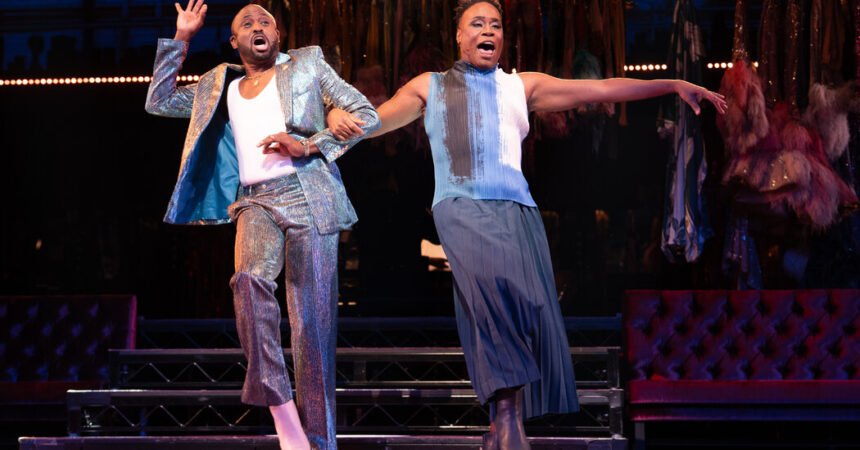
We might want to hate Georges for rolling over and acquiescing to such cruelty, but Brady is simply too charming to let us. Afraid to tell Albin that he’s being banished, Georges serenades him with the romantic “Song on the Sand,” his wistfulness so persuasive that you nearly forget he’s about to perpetrate a terrible double cross. You sense the love between these two, and the sexual chemistry — elements without which any “La Cage” is doomed to fail.
Still, Robert O’Hara’s production feels more germinal than fully figured out. Fair enough; it’s a concert staging at which, as the program says, actors may perform with script in hand. Porter, on Wednesday night, did so for much of the show, and that mostly didn’t get in the way because he understands just who Albin is: his ferocity and vulnerability, his eccentricity and comedy. Very likely, Porter will get more comfortable over the course of the run.
If his voice sounds frayed at times, it doesn’t really matter for Albin and his drag persona, Zaza. “I Am What I Am,” Albin’s wounded cri de coeur of a song — his clear-minded rejection of being rejected by his family — is still a blazing end to Act 1.
On a set by David Zinn that has the air of an unfortunate compromise, the orchestra (conducted by the dynamic Joseph Joubert) occupies much of the upstage floor, leaving cramped quarters for the Cagelles, the company of performers at the drag club. There are 19 of them, yet somehow they get lost in this production, whose forays into spectacle are chiefly in the realm of costume (by Clint Ramos and Michelle Ridley).
Unsurprisingly, Porter makes a gorgeous and shimmery Zaza. He is also pretty, in a suburban matron kind of way, when — slight spoiler — Albin masquerades as Jean-Michel’s “maman.” (Hair and wigs are by Robert Pickens, makeup by Joe Dulude II, lighting by Adam Honoré.)