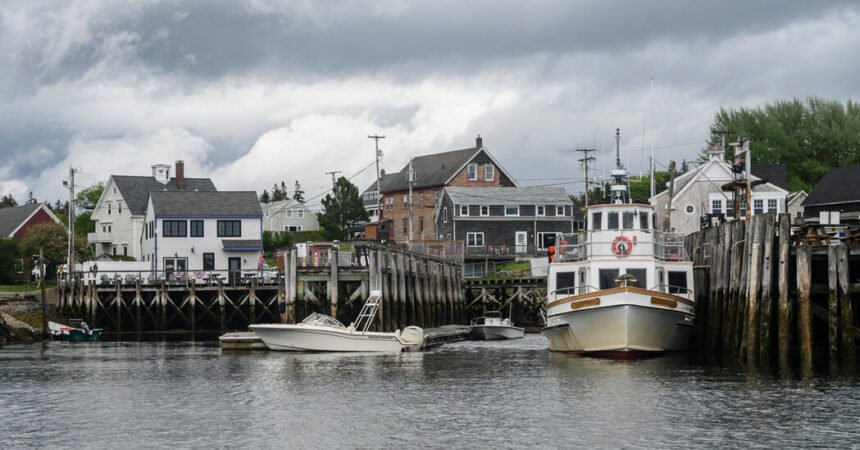
In the fishing village of Port Clyde, Maine, where tame chickens cross and recross the one road in and out, never saying why, life still unfolds at the Monhegan Boat Line, Off the Dock Lobsters, Squid Ink Coffee, the Barn Café, Village Ice Cream, the Black Harpoon restaurant, the art gallery, two old inns and a lighthouse.
But just about everything else changed on the night of Sept. 28, 2023, when a stove gas leak exploded into a blaze that destroyed the popular waterside Dip Net restaurant and adjacent general store and its art gallery upstairs filled with hundreds of thousands of dollars’ worth of works by the Wyeth dynasty of painters, who have deep roots in the area. No one was hurt, but the community was devastated, leaving a waterfront gap like a missing front tooth in the smile of a beauty queen.
A benefactor arrived in Linda Bean of the L.L. Bean outfitting family, who promised to rebuild the town. But just six months later, on March 23, 2024, she died at 82, orphaning her development dreams, to mixed local emotion.
Now, Colby College, about 90 minutes away in Waterville, and a construction magnate with a hefty foundation have joined forces in an unusual environmental initiative aimed at reviving Port Clyde and then some.
As villages go, they don’t come much smaller, or more stunning, than this speck of Land’s End some 14 miles down the rocky St. George Peninsula from midcoast Thomaston. Fewer than 300 hardy year-rounders brave the fierce winters of Muscongus Bay; summers bring thousands of vacationers to ogle the Bush compound in Kennebunkport and maybe rub shoulders with celebrities like Chief Justice John Roberts, whose retreat on Hupper Island faces Port Clyde.
Colby’s plans would expand Port Clyde from a town almost exclusively dependent on tourism, fishing and the arts to an academic and research center aimed at helping to find remedies for natural disasters and climate change nationwide. The initiative, if successful, would change not only the economics of Port Clyde but also its cultural and physical fabric.
Colby has bought Port Clyde’s main commercial properties from the Linda Bean estate, which included properties that made up the heart of town and some 70 other holdings. Sheryl and Daniel R. Tishman and their NorthLight Foundation provided the funding. And Colby has opened science and art campuses on the nearly touching twin islands of Allen (450 acres) and Benner (50 acres), which it bought from Wyeth family foundations in 2022 for $2 million, well below their value of up to $12 million.
“We’re focused on the public good and how to invest for resilience,” said Denise Bruesewitz, provost of Colby, a highly regarded liberal arts college with a $1.2 billion endowment.
Port Clyde’s Seaside Inn, a 12-room ship captain’s home from the mid-1800s acquired by Ms. Bean, has been converted to housing for Colby students and faculty.
And soon, there will be a $6 million Center for Resilience and Economic Impact with offices and a new restaurant where Ms. Bean’s Dip Net, general store and gallery once stood. Nichole Price, a marine ecologist, will be the inaugural director of the center. But to some local dismay, the general store won’t be rebuilt, leaving the closest provisions five miles away, in Tenants Harbor.
While voicing hope that Colby would spur business, some locals were guarded. “I don’t really know yet because it’s so new,” said Jessica Thompson, an eighth-generation resident and the proprietor of Village Ice Cream.
Barbara Ernst Prey, an award-winning painter with an art gallery in Port Clyde whose family roots on the islands go back to the 1700s, said that it was too soon to predict outcomes but that she was optimistic that Colby could be good for the village.
David A. Greene, who has been Colby’s president since 2014, said that Port Clyde would continue to nurture tourism and that the college would help rebuild the town as well as its ecosystem.
“I talked to fishermen who grew up fishing cod and shrimp no longer there,” said Mr. Greene, 63, a native of Worcester, Mass. “Now it’s just lobster. But what do you do when that’s no longer there? It’s at the root of our national malaise.”
“Our first mission is to make sure the people of Port Clyde are not left behind,” he added. “What happens when the worker base is pulled out?” Perhaps, he suggested, career retraining.
Colby expects to bring economic revival to Port Clyde by drawing on experience from its projects in Waterville and its Island Campus, on Allen and Benner Islands.
Waterville was a struggling mill city when the C.F. Hathaway shirt factory (a brand once famous for its model with an eye patch) closed in 2002. Now, 200 of the college’s 2,250 students are living downtown to volunteer for public projects put in place by Colby, and $250 million in public and private investments have been poured into the area, Mr. Greene said during a tour. (The town was portrayed as “Empire Falls” in Richard Russo’s 2001 Pulitzer Prize-winning novel, which was made into an HBO mini-series starring Ed Harris, Helen Hunt and Philip Seymour Hoffman.)
The former shirt factory, now the Hathaway Creative Center with lofts and shops, Lockwood Hotel, arts centers and other new businesses, spurred $1.3 billion in additional economic activity from 2019 to 2024, according to a study commissioned by the college.
“That’s new, that’s new, that’s new, that’s new,” Mr. Greene said while walking through Waterville.
When he ran into Brenda and Tanya Athanus, former food store owners, they embraced him. “We knew every president of Colby,” Brenda Athanus said. “This is the best one.”
When it came to reviving Port Clyde, Mr. Greene found an ally in another converted Mainer: Mr. Tishman, chairman of Tishman Realty and Construction, which built the World Trade Center.
With his wife, Sheryl, a native Mainer, Mr. Tishman, 70, runs the NorthLight Foundation, a $100 million fund that calls itself “a left-of-center environmentalist grant-making fund.” He has had “a lifelong love affair with the state” since attending Camp Androscoggin, near Augusta, he said.
Later, he and his wife bought an 800-acre farm in Jefferson, the 125-acre Caldwell Island off Port Clyde and a house in Port Clyde.
They were friendly with Gov. Janet Mills, and in January 2024, amid terrible storms after the fire, “I made the mistake of suggesting she put a commission together,” Mr. Tishman said. “You can guess what happened.”
As a chairman of the governor’s Infrastructure Rebuilding and Resilience Commission, he worked on strategies to combat climate crises.
That, he said, took him to Ms. Bean.
She was a neighbor, her buying spree having included Teel Island, next to Mr. Tishman’s Caldwell. “Many say one of the worst things about Port Clyde was Linda so in love with it,” Mr. Tishman said. “There was never a property that Linda wanted that she didn’t buy.”
Her notion of land conservation, he said, was: “Buy it!”
And she did, including a number of properties connected to the Wyeths, the first of whom arrived in Port Clyde in 1910. That was the painter and classics illustrator N.C. Wyeth, who came from Chadds Ford, Pa., and, a decade later, built a coastal homestead. His son Andrew painted “Christina’s World” nearby in 1948, and his grandson Jamie now often paints at properties around Port Clyde, where he still owns land.
“We were as opposite as could be,” Mr. Tishman said of Ms. Bean, who had made excessive contributions to a political action committee supporting President Trump during his first run for the presidency. But Mr. Tishman and Ms. Bean bonded over Port Clyde. “That’s what’s magical about this town,” he said.
Mr. Greene also got along well with Ms. Bean, as long as they avoided politics. “She said, ‘I don’t trust pointy-headed academics,’” he recalled. But she softened after seeing Colby’s commitment to Waterville. “Same movie, different ending,” Mr. Greene said.
A few weeks later, she was dead.
Colby and Mr. Tishman continued their own planning, with the Tishmans spending almost $3.4 million to buy the waterfront site of the former general store, restaurant and gallery, as well as the hilltop Seaside Inn for donation to the college.
“The heart of the Port — the store — was wrenched from its body, and Colby is making a huge and valiant effort to bring that pulse back,” Jamie Wyeth said.
Additionally, the Tishmans’ NorthLight Foundation funded $1.4 million toward the construction of the Center for Resilience and Economic Impact and $4.6 million for its programs, including staffing, research and student fellowships.
Ms. Bean’s business manager, Veronika Carlson, did not respond to messages.
On a recent five-mile ride aboard a former lobster boat from Port Clyde to the longtime Wyeth island retreats, Benner and Allen, Whitney King, a chemistry professor at Colby, traced the enduring imprint of Betsy Wyeth, Andrew Wyeth’s wife and business manager. She had bought a sail loft and had it dismantled and moved to a hilltop of Allen Island as a surprise for her husband.
“You’re walking into Betsy’s world,” Mr. King said.
Catrin Carey, a Colby graduate student, conducted a bouncy truck tour of the wooded interior. She called Betsy’s presence indelible — with the Wyeths, unlike Colby, wielding seemingly unlimited funds.
“It’s the Betsy way,” she said of the college’s programs — “not the Betsy budget.”
While it is still early in Port Clyde’s transformation, Mr. Greene said Colby’s work was going to help rebuild the town, as it did with Waterville. And he promised that locals would have a powerful voice. “The idea of a college coming in to tell you what to do is never a good idea,” he said.