Published on 6/18/2026
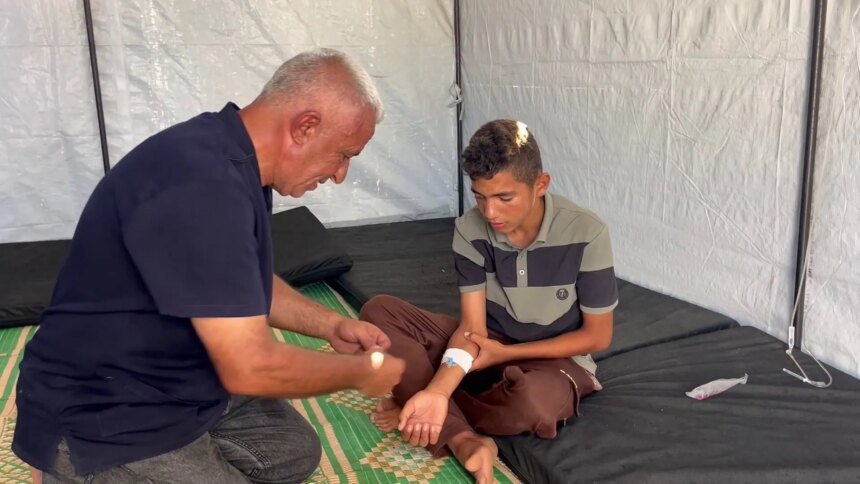
In light of the absence of medical points and the continuing deterioration of the humanitarian conditions in the Gaza Strip, a displacement tent in the Sheikh Ajlin area, north of the Strip, has turned into an alternative space for providing health care, led by volunteer nurse Fayez Al-Barawi, who provides emergency and therapeutic services to the displaced with limited capabilities.
Al-Barawi – a nurse from Beit Lahia who was displaced to the Sheikh Ajlin area – says that the experience of medical work within the displacement began after he moved to the area and the people embraced him and his family, which prompted him to provide whatever humanitarian services he could to the residents.
He explained to Al Jazeera Mubasher that the first case he dealt with was an elderly woman suffering from heart muscle problems and severe pain, and he provided her with first aid inside the place of displacement before later transferring her to the hospital for the necessary medical examinations.
Since then, Al-Barawi has received between two and five cases daily, including children and the elderly, relying on available medicines that residents share or leave part of to be used to treat other cases.
Additional challenges
He confirms that working inside tents imposes additional challenges, most notably the extreme heat and the absence of medical equipment, beds, and devices for suspending solutions, which prompts him to devise alternative means of treating patients and transferring complex cases to health centers through his medical knowledge.
He pointed out that the lack of medical points in the region doubles the health risks, especially during the night hours and the difficulty of movement, pointing out that delayed access to care may lead to serious complications, whether for children suffering from dehydration or patients with high blood pressure or chronic diseases.
He stressed that the need for field medical points has become an urgent necessity, stressing that the continued absence of health services in areas of displacement threatens the lives of residents and increases their daily suffering.
For their part, displaced people in the region said that they face great difficulty in reaching hospitals due to the long distances, the high cost of transportation, and the scarcity of medicines. They stressed that the presence of barawi saved them the trouble of transportation and contributed to providing quick interventions within their places of residence.
Residents also appealed to international institutions to work to provide medical points and bring in medicines and health supplies, stressing that the sector suffers from a severe shortage in health services, and that most families now include patients who need continuous follow-up and treatment.