Published on 6/16/2026
|
Last update: 21:29 (Mecca time)
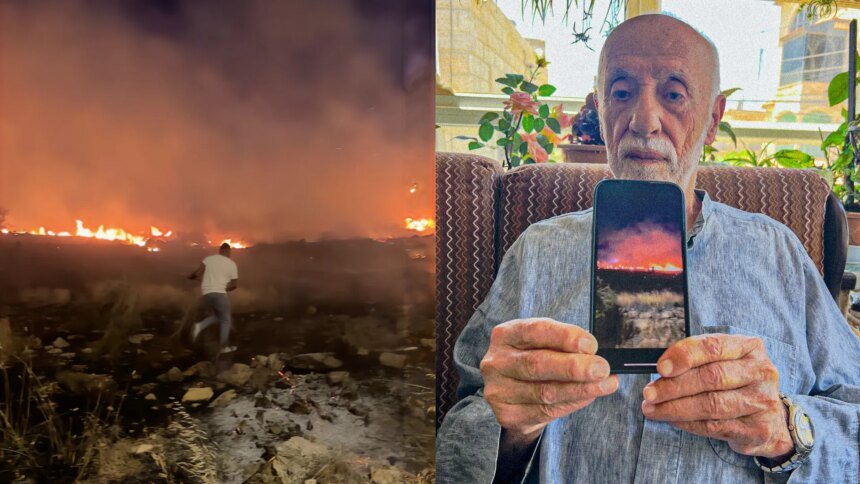
Ninety-year-old Hajj Yasser Saqr Rashid did not realize that the session of contemplating the Qur’an between the Maghrib and Isha prayers inside the “Al-Marah” Mosque in the town of Deir Dibwan would turn into a night in which he faced the risk of death by burning.
Details of the attack, which was documented by surveillance cameras and published on the Al Jazeera Palestine page, show that armed groups of masked settlers infiltrated the mosque’s courtyard and stormed its inner rooms.
Hajj Yasser, 92 years old, tells Al Jazeera the details of those moments, saying: “I was surprised by a settler carrying a gasoline pump, and he directed it towards my face and my clothes… He wanted to burn me alive, and he poured the incendiary substance on the window to ignite the fire.”
The American passport dilemma
The irony of this incident is evident in the fact that Hajj Yasser holds American citizenship, which did not prevent the risk of death and intimidation from him inside the house of worship.
This attack prompted the Palestinian elderly man to send a direct appeal via Al Jazeera to the US administration in Washington, demanding the right to effective protection for Palestinian citizens who hold US citizenship, and whose travel documents have become unable to repel the escalating settler attacks and protect them in their villages.
Division of roles
The attack launched by the settlers was not random, as confirmed by the mayor of Deir Dibwan, Dr. Mansour Mansour, in his field testimony, as he explained that the attackers carefully distributed the roles among their members.
Mansour explained that groups of settlers stormed the town and dispersed in its streets at the same time. One group advanced to target the mosque and attempt to burn the elderly person, another attacked the surrounding homes of citizens, while a third group set fire to six vehicles belonging to the entire population, before withdrawing and setting fire to agricultural lands and crops.

The steadfastness of the people
In the neighboring town of Barqa, the scene was repeated shortly after the storming of Deir Dibwan, as settlers attacked the courtyard of the Al-Nour Mosque and set fire to car tires and flammable materials at the doors with the aim of burning the entire building.
The mosque’s muezzin, Adel Maatan, who was reading the Qur’an at the time of the attack, pointed out that places of worship and property in this area are subject to constant attacks. Despite the losses, the muezzin concluded his speech by saying: “We are stationed here and we will not leave. This is our land. We inherited it from our ancestors, and we will remain in it until the Hour.”

Settler terrorism escalated
The attack on the towns of Deir Dibwan and Barqa is not an isolated event in the details of the Palestinian scene. Human rights and official reports indicate an escalation in settler attacks in the West Bank, and their transformation into organized plans supervised by armed groups that enjoy political and security cover from the occupation authorities.
The Wall and Settlement Resistance Commission’s data shows that targeting Islamic and Christian holy sites represents a basis for intimidating residents and forcing them to forcibly leave.
The eastern Ramallah region is at the forefront of the sites exposed to these attacks due to its proximity to settlement outposts that are witnessing intense activity, which resulted in the burning and vandalization of dozens of mosques and homes, in addition to the destruction of crops and the charring of people’s vehicles.