
 Getty Images
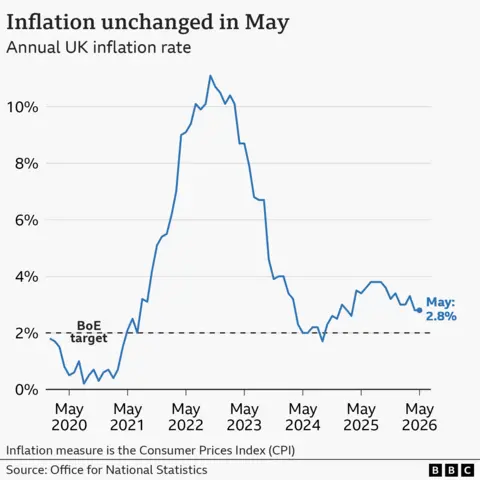
Inflation remained at 2.8% in the year to May according to new figures.
Experts had expected inflation — the rate at which the cost of goods and services is rising — to rise to 3% in May, and were widely expecting it to steadily increasing over the coming months due to the ongoing impact of the Iran war.
Inflation had slowed to its lowest level for more than a year in April because of a decline in household energy prices for the month.
Over the year to May, transport costs rose by the fastest rate, the Office for National Statistics (ONS) said, while the rate of price increases in food and non-alcoholic beverages slowed.
Many economists have predicted that it would peak at between 3.5% and 4% in the second half of 2026, as the effects of the conflict in the Middle East filter down to household costs.
It comes ahead of the Bank of England’s next interest rate decision on Thursday. Economists widely expect the Bank to hold the core interest rate at its current level of 3.75%.
Grant Fitzner, the ONS’s chief economist, said that airfares, vehicle taxes and petrol prices all pushed up inflation.
But these were “offset by lower food prices, with decreases in inflation seen across a range of meat, dairy and vegetable items compared to last month”.
However, food is still more expensive than it was this time last year.
Domestic heating oil — which does not have a price cap like energy bills — also fell after rising sharply due to the war.
Chancellor Rachel Reeves said the government was “protecting families and businesses from rising costs, with cuts in energy bills and freezes in fuel duty and rail fares”.
“While the war in the Middle East pushes prices up globally, we have got the right economic plan and inflation has held steady.”