On Friday night, Maureen Donohue-Peters will turn out the lights one last time at Donohue’s Steak House, the restaurant on the Upper East Side where she started working 47 years ago before taking it over from her father in 2000. She’s earned the right to take it easy in the homestretch, to pull up a chair in the dining room and receive farewells and thanks from legions of regulars.
That is not how Ms. Donohue-Peters has chosen to go out.
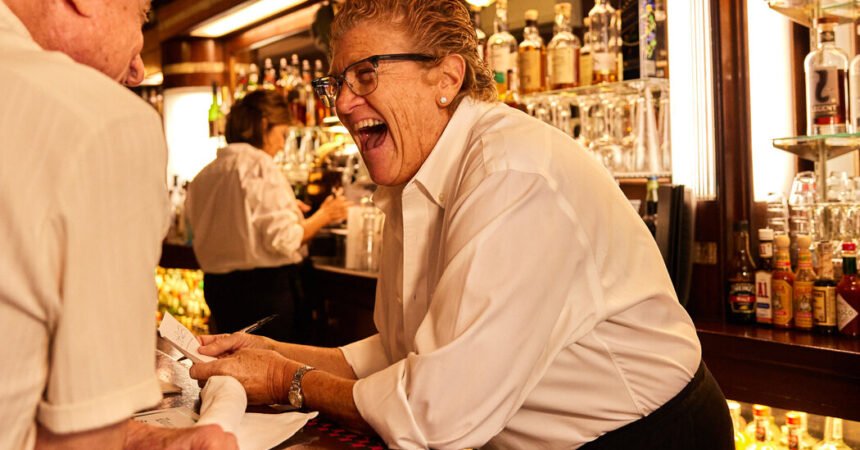
Several nights a week for the past month or so, she has worked behind the bar, alone, pouring drinks for all 13 people at the stools, the standing-room crowd behind them, and the entire dining room, which can seat 50. The faster the orders come in, the happier she looks.
Ms. Donohue-Peters, 64, holds down her turf with the poise and resourcefulness of Jalen Brunson on a scoring streak or Nathan Lane stepping out of Willy Loman’s Chevrolet. One of the last true saloonkeepers in New York, she is doing what she trained for all her life.
Ten restaurateurs have applied to lease the space on Lexington Avenue, according to David Berger, the landlord. Two are still in the running. Mr. Berger won’t say who they are. Whoever takes over, though, everybody agrees that it won’t be Donohue’s anymore, and not just because the name is not for sale.
“The first thing that people do when they call up” for reservations, Mr. Berger said, “is they’ll ask if Maureen is going to be there. Because she is the restaurant.”
Donohue’s does have other charms. The interior, with its checkerboard floor and its blue-glass engraving behind the bar of an elephant looming over a cocktail glass the size of a mouse, looks almost exactly as it did in 1950 when Ms. Donohue-Peters’s father and grandfather built it. The menu is loaded with vintage Americana, too — Boston scrod, Maryland turkey, Hawaiian ham steaks and the occasional broiled sirloin. (Few people treat Donohue’s as a steakhouse, no matter what the sign out front says.)
The “imported skinless and boneless sardines” offered in 1950 are no longer listed, but a few cans are usually kept around for one particular customer, said Mary Barrie, Ms. Donohue-Peters’s niece, who works in the restaurant. “He’ll go to the store if we don’t have them, just so he can have them here.”
The sardines and the other things are still there because Ms. Donohue-Peters is still there. She has implacably resisted changes to the way her father, Michael Donohue, ran the business.
His own father, Martin Donohue, was born in a small town in County Galway and immigrated to New York City. Eventually, he opened a restaurant at 70th and Lexington, then built one for each of his four sons. Donohue’s is the last one standing.
Ms. Donohue-Peters remembers sitting on the bar as a 5-year-old, counting quarters. Waitressing was her first job at the restaurant. She earned a degree in communications from Pace University, but when she told her father that she wanted to go into the family business, he insisted she go to culinary school “so no chef will have it over you.”
He taught her how to work the bar and balance the books. When something breaks, he told her, look over the repairman’s shoulder so you can fix it yourself the next time. Michael Donohue died in 2000. Hanging above the chrome cash register is a framed photograph of him pouring a cocktail taken the week Donohue’s opened.
Although Ms. Donohue-Peters has kept her father’s restaurant in ship shape, close inspection reveals a lasting habit of thrift.
Handwritten checks are posted on a cork rail that has been eroded by decades of thumbtacks. The black wall phone at the end of the bar is the same one the New York Telephone Company installed 76 years ago, although the line is also hooked up to a Panasonic cordless that is a period piece itself.
Walking in or dialing the phone are the only ways to get a reservation. A brief experiment with OpenTable was, Ms. Donohue-Peters said, “a nightmare.”
Donohue’s does have a credit-card reader, although Ms. Donohue-Peters prefers to carry cash herself. “I feel naked if I walk out of the house without a couple hundred bucks in my pocket,” she said.
She has a cellphone but takes a dim view of people who don’t know when to turn theirs off.
“I don’t understand it at all,” she said. “Talk to the person to the right and left of you. Next thing you know, everyone’s laughing and having fun.”
This is, in fact, what happens at Donohue’s whenever it is even moderately busy. Although it does not advertise itself as an Irish bar with shamrocks or Guinness signs, the restaurant shares one key characteristic with traditional pubs in Ireland: people go there to gab.
“This place, conversation abounds,” said Carlos Garcia, a chemist in the pharmaceutical business who was eating dinner at the bar last week. Other restaurants in a similar vein “don’t have that,” he said. “I can’t explain it.”
Faithful diners and drinkers range from the anonymous to the famous to the infamous. The Supreme Court Justice Anthony M. Kennedy ate at Donohue’s. So did Michael R. Bloomberg, the former mayor, and Timothy Dolan, the former archbishop. So did the television journalists Walter Cronkite, Dan Rather and Matt Lauer, along with the writers Gay Talese and Tennessee Williams.
“You could eat sitting at that bar and it would be Bernie Madoff next to the postman,” said Brooke Emmerich, who has been coming to Donohue’s since she was a girl, when her family would troop over every Thursday from their home around the corner for corned beef and cabbage.
When non-celebrities become regulars — and at Donohue’s it doesn’t take many visits to be considered one — the bartenders and servers will know their first names, along with their drink orders.
Alex Stupak, the restaurateur behind the Empellón group in Manhattan, was on a first-name basis with the staff by his third meal, and not because anyone had Googled him.
“They actually just remember you in a nondigital, direct-human-contact way,” said Mr. Stupak, who has been back 50 or 60 times. “They know my name is Alex and I’m going to have a Tanqueray and tonic, and I’m going to have three and they always give me a fourth one. ”
On Tuesday night, Frank McCawley, who tended bar at Donohue’s for 13 years, sat in one of the black vinyl booths with two former customers who had become his friends. The three were enjoying “one final crawl.”
Mr. McCawley, one of the owners of McGee’s Pub in Midtown Manhattan, said that Donohue’s “is part of a New York that’s just going into the sunset. It’s almost a museum of what bars used to be.”
One reason bars and restaurants have changed so much is the rise in expenses, especially rent. That is not why Ms. Donohue-Peters is getting out. In fact, she said, when she told Mr. Berger, the landlord, that she was through, he offered to lower her rent.
She is simply tired of the city’s noise and danger, she said. She would rather “look at the water” on the east end of Long Island. She and her husband own a house in Hampton Bays, and she opened Donohue’s East in Westhampton Beach last year.
The rent will go up now, though, which could pose challenges for the next tenant. Joe Carroll, who owns St. Anselm in Brooklyn, nibbled at the idea of applying but backed off after studying the square footage and hearing that he’d be going up against some deep-pocketed restaurateurs.
“There comes a point where the numbers don’t work anymore for a place like that,” he said.
“My guess is it’s very close to that point.”
According to Mr. Berger, some prospective tenants can’t figure out how Ms. Donohue-Peters made the numbers work. The answer, he said, is that “she survives because she’s willing to do the work herself.”
Between her two restaurants, she puts in 100-hour weeks. This isn’t the way large restaurant groups operate.
“You don’t see many restaurants these days run by the owners,” Ms. Donohue-Peters said. “The kids today just don’t have it.”
Mr. Stupak, the restaurateur, won’t try to take over Donohue’s, either, even though he calls it his favorite restaurant.
“I would ruin it,” he said. “Sometimes imperfections are perfect.”
Ms. Donohue-Peters will not choose her successor. She said she may sell the bar and other fixtures to the new operators, but only if she likes them. If not, she’ll pack it all up and bring it to Long Island with her, including the photograph of Michael Donohue at the bar.
And that will be it. There will be no big send-off to mark Donohue’s last day on Lexington Avenue.
“No after-party, no nothing,” she said. “It’ll be a regular night of business, and then I’ll sit down and have a couple cocktails with my father.”