Published on 6/15/2026
|
Last update: 13:44 (Mecca time)
Japanese national team coach Hajime Moriyasu did not resort to shouting or traditional signals on the touchline to convey his instructions to his players, but rather chose a calm and innovative method of communication during the course of the match.
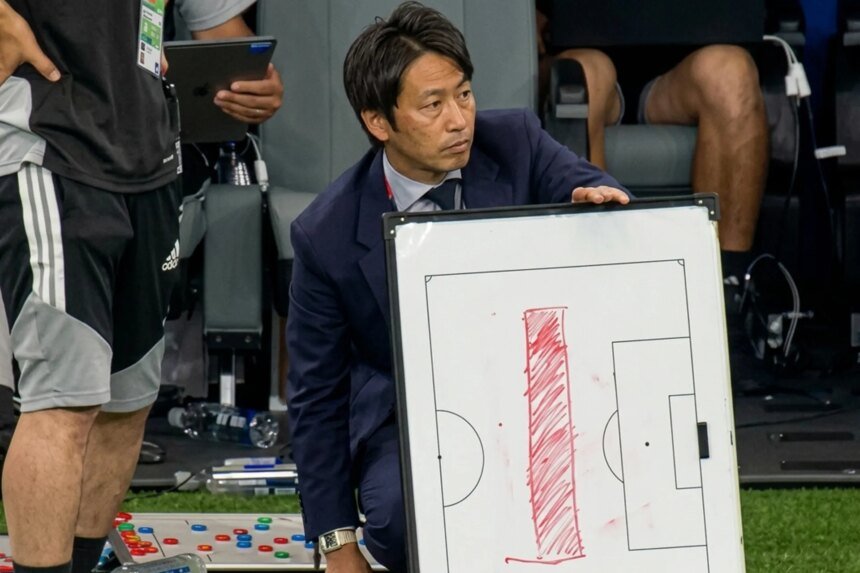
During the confrontation between Japan and the Netherlands in the 2026 World Cup, yesterday, Sunday, Moriyasu caught attention after he appeared on the touchline holding up a whiteboard with large numbers, in a scene that quickly became the talk of the fans and the media, ahead of the events of the match itself in terms of interaction and spread.
The footage showed the Japanese coach using this tactical blackboard to communicate with his players from outside the field, as he began raising a board with the numbers “4-5” written on it, indicating an increase in the number of players in the offensive situation, before he later proceeded to gradually adjust the numbers to “3” then “2” all the way to “1”, in a sequence that reflects an immediate reset of the rhythm and format of play, with the aim of raising the pace of offensive pressure and enhancing the pursuit of the winning goal in the decisive minutes.
While the match ended in a 2-2 draw, it seemed that the “language of numbers” adopted by Moriyasu stole the spotlight from the details of the match itself, after it revealed a special tactical system that had been prepared in advance for communication between the technical staff and the players during the matches.
Read also
list of 2 itemsend of list
The language of numbers reveals an unconventional tactical system
The Japanese coach appeared more than once raising different numbers towards his players, which raised widespread questions about their meanings, in light of the adoption of an unconventional style that departs from the usual voice instructions on the field.
The repercussions of the shot were not limited to the field, as it received millions of views across social media platforms, and sparked a wide wave of interaction, with many considering it one of the most striking tactical scenes in the 2026 World Cup so far.
According to observers and analysts, the numbers used by Japanese national team coach Hajime Moriyasu do not come randomly, but rather represent a precise communication system that relies on tactical instructions agreed upon in advance between the technical staff and the players, within a short and quick method during the match.
A number of observers believe that Moriyasu resorted to this “digital dictionary” as a result of the difficulty of communicating voice instructions amidst the crowd noise, which prompted him to adopt digital codes that allow players to understand what is required and implement it immediately without stopping play or approaching the technical area.
This code is based on encoding roles and plans with specific numbers, where each number carries a different tactical direction, such as increasing the pressure on the opponent, switching to a defensive formation, or changing the rhythm of play, which gives the team a greater ability to quickly adapt to the course of the match.
Public fascination and tribute to the Japanese mentality
In this context, bloggers saw that what happened in Dallas reflected the image of the Japanese team during the World Cup, and presented a scene that embodies the character of the “samurai” who does not know calm even in the most heated moments of the match, as instructions turn into part of the continuous game movement.
Followers also described this scene as a direct reflection of Moriyasu’s coaching mentality, which combines discipline and innovation, and turns the touchline into a space for precise management of the match even in the most noisy circumstances.
Others argue that this shot goes beyond being a passing detail, to provide a model of an integrated tactical identity for the Japanese national team, which has become seen as one of the most organized and innovative teams in the tournament.
A number of observers and analysts concluded by pointing out that the Japanese experience is not limited to the playing style only, but extends to the results achieved by the team in recent years against major teams, which reflects a combination of high discipline and tactical imagination, and confirms Japan’s presence as a rising power in world football.