


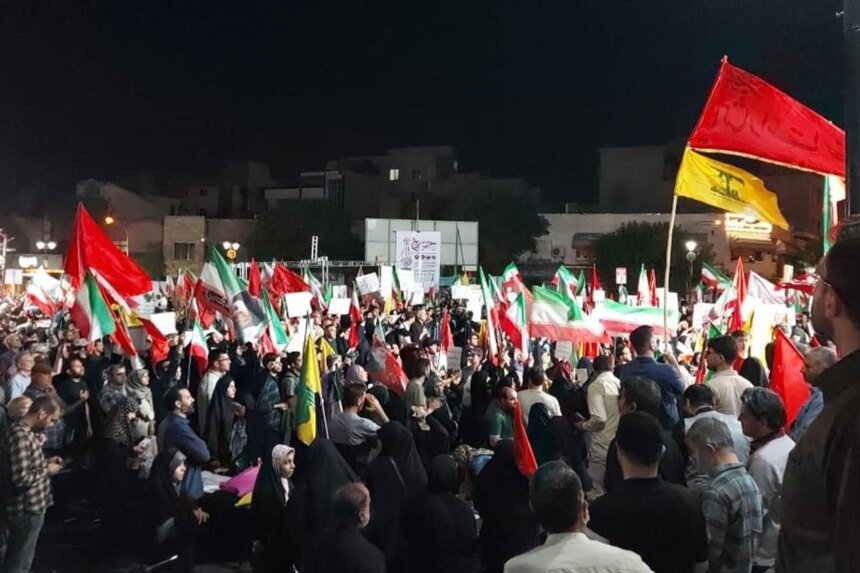
Tehran- In a rare scene in a country known for its strict restrictions on freedom of demonstration, thousands of Iranians came out two nights ago in several cities in rejection of the upcoming agreement with the United States, chanting slogans accusing the negotiating delegation of neglecting the country’s interests. This raises questions about the motives of this early popular anger over an agreement whose terms have not yet been officially announced, and about whether it reflects an independent popular position or is it part of a raging conflict between the political wings?
To find out the motives for this movement and its repercussions, Al Jazeera Net participated in the gathering that was held on Sunday night in the vicinity of the Iranian Ministry of Foreign Affairs on Ferdowsi Street in central Tehran, and interviewed a number of participants, each of whom had his own story and concerns.
In a corner of the gathering, cultural activist Hassan (32 years old) attributed the reason for his participation to his feeling of being ignored by the delegation, saying: “We have been in the street for more than 105 nights, but why is no one talking to us about the terms of the agreement? Why is no one explaining it to us transparently? The experiences of the past are before us, and America is known for breaking its covenants. Now our officials are acting exactly as some of them and their former colleagues practiced obfuscation in 2015 before reaching the nuclear agreement, as if we were foreigners and not children. “Country.”

Driving conditions
Speaking to Al Jazeera Net, Hassan referred to the observations made by the new guide, Mojtaba Khamenei, to end the war, explaining that the negotiating delegation was talking about the conditions of the Iranian supreme leadership, but they were not met. Did someone talk about the fate of the Strait of Hormuz? Or about uranium enrichment? Or about war reparations?.. Nothing. These conditions are not present in the initial agreement.”
When asked whether his presence was spontaneous or at the invitation of political movements, he replied, “I am here of my own free will and because of my feeling of responsibility towards my country,” stressing that he will continue his protest until the Supreme Leader’s position on the agreement with the United States becomes clear.
He explained, “If the Guardian of the Jurist agrees to the prospective agreement, his acceptance of it will mean that the negotiating delegation is acting under his supervision, but we remember that during the previous nuclear agreement negotiations they also said that everything was under the guidance of the leadership, but the result was a disaster.”
Regarding the slogans chanted by the demonstrators against Foreign Minister Abbas Araghchi more than others, Hassan responded jokingly, “Do not worry… the slogans against the head of the negotiating delegation, Muhammad Baqir Qalibaf, are present in the arena with force, but people deal with him with caution because he is an official and an envoy approved by the Supreme Leader, and has a long revolutionary and jihadi record. But this does not mean that the street acquits him. The chants directed at him remind him of his responsibility towards the people and national interests.”
As for the fifty-year-old woman, Marziyeh, who was wearing a black chador and chanting at the top of her voice, said, “If we – the Iranians – were the ones who killed US President Donald Trump, would America have come to sit with us at the negotiating table? Of course not… They killed our Imam and Supreme Leader Ayatollah Ali Khamenei, and then we go to negotiate with them? What logic is this?”
In her statement to Al Jazeera Net, she turned her anger towards the officials, saying: “We did not hear a single voice from any Iranian official threatening them. What if they assassinated the new leader tomorrow? Who is responsible? Who gave them the audacity to commit another crime? If it were not for the valor of the armed forces and the resistance of the people, the officials – who go to sit down the killer and ask him to lower his tone – would have presented the country on a golden platter to Trump.”
Bitter experiences
As for the young man Jalil (29 years old), a cleric, he remembers that the body of the former guide has not yet been buried, as he had previously repeatedly warned of the consequences of negotiating with Washington. He added, “Today we are witnessing a repetition of the nuclear agreement scenario, but this time with Trump, who tore up the previous agreement… So how, after only a hundred days have passed since the martyrdom of the former guide, do we give up on his and his son Mujtaba’s remarks that were contained in his written speeches?”
He explained to Al Jazeera Net, “The negotiating delegation told us in the midst of its negotiations with the six-party group in 2015 that everything is coordinated with the senior leadership, and now they are saying, ‘Is it possible that the new guide does not know anything about the negotiating path?’ Same argument and justifications. In the nuclear agreement, they promised us that all sanctions would be lifted, and now they are talking about liberating only $12 billion of frozen Iranian assets.”
He continued, “Previously, they bet on the signature of US Secretary of State John Kerry at the time, and now they are betting on the promises of US Vice President J.D. Vance.”
When referring to the Israeli bombing of the southern suburb of Beirut again, Jalil considered that this attack exposed the fragility of the expected understanding between Tehran and Washington, and proved that any agreement with America is worthless as long as the “occupying entity” strikes Iran’s allies without deterrence, adding that whoever thinks that “Washington can restrain Israel is delusional, and whoever signs an agreement without guaranteeing Tel Aviv’s deterrence is selling the weapons of the resistance at a low price.”

Official failure
For his part, political analyst Mehdi Khorsand believes that the root cause of the protests against the agreement with Washington is the failure of the official circles to guide public opinion and justify the expected understanding, adding that in the absence of a clear official narrative, citizens find themselves facing an initial reading of the agreement that reaches them through Western and Israeli media, which fuels their fears and pushes them into the street.
Speaking to Al Jazeera Net, Khorsand considers that the protesters are “the solid core of those loyal to the Islamic regime that spent 105 nights in the streets, thus overturning the equation of the arrogant powers that were betting on the collapse of the regime and the division of Iran,” adding that for them, “agreeing with the killer of the former guide is tantamount to wasting the precious blood that was shed in defense of the country.”
He points out that the anger of the segment opposing the agreement is not a partisan or political whim, but rather stems from real concerns about the future of the Islamic Republic. He considers that the criticism directed at the negotiating team is very likely, because they did not speak transparently with public opinion, leaving room for malicious rumors and leaks.
This silence made the citizens – according to the analyst – feel that the sacrifices and steadfastness they had made over the years were being wasted at the negotiating table, and it indicates that the emergence of these protests reflects the existence of a margin of freedom of expression inside Iran, and that the demand for clarity is not a departure from the regime as much as it is an attempt to correct its course.
He concludes that what worries the street are readings that talk about giving up strategic files, such as opening the Strait of Hormuz, which contradicts the directives of the Supreme Leader. “Indeed, any harm to nuclear or missile capabilities is sufficient to create an atmosphere of mistrust and a feeling that the state has become vulnerable to attacks.”

Political conflict
On the other hand, academic and political analyst Mahdi Arab Sadiq offers a different reading of the protests, considering that they are not spontaneous popular anger, but rather part of a political struggle within the elite, explaining that there is a trend in the country that lives on fear of Iran (Iranophobia), and rejects any rationality in foreign policy.
He told Al Jazeera Net that the segment opposing the agreement were the ones who were attacking the former Secretary-General of the Supreme National Security Council, Ali Larijani, and are now attacking Parliament Speaker Muhammad Baqir Qalibaf and Foreign Minister Abbas Araghchi, and “they do not have a real ideology, and their gatherings are organized and not spontaneous as they claim.”
Regarding the reason for the focus of the chants against Araghchi more than Qalibaf, Arab Sadiq explained, “Because Araghchi is the face of diplomacy and the symbol of rationality. And targeting him is targeting the logic of rationality in governance in Iran,” adding that Qalibaf is also not immune from accusations, but because of his long record in positions, they deal with him with caution.
The capital, Tehran, remains on the hot plate, and the demonstrators are meeting in concern that “history will repeat itself, and that the achievements of the difficult years will evaporate at the negotiating table with an enemy they do not trust.” The biggest question remains, according to observers, will the ruling institutions in Iran be able to absorb this anger and turn it into a negotiating force? Or will the agreement face the fate of its predecessor from within before facing it from the outside?


