Published on 6/15/2026
The Group of Seven summit, which includes some of the largest economies in the world, begins today, Monday, for three days, in the French resort of Evian overlooking Lake Geneva-Léman, near the Swiss border, amid exceptional security measures on both sides of the French-Swiss border.
The Group of Seven, known as the G7 for short, includes: the United States, Canada, Germany, the United Kingdom, France, Italy, and Japan, and its annual summits discuss prominent international issues, including international security and the global economy.
Wide international participation
Leaders of the group’s countries will participate in the Evian Summit, along with leaders of countries invited by France, including Egypt, Qatar, the Emirates, Brazil, India and South Korea, while Saudi Crown Prince Mohammed bin Salman apologized for not participating “due to prior engagements.”
Hebrew Channel 12, citing an unnamed senior American official, announced that Prime Minister Benjamin Netanyahu will not come to France, without explaining the reasons.
The President of the European Council and the President of the European Commission, as well as the heads of a number of international and regional organizations, will also participate in the summit.
France also invited a number of global technology sector leaders to a working lunch on Wednesday, including OpenAI CEO Sam Altman and Anthropic CEO Dario Amodei, as well as Frenchman Arthur Mensch, founder of Mistral AI, with the aim of advancing its initiatives in regulating the sector and banning social media networks for those under 15 or 16 years old, two topics about which discussions are expected to be tense with President Donald Trump.
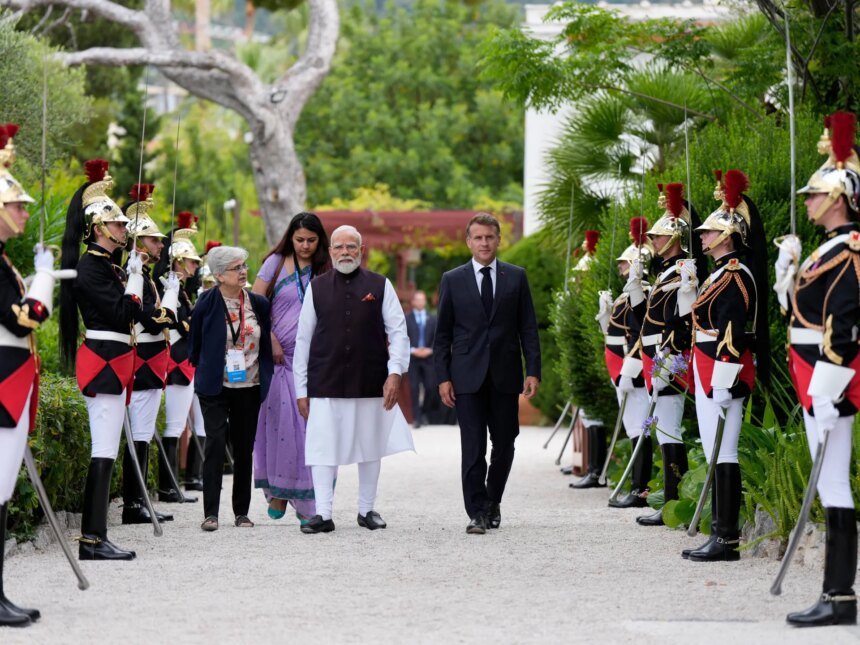
Before arriving in Evian, French President Emmanuel Macron met in Nice, southeastern France, with Indian Prime Minister Narendra Modi, whom he will meet again at the summit.
Sensitive files
The summit will be held hours after Washington, Islamabad, and Tehran announced that they had reached a peace agreement between the United States and Iran that ends a war launched by the United States and Israel against Iran on February 28, which exacerbated tensions in the Persian Gulf and on both sides of the Atlantic and shook the foundations of the global economy.
President Macron announced that the group’s summit will discuss reopening the Strait of Hormuz in the long term under the newly announced US-Iranian agreement to end the war in the Middle East.
Macron said, on Sunday, in a video clip he posted on Instagram, that during the G7 summit in France, “the goal will be to see the results of this agreement, support Lebanon, reopen the Strait of Hormuz permanently, and of course conclude an agreement on nuclear and missile activities in Iran.”
The summit also discusses the war in Ukraine and peace efforts, as President Volodymyr Zelensky participates on Tuesday in a working meeting with the leaders of the Group of Seven, in the presence of the American President.
Zelensky explained that he discussed with Trump, via a phone call, on Sunday, “issues that will help achieve peace now,” noting that he informed Trump of “the latest developments on the battlefield and how our position has been strengthened. We agreed to deepen the discussion during our meeting at the G7 summit.”
One American official explained that Trump intends to raise issues of common interest with the leaders at the summit, including economic growth and development, the strength of supply chains, illegal immigration, and artificial intelligence. It also plans to work on strengthening supply chains for strategic minerals needed for advanced technologies.
It is expected that several statements will be issued at the conclusion of the summit, especially regarding global economic imbalances, strategic minerals, the immigration issue, as well as the digital file.
Protests in Geneva
On the eve of the summit, the Swiss city of Geneva, located dozens of kilometers from Evian, witnessed a demonstration in which about 15,000 people participated at the invitation of the “No to the G7” coalition. They chanted slogans with varied contents, as some expressed support for the Palestinians and Kurds, and another section centered on climate and feminist issues, and anti-capitalist slogans.
The demonstrators gathered in a park on the shores of Lake Leman, carrying banners with slogans such as: “No to the Seventh Summit and all imperialist alliances!” And “Abort the G7 summit.” The demonstrators then set off through the streets of the city, where security forces and checkpoints were deployed so densely that it appeared as if they were preparing for an invasion, while helicopters began flying in the sky.
Confrontations took place between police and groups of demonstrators in the vicinity of the United Nations headquarters. The demonstrators threw bottles, stones, pieces of cement, and firecrackers at the security forces, who responded by firing tear gas.
Security measures
Switzerland deployed about 4,000 soldiers to support police units, while France announced that nearly 16,000 police, gendarmerie, soldiers, firefighters, and border guards were participating in security measures.
The French authorities are responsible for ensuring protection in the immediate vicinity of the summit, and are taking strict security measures in areas around Evian, Thonon-les-Bains and the main roads.
The Haute-Savoie authorities explained that about 16,000 members of the police, gendarmerie, army, firefighters and border guards will participate in these procedures, and they will be assisted in this mission by boats, motorcycles and drones, as well as cavalry teams and police dog units.
As for the Swiss government, it agreed to implement a “supportive deployment” of between two thousand and five thousand soldiers to “support” the police units of the cantonal authorities.