Published on 6/14/2026
The health sector crisis in the Gaza Strip is no longer limited to hospitals and medicines, but has extended to the medical and dental industry, which faces the risk of complete collapse due to the Israeli blockade and the depletion of basic raw materials, which threatens to deprive thousands of patients of treatment and rehabilitation services that have now almost stopped.
At a time when the number of infected people and patients in need of dental implants and rehabilitation treatments is increasing, workers in this sector find themselves facing an unprecedented reality, after laboratories have turned into workshops that operate with primitive alternatives that do not guarantee the minimum required quality.
Dental technician Rami Al-Rifi says that dental laboratories in Gaza suffer from a severe shortage of basic materials used daily, explaining that some of the necessary supplies have been completely cut off in recent years, which has had a direct impact on the laboratories’ ability to continue working.
Speaking to Al Jazeera Mubasher, Al-Rifi explained that the dental impression material, known as “Zeta Plus”, has become completely missing from the market, while its prices reach exorbitant levels when available, which has led to a significant decline in the number of cases transferred from clinics to laboratories.
The impact of the crisis did not stop at the stage of taking measurements, but rather extended to the subsequent stages of manufacturing, as laboratories face extreme difficulty in securing the specialized medical gypsum used in the manufacture of dental models and their various fixtures.
Alternatives under bombardment
Al-Rifi pointed out that the laboratories were forced to use alternative gypsum recycled from the waste of destroyed buildings after grinding and processing it locally, stressing that these alternatives do not match medical gypsum in terms of quality, durability and precision required in the work.
These alternatives are directly reflected in the quality of the final product, as the assemblies become more susceptible to damage and cracking, while technicians lose the ability to carry out precise work that was considered one of the basics of the profession before the outbreak of war and the tightening of the siege.
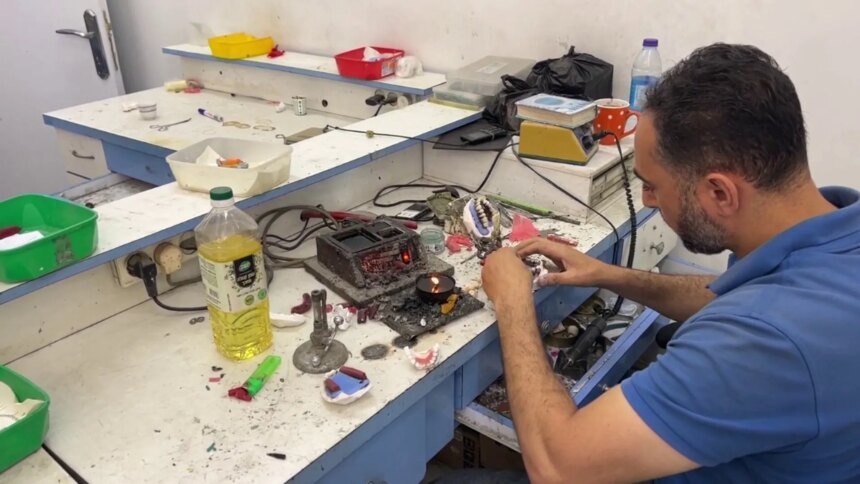
The suffering inside laboratories increases with the loss of energy and fuel sources necessary to operate the equipment, which prompted workers to resort to primitive methods to melt the wax used in making dentures for patients and the elderly.
In this context, Al-Rifi explained that technicians are now using vegetable oil instead of gas to heat the wax, which is a method that leads to the emission of soot and the accumulation of traces of combustion on dental molds, which negatively affects the final appearance and quality of manufacturing.
The problem is not limited to mobile crews, as fixed installations face greater challenges due to the interruption of the metal materials used in the manufacture of bridges and coverings, which are basic components that cannot be dispensed with or replaced easily.
Al-Rifi confirmed that dozens of treatment cases are pending in laboratories awaiting the availability of the necessary metal to complete them, pointing out that patients who lost their teeth or parts of them during the war are the most affected by this worsening reality.
The specter of complete closure
Those working in the sector warn that the continuation of the crisis will lead to the closure of more laboratories and the layoff of their workers, after operational capacity declined to low levels that are not sufficient to maintain business continuity or cover basic expenses.
According to Al-Rifi, the laboratory in which he worked included 10 technicians before the war, but most of them stopped working as a result of the depletion of raw materials and the decline in production volume, while the remaining staff continue to work at the minimum possible level.
The condition of this laboratory is no different from hundreds of other dental laboratories in the Gaza Strip, as some were directly destroyed by bombing, while others closed their doors after depleting their stock of basic materials and being unable to replace them.
With the increasing number of patients and postponed cases, incomplete molds and assemblies are piling up inside laboratories awaiting the arrival of the necessary materials to complete them, in a scene that reflects the scale of the crisis hitting one of the most specialized health sectors in Gaza.
Al-Rifi sent an urgent appeal to international organizations and the World Health Organization to intervene in order to introduce dental supplies, stressing that the continued ban on these materials deprives patients of their right to treatment and rehabilitation and threatens the collapse of the entire sector.
The dental industry crisis comes within a broader scene affecting other health sectors in Gaza, including heart surgery and dialysis units, amid continuous warnings of the repercussions of the lack of medical supplies, despite the urgent need to rehabilitate the health infrastructure and provide its basic needs.