The Cold War period witnessed moments in which the world held its breath and stood on the brink of a devastating nuclear war that almost destroyed humanity.
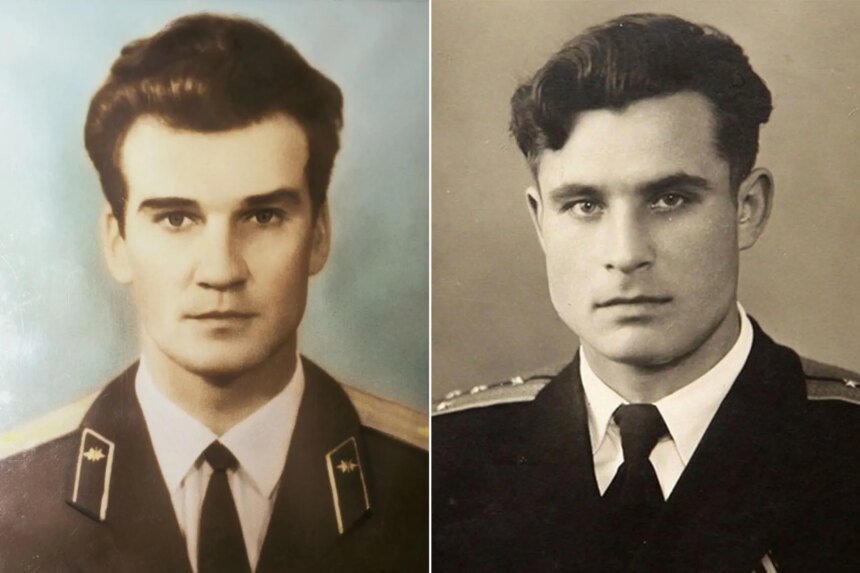
In the darkness of the Soviet leadership centers, survival was not the result of political treaties, but rather depended on the human will and the courageous decision of two officers who refused to submit to machines and military pressures: Vasiliy Arkhipov and Stanislav Petrov.
Read also
list of 2 itemsend of list
The following is a summary of what they did. For Arkhipov, he relied on a recent report from the French magazine Le Point, and for Petrov, he relied on a report from the archives of the American newspaper The New York Times.
On October 27, 1962, the Soviet submarine B-59 was surrounded by American ships near Cuba.
Due to the loss of communication with Moscow and the harsh conditions inside the submarine, where the temperature exceeded 45 degrees Celsius, the air conditioning was broken, and the percentage of oxygen was decreasing rapidly, Commander Valentin Savitsky believed that the war had begun, so he ordered the preparation of a nuclear torpedo with a power almost equivalent to the Hiroshima bomb.
Launching a nuclear weapon required the approval of three senior officers, and while two agreed, Arkhipov refused to give his approval, despite American forces dropping warning depth bombs near the Soviet submarine.

Thanks to his calmness and previous experience in the K-19 nuclear submarine incident, he convinced the commander that the American ships were not attacking them but were trying to force them to the surface to communicate.
The commander responded to his opinion, and the submarine rose to the surface and then returned to the Soviet Union without launching the nuclear weapon.
Many historians believe that Arkhipov’s decision may have prevented an escalation that could have led to a global nuclear war.
Despite the importance of his role, Arkhipov was not honored upon his return. Rather, he and his staff were criticized, and he remained relatively unknown until 2002 when his role was revealed during a conference on the crisis, according to a French magazine report on the subject.
But after his death in 1998, he was given posthumous honors, and some scholars described him as “the man who saved the world.”
However, the report notes that some details of the incident are still subject to historical debate, because most of the information is based on testimonies given by participants decades after the events occurred, and no official Russian documents have emerged confirming all aspects of the story.
Terrifying scenario
Twenty-one years after the submarine incident, exactly on September 26, 1983, the terrifying scenario was repeated, but above ground.
The warning came in a highly charged political climate, as it was a few weeks after the Soviets shot down a Korean airliner, and at a time when then-US President Ronald Reagan was describing Moscow as an “evil empire.”
In this incident, the Soviet leadership had only 25 minutes to decide to respond before the explosion.
Lieutenant Colonel Stanislav Petrov (44 years old) was on duty as a guard officer at the secret command center “Serpukhov-15” responsible for Soviet satellites.
Suddenly, sirens sounded and the screens turned red. The computer categorically announced: The United States launched 5 intercontinental ballistic missiles towards the Soviet Union.

Amidst tremendous pressure and with the eyes of 200 employees watching him, Petrov made a brave decision to inform his leadership that what was happening was a malfunction in the system and not a real attack.
He based his decision on three facts:
- First, the military logic, as he saw that if America wanted to start a nuclear war, it would launch a comprehensive attack with thousands of missiles and not just 5 missiles.
- Secondly, unreliability. He knew that the new Soviet warning system had been rushed into service and was not 100% reliable.
- Third, ground radars. These Soviet radars did not detect any missiles on the horizon.
It later turned out that Petrov’s intuition was correct: the Soviet satellite was mistaken when it considered the reflection of sunlight on cloud tops to be flames resulting from the launch of American missiles, and that the technological system that was rushed into service was flawed.
The Soviet satellite mistook the reflection of sunlight off cloud tops as flames caused by American missile launches
Although the two men saved planet Earth from a nuclear winter and certain annihilation, the shocking historical irony was represented by the way the Soviet Union treated them:
When Arkhipov returned, the military command rebuked him, saying: “It would have been better if you had sunk with your ship.” As for Petrov, instead of honoring him, he received an official reprimand because the accelerating circumstances of the event made him forget to write down notes in his daily observation book!
The two men lived the rest of their lives in the shadows and media blackout, as Arkhipov died in 1998 of cancer, while Petrov lived on a miserable pension and grew potatoes to feed on them, and he died alone in 2017.
Their story did not come out to the world until decades later, Arkhipov in 2002, and Petrov in 1998, through military memoirs.
Only then did the two men gain wide international recognition and global awards, and were classified as some of the most important men in modern history, as they preferred wisdom and human intuition to pressing the buttons of death that neither leaves nor leaves.