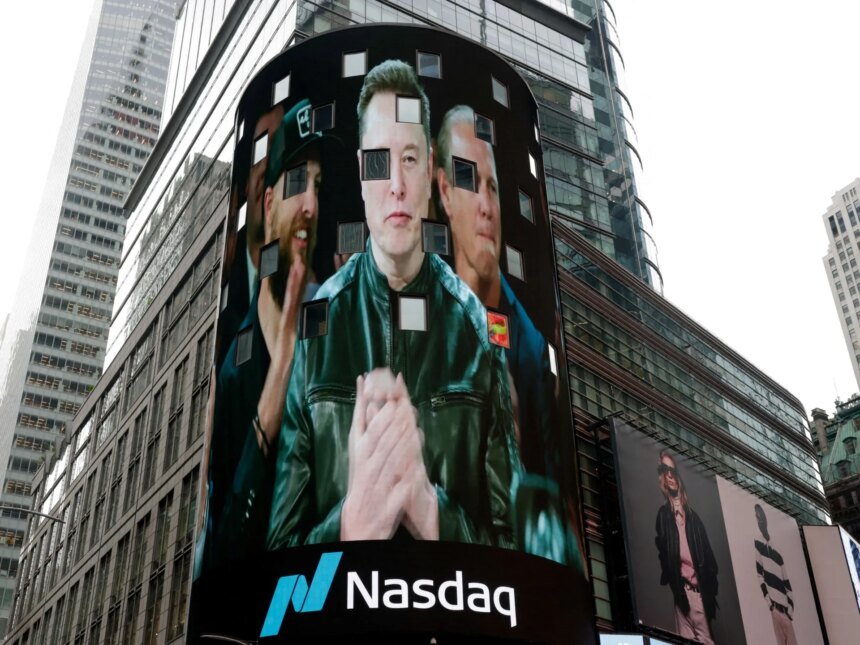
In a moment that seemed closer to a scene from science fiction than to the reality of the financial markets, Elon Musk entered history from the broadest gates after he became the first person whose wealth exceeded the trillion-dollar barrier, driven by the historic initial public offering of SpaceX, which broke records and raised the company’s value to more than two trillion dollars during its first days of trading on the Nasdaq Stock Exchange.
In just one day, Elon Musk became the first trillionaire in modern history, after SpaceX, a company specializing in space and satellites, achieved the largest initial public offering in the history of financial markets, raising about $75 billion and valuing the company at more than two trillion dollars on the first day of trading.
Read also
list of 2 itemsend of list
The richest man in history
But the event, which was celebrated by investors as an exceptional victory for American innovation and entrepreneurship, at the same time sparked a wide wave of political and economic controversy, and newspapers and analysts were divided over it between those who saw it as a testimony to the strength of American capitalism and its ability to reward risk-taking and creativity, and those who saw it as evidence of an unprecedented concentration of wealth and influence in the hands of a single individual.
SpaceX shares were estimated at about 19% in the first trading session, bringing the company’s market value to about $2.1 trillion.
Political and economic figures considered what happened as evidence of deeper imbalances in the American economic system. The Washington Post quoted Senator Elizabeth Warren as saying that Musk now has “more money and wealth than any person in the history of mankind,” adding that this is “not just a coincidence, but a feature of an economy designed for the benefit of the few.”
She explained in a news report that SpaceX shares were estimated at about 19% in the first trading session, bringing the company’s market value to about $2.1 trillion, which made it the sixth largest company in the world behind technology giants such as Nvidia, Google, Apple, Microsoft, and Amazon.
During the historic listing ceremony, Musk recalled the beginnings of his company, which he founded in 2002, saying: “It is really difficult to believe that a small company that started in a warehouse in El Segundo, California, has today become the owner of the largest initial public offering in history.”
He added that if anyone had told him in those days that the company would reach this stage, “I would have thought he was smoking something very strong,” referring to the extent of the challenges the project faced in its beginnings.
The shocking irony highlighted by the Washington Post report is that this astronomical valuation comes to a company that is “bleeding cash and whose revenues are meager compared to other technology giants,” as its accumulated losses have reached about $13 billion since the beginning of 2023.
However, David Mayer, chief investment analyst at The Motley Fool, believes that the huge demand from retail and institutional investors, versus the limited supply of stocks, is what created this significant price jump, and he expects this strong momentum to continue throughout the summer.

Genius and human tragedy
Between the praise of liberal economists and the attacks of progressives, the human and behavioral side of Elon Musk’s personality remains deeply questionable. In an opinion article published by the British newspaper iNews, writer Chris Stockell-Walker discussed an aspect of Elon Musk’s actions on the eve of his remarkable achievement.
While the writer acknowledged that Musk contributed to the development of industries that changed the face of the world, from electric cars to reusable rockets and satellite Internet, he believed that his historical legacy would remain marred by what he described as a “tragic contradiction.”
Musk, who “should have been the coolest man on Earth,” chose in the hours before the biggest financial victory of his life to engage in divisive political and social discourse on his X platform, Stockel-Walker wrote.
Senator Elizabeth Warren: Musk has more money and wealth than anyone in the history of humanity. This is not just a coincidence, but rather a feature of an economy designed for the benefit of the few.
According to the article, the man who could have been immortalized as one of the great builders of the future spent his time interacting with messages calling for the “deportation of invaders” and “government imprisonment” and fueling racial tensions in Britain and Italy, which led him to be considered a “tragic loser” despite all his economic and technological successes.
The writer believes that the man who contributed to the development of electric cars, reusable rockets, and the satellite Internet was supposed to be remembered as one of the greatest builders of the future, but he chose to indulge in a political and social discourse that exacerbates divisions.
The writer believes that the problem does not lie in passing posts on social media, but rather that these statements are issued by a person who owns one of the most influential communication platforms in the world, and controls companies related to communications infrastructure, transportation, defense, and space.
Therefore, the language he uses “does not remain just electronic publications,” but moves into the public sphere and influences political and social debates.
SpaceX’s inclusion in major market indices will make millions of Americans indirectly invested in it through retirement and investment funds, even if they do not choose to do so themselves.
Failure of capitalist principles?
From an economic angle, the criticism was more severe in an article published by the British newspaper The Guardian by economist Robert Reich, former US Secretary of Labor and professor of public policy at the University of California – Berkeley.
Reich considered that Musk’s rise to the rank of trillionaire does not reflect the success of traditional capitalism as much as it reveals its transformation into a system governed by populism and political relations more than known economic foundations.
He pointed out that traditional economic principles based on supply and demand, as taught in educational curricula, are no longer valid to explain what is happening. He explained that Musk priced SpaceX shares at the equivalent of 100 times the company’s total revenues for the year 2025, which he described as a very bold step given the company’s negative profitability and its failure to achieve its previous goals.
In his opinion, a large part of the company’s market value is not based on profits or cash flows as much as it is based on investors’ confidence in Musk’s personality and his ability to fulfill promises that seem to some to be closer to science fiction.
Reich also criticized the close relationship between Musk’s economic empire and some decision-making circles in Washington, noting that his companies benefited from regulatory decisions that strengthened their dominance in the satellite and satellite communications sector.
He warned that SpaceX’s rapid inclusion in major market indices would make millions of Americans invested in it indirectly through retirement and investment funds, even if they did not choose to do so themselves.

Network of influence
The event was not purely financial, but rather its deep shadows extended to the corridors of American politics. An investigative report by Julia Ornedo, a reporter published by The Daily Beast, revealed widespread benefit from MAGA movement symbols supporting President Donald Trump.
The report was based on Bloomberg’s analysis of financial disclosures, which showed that at least 10 Trump administration officials own financial shares in SpaceX or in the artificial intelligence company (XAI).
Among the most prominent names mentioned in the report, based on financial disclosures analyzed by Bloomberg, are Donald Trump Jr., presidential envoy Steve Witkoff, Joshua Kushner, brother of Jared, the president’s son-in-law, former Senator Kelly Loeffler, Michael Lynch, and Anthony Scaramucci.
Scaramucci, who briefly served as White House communications director during Trump’s first term, summed up this phenomenon by saying that “the cult of personality surrounding Elon Musk gives his companies a price premium that is so exaggerated that it is difficult to believe,” indicating that the evaluations of his companies have become more linked to his personality than to their actual performance.
One trillion dollars is theoretically enough to distribute about $7,800 to every American family, buy millions of homes, or finance almost an entire year of American defense spending.
What can a trillion dollars buy?
In an attempt to clarify the extent of the new wealth that Musk has accumulated, journalist Susan Blake published in Newsweek a report that dealt with the digital dimensions and the purchasing value of the trillion dollars.
It quoted Kevin Thompson, CEO of 9i Capital Group, as saying that many people do not really realize what it means for someone to own a trillion dollars, explaining that the real power of this wealth does not lie in the cash, but rather in the influence it gives to its owner and his ability to borrow and invest using his huge assets as collateral.
In a remarkable paradox that illustrates the magnitude of the amount, the magazine stated that if Musk counted his wealth in one-dollar bills, at a rate of one bill per second without sleep, he would finish this task after 31,700 years.
Newsweek indicated that a trillion dollars is theoretically enough to distribute about $7,800 to every American family, buy millions of homes, or finance almost an entire year of American defense spending.
But at the same time, she stressed that most of Musk’s wealth remains “paper wealth” because it is linked to the stock prices of his companies, making them vulnerable to sharp fluctuations in the markets.
Contrasting visions
In the opposite camp, a desperate defense emerged from the liberal-capitalist side, embodied in the official editorial of the Wall Street Journal editorial board, which was titled “Who Wants to Be a Trillionaire?”
The authority considered that the success of “SpaceX” is a certificate of credit and appreciation for Elon Musk and American capitalism, criticizing what it described as “the atmosphere of political rancor and envy” prevailing in democratic media outlets such as Bloomberg.
She believed that the focus on the size of his wealth overshadows the real achievement of building a company that changed the space industry globally. The newspaper confirmed that SpaceX succeeded in reducing the costs of launching rockets by developing reusable rockets, and ended the United States’ dependence on Russia to transport astronauts and launch satellites.
The newspaper also praised the role of the company’s “Starlink” service in providing communications to Ukraine during the war with Russia, and in helping opponents living under authoritarian regimes.
The editorial pointed out that SpaceX’s success was not limited to its large shareholders, but rather extended to thousands of employees who obtained shares in the company, noting estimates that the initial public offering turned about 4,400 current and former employees into millionaires.
For critics, Musk has become a symbol of a new era in which the power of corporations and individuals transcends limits that were once reserved for major powers.
Free market
In the newspaper’s view, the enormous wealth that Musk has achieved is not evidence of an economic defect, but rather a natural result of the free market system that rewards risk and innovation.
“Financial rewards are what drives investors and entrepreneurs to take risks and create companies that make Americans’ lives better,” she wrote.
Between these conflicting visions, Musk’s rise to trillionaire status seems to go beyond the boundaries of an individual success story or an exceptional financial event. It raises deeper questions about the future of capitalism, and the limits of the influence that a single individual can have in a world where technology is intertwined with politics, economics, and national security.
For his supporters, Elon Musk embodies the American dream in its purest form: an immigrant who started a small business and became the richest man in history thanks to innovation and risk.
As for his critics, Musk has become a symbol of a new era in which the power of companies and individuals exceeds limits that were limited to major countries. Between the two stories, it remains certain that the world has entered, with the rise of the first trillionaire, a new phase that will remain the subject of a long debate about the meaning of wealth and power in the 21st century.