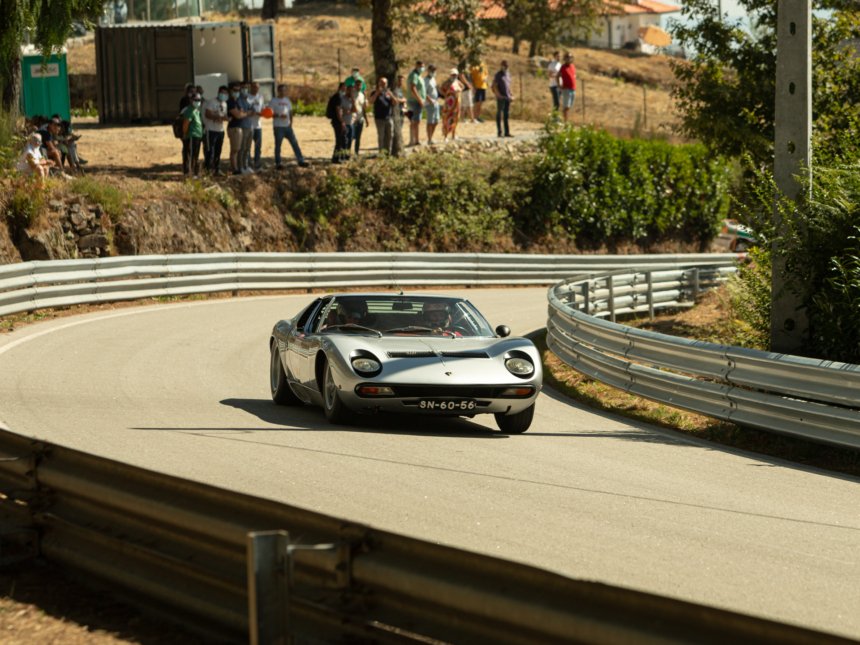
In 1966, Lamborghini unveiled the Miura, and it seemed that the automotive world was facing a different moment. The car was not just a new sports model, but rather a design that changed the idea of a supercar, and presented a bolder, lower, and more streamlined shape than the public was accustomed to at the time.
Behind this transformation was Italian designer Marcello Gandini, who was only twenty-seven when he created one of the most influential cars in the history of the industry. Miura was not an isolated case, but rather an example of the role played by great designers in transforming the car from a mechanical product to a visual and cultural identity.
In the automobile industry, the engine alone is not enough to create a legend. Design is the first thing the public sees, and it is what gives the car its personality and distinguishes it among hundreds of models. Through the structure’s lines, aspect ratios, and mass distribution, prominent designers were able to create entire schools whose impact lasts for decades.

From Art Deco to digital design
Car design has undergone vast transformations since the beginning of the twentieth century. In the 1920s and 1930s, the sector was influenced by the “Art Deco” style, which was known for its sharp lines, luxurious details, and the early search for fluidity. Cars such as the Rolls-Royce Phantom were a clear expression of that combination of luxury and visual presence.
With the 1950s and 1960s, the industry entered a bolder phase. In the United States, designs were influenced by the world of aviation and space, featuring tail fins, large areas of chrome, and massive fuselages. In Europe, designs tended toward compact elegance, efficiency, and attention to precise proportions.
Then came the oil crisis in the 1970s, pushing companies towards more practical cars and less fuel consumption. The aesthetic aspect has not disappeared, but has become more linked to efficiency, weight, space, and production cost.
In the 1980s, computer design entered corporate offices, opening the way for greater accuracy in drawing surfaces and testing fluidity. Today, design has become part of a complex system that includes safety, the brand’s visual identity, smart technologies, electricity, and sustainability.

The most famous car designers in history
A number of talented designers have emerged since the beginning of the automobile industry, and they played an important role in creating models that later became symbols of distinction and elegance. Below we review the most prominent of them in the world:
Giorgetto Giugiaro…the designer of the century
Giorgetto Giugiaro is one of the most influential names in the history of automotive design. He began his career early in 1955, when he joined Fiat at the age of seventeen after his drawings caught the attention of one of his teachers.
In 1968, he founded ItalDesign Studio, which later became one of the most important industrial design houses in the world. During his long career, his name was associated with the design of hundreds of models, and millions of cars bearing his mark rolled off the production lines.
In 1999, Giugiaro was awarded the title of “Designer of the Century” after a vote in which journalists and experts from around the world participated. His style was characterized by sharp lines and flat surfaces, while it was sometimes known as the “origami” trend, which is a style that gave cars a modern, sharp appearance, different from traditional curves.
One of his most famous works is the first Volkswagen Golf, a car that played an important role in shaping the concept of the modern hatchback. He also designed the DeLorean DMC-12 with wing doors, the Lotus Esprit, the Fiat Panda, and a large number of models that combined practicality and a strong identity.

Marcello Gandini…the designer of the most beautiful car in history
Marcello Gandini’s name is associated with bold design and major transformations in the form of sports cars. He joined Bertone Design House, then headed its design department in 1965, starting one of the most exciting chapters in the history of Italian cars.
The Lamborghini Miura, which appeared at the 1966 Geneva Motor Show, was one of his most notable works. The car came with a mid-engine, low and flowing lines, and presented a new vision of the supercar, before this style became a rule in the world of high-performance cars.
But Gandini did not stop at Miura. In 1971, Lamborghini introduced the Countach with a sharp and shocking design, based on harsh angles and geometric surfaces. Then the car entered production in 1974 and remained for many years a symbol of the sporting dream for entire generations.
Gandini also left his mark on other notable cars, including the Alfa Romeo Montreal, Lancia Stratos, Fiat X1/9, Maserati Khamsin, and Ferrari GT4. His influence remains evident in the supercar concept to this day, from the low stance to the scissor doors and aggressive lines.

Harley Earl…who made design an industry within General Motors
It is difficult to talk about modern automobile design without mentioning Harley Earl, who was born in 1893 in Hollywood, and grew up in an environment associated with the manufacture of special automobile bodies, as his father ran a workshop that designed cars customized for movie stars.
His work caught the attention of Cadillac officials, and the 1927 Cadillac LaSalle was a turning point, as it was considered one of the first production cars designed by a professional designer within an integrated vision. Its success prompted GM to create an independent design department, which Earle led.
Earle introduced concepts that later became an essential part of the automobile industry, including test or concept cars that are displayed to test public reactions before ideas are turned into production. In 1938, the Buick Y-Job appeared, one of the first concept cars in history.
Earle also introduced aircraft-inspired tail fins, a feature that defined American cars in the 1950s. Another of his most prominent works is the 1953 Chevrolet Corvette, which turned into one of the most important American sports symbols.

Battista Farina… Italian elegance in its purest form
Battista Farina was born in Turin in 1893. He was the youngest of his brothers, and therefore he was nicknamed “Pinin”, meaning the little one, a name that later became part of the name of one of the most famous design houses in the world: Pininfarina.
Farina began working early in his brother Giovanni’s workshop, where he learned metal bodybuilding and automobile design. In 1930 he founded his own company, Carrozzeria Pininfarina, which quickly gained a prominent position among European automobile companies.
One of his most prominent stations was the Cisitalia 202, which was displayed at the Museum of Modern Art in New York, in reference to the artistic status reached by car design at that time.
But the biggest name in Pininfarina’s career was Ferrari. A long partnership was established between the Italian house and Enzo Ferrari, which extended for decades and contributed to shaping the identity of some of the most beautiful classic Ferrari cars. Among the most notable works is the Ferrari 250 GT Berlinetta, which is still considered one of the most beautiful historical Ferrari cars.

Bruno Sacco… Mercedes’ sober features
Bruno Sacco’s passion for cars began at an early age, after he saw a Studebaker Commander on the streets of his city, so he decided to make car design a career path.
Sako joined Mercedes-Benz in 1958, and participated in the design of a number of important models, before becoming head of the design department in 1975, a position he held until 1999.
During that period, he oversaw a group of the most influential Mercedes models, including the W123, W124, and W126, in addition to the second generation of the S-Class. His designs represented the Mercedes philosophy at that stage: calm lines, a strong presence, and balanced proportions that were not subject to fast fashion.
The Mercedes 190 was one of the cars closest to SACO, because it opened the German brand to a new segment of customers, and presented a more youthful image without abandoning the traditional Mercedes character.

Malcolm Sayer.. When aerodynamics entered beauty
Malcolm Sayer did not come to automotive design from a traditional path. He studied aeronautical engineering and worked in the aircraft industry during World War II, before joining Jaguar in 1951.
This geometric composition was clearly reflected in his works. Sayer was not looking for a beautiful shape alone, but for a body that cut through the air efficiently. Therefore, his cars were a mixture of engineering calculations and visual fluidity.
Sayer designed the Jaguar C-Type, which won Le Mans in 1951 and 1953, and then the Jaguar D-Type, which achieved three successive Le Mans victories between 1955 and 1957.
The pinnacle of his career was the Jaguar E-Type in 1961, a car that combined performance, flow, and rare beauty. Enzo Ferrari described it as one of the most beautiful cars ever made, and to this day it remains one of the most famous and influential classic cars.

Alec Issigonis… the genius in exploiting space
Alec Issigonis provided a different design lesson. His goal was not to create a luxury or supercar, but rather a small, practical and economical car, responding to the conditions after the Suez crisis and the high need to reduce fuel consumption.
In 1957, the British Motor Company commissioned him to design a small car that could transport four passengers and their luggage within very limited dimensions. The result was the original Mini, which later became one of the most famous small cars in history.
Issigonis relied on placing the engine transversely with front-wheel drive, a solution that allowed more space for passengers in a small body. This arrangement later became an accepted model in most small cars around the world.
In honor of his role, Queen Elizabeth II knighted him in 1969, after his design turned into a milestone in the history of practical cars.

Why is design still crucial?
Design does not operate in isolation from price, reliability, or performance, but it is often the first thing that determines a buyer’s relationship with a car. The exterior appearance gives the car its first presence, and makes it recognizable in a crowded market of technically similar models.
This is why car companies invest heavily in design studios, not only to produce beautiful cars, but also to build a cohesive visual identity. The front fascia, the shape of the lights, the proportions of the body, and the way the side lines are drawn are all elements that create brand memory in the public’s mind.
With the rise of electric cars, design is entering a new phase. The absence of large traditional engines, changing battery locations, and the expansion of intelligent driving systems give designers greater freedom to reimagine the shape of the car and its interior space.
But the challenge hasn’t changed much. Technology alone is not enough to create an icon. What is required is a vision capable of transforming engineering requirements into a form that remains memorable.
This is what brought together Giugiaro, Gandini, Earle, Farina, Sacco, Sayre, and Issigonis. Not only did they draw successful cars, but they created a visual language for entire eras. Each of them left a car, or more, that the world can recognize at a glance, and that is the true sign of great design.