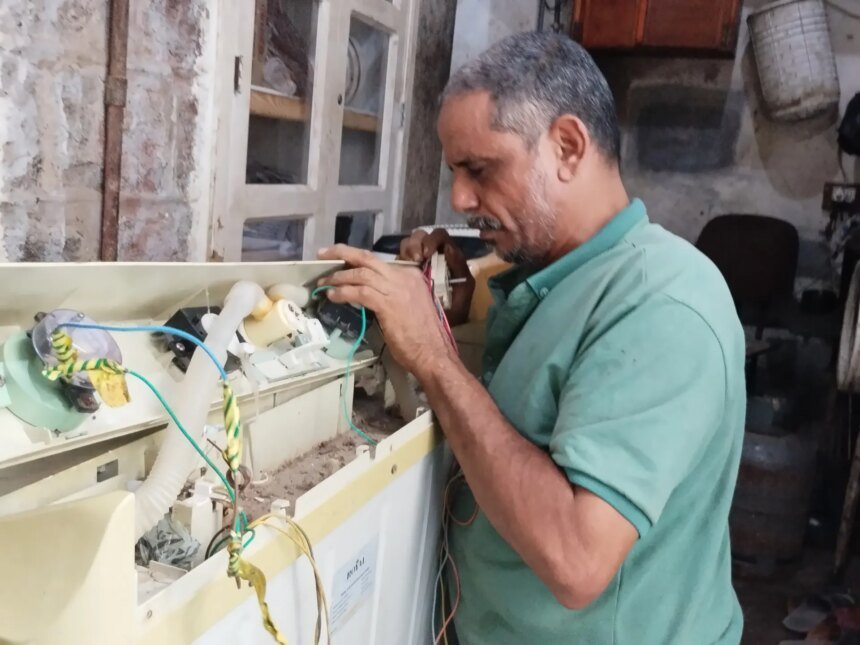
In a popular neighborhood in Sheikh Othman District in the temporary Yemeni capital, Aden, Lutfi Omar’s workshop appears to be nothing more than a narrow corner that he carved out of his humble home. But this small space, filled with old washing machines, wires, and spare parts, became for the blind man his window to a delicate profession that is not devoid of danger.
Lutfi, 52 years old, bends down in front of an open electric washing machine. He extends his fingers between the wires and small pieces, slowly feels their path and listens for a faint sound, then stops at the site of the fault as if he saw it. He does not read faults with his eyes, as he has lost his sight since childhood, but he reads them by hand memory and years of experience.
Read also
list of 2 itemsend of list
Screwdrivers, wires, and plastic and metal pieces are scattered around the man, and old devices lean against corroded walls in a space barely large enough for him. Nevertheless, Lutfi moves in his workshop with the confidence of someone who knows its terrain well. Here he places the screwdriver, there he extends his hand to the wire, and in the corner another washing machine is waiting for its turn to be repaired.
Lotfi told Al Jazeera Net that losing his sight did not make him give up, but rather made him look for a way to rely on himself. He repeats – as he rearranges the wires in his hands – that a person “with persistence and challenge can do the impossible.”

A profession without light
Lutfi’s workshop does not resemble a shop open to the street and does not carry a sign that attracts customers. It is a small corner of the house cramped with equipment and tools, but it has expanded into a craft that has become a source of livelihood and dignity. In this corner, Lutfi receives washing machines, water generators, and household electrical appliances brought to him by neighborhood residents.
He begins work as if he is feeling a page written in a language that no one else can read. He opens the device and runs his fingers over the wires and connections, distinguishing small pieces by their texture and listening to the sounds that help him understand the nature of the malfunction.
During the visit to Al Jazeera Net, we saw him opening the devices and carefully feeling their small parts, and when a bolt or piece of metal fell from it, he passed a small magnet on the ground until he picked it up, in a practical trick that helped him continue working without the need for eyes.
It does not rely on touch alone, as it uses an electrical inspection device known as a “megger” that emits audio signals that help it track connections and detect some malfunctions. But he says that his dream is to obtain a talking measuring device that reads electrical values to him vocally, a type available in some foreign markets, but he has not found it in Yemen yet.
With these limited tools, electricity remains a profession that requires extreme caution, even for sighted people. However, years of practice have taught Lutfi how to approach danger consciously. He tests the wire, stops for a while and rethinks, then returns to the device as if every new malfunction is another lesson in an endless career.

From TV to washing machine
Lotfi started his profession in 1992 and started by repairing television sets. He remembers that stage as the most difficult in his professional path, especially dealing with the high electrical pressure in old television screens, a task that requires extreme caution and precise experience.
Over time, he found that repairing televisions was more complicated than his circumstances and tools allowed, so he stopped this field and headed to repairing washing machines, water tanks, and home juice mixers, devices that later became part of his professional day. Lotfy says that his move from televisions to these devices was not a retreat, but rather a search for a field in which he could master and perform his work with greater confidence.
Since then, he has accumulated his experience, one device after another, until the neighborhood residents started coming to him whenever a washing machine, dynamo, or simple home appliance broke down. With every device he opens, Lutfi recalls the essence of many years of experience, from groping fingers to a listening ear and a memory that memorizes the paths of wires and the sounds of malfunctions.

A struggling family
Lotfi lost his sight early in childhood due to retinal atrophy, as did his sister Najwa, 54 years old. As for his brother Muhammad, 53 years old, he was paralyzed by a stroke that made him unable to move. In the same house, the small family lives in a daily rhythm of patience and struggle.
Lutfi talks about his sister with clear pride. Despite her loss of sight, he says that she is the one who takes care of him and their brother, prepares food, and manages many of the household affairs. This is not mentioned as a passing detail, but rather as evidence that the family – despite illness, disability, and hardship – is still resisting in its own way.
In this house, no one has the luxury of withdrawing. Lotfi goes to his workshop, Najwa manages the household affairs, and Muhammad faces the effects of illness. Thus, the family shares what is left of its ability and tries to make a life moving forward from what little it has.
Lutfi tried – in previous stages – to get a government job that would give him a fixed income, and he tried to do so more than once, but he did not succeed. He did not stay in front of a closed door for long, so he returned to what he knew well: wires, screwdrivers, and devices waiting for someone to move them back.

A new burden
Lutfi’s difficulties do not stop at losing sight or a cramped workshop. In Aden – where summer turns into a severe test for the population – power outages add a new burden to his work and life. He says that the power may sometimes go out for more than 12 hours a day, in exchange for only two hours of operation.
Lotfi does not need electricity to see, but he does need it to operate the devices, inspect them, and make sure the repair is successful. When the power is cut off, work stops, equipment piles up in the workshop, and the heat inside the confined space becomes part of the daily suffering.
However, the man does not speak in a tone of defeat. He says that the country is full of crises, but surrendering to them makes them more cruel. He directs his message to young people and people with disabilities, saying that striving and making an effort may open doors that complaints alone cannot open.
For him, waiting for help alone is not a guaranteed path, as charity may come with blessings or not at all, while work – no matter how hard – remains closer to dignity.

Neighborhood trust
During Al Jazeera Net’s visit, 3 customers knocked on Lutfi’s door carrying electrical tools in need of repair. The scene seemed normal in the neighborhood; People come to a man they know, not to help him, but to seek his skill.
One of the customers – Amid Muhammad Ahmed – says that Lutfi is a struggling and proud man, and that the neighborhood residents used to come to him to repair their electrical appliances.
He explains that losing his sight did not prevent him from gaining people’s trust and respect, and Amid added to Al Jazeera Net: “We come to him because we trust his work. He is an honest and proficient man and is appreciated by the neighbors in the neighborhood.”
This confidence is not a small detail in Lutfi’s life. The man who did not get the job he wanted, made work for himself with his own hands and increased his standing among the people, one device after another and one malfunction after another.

Capacity industry
Lutfi does not want his story to be told out of pity. In his speech, he returns frequently to the meaning of dignity and to the fact that a person – no matter how difficult his circumstances are – can search for a way to preserve his self-respect.
He told Al Jazeera Net: “Living with dignity is the most precious thing. I do not want to be a burden on anyone. If a person strives and makes his effort, God will grant him success.” In his small workshop, he does not repair appliances alone. Every washing machine he restarts and every wire he reconnects seems like a practical response to a stereotype that reduces the blind to helplessness and waiting.
Here, losing sight is not the end of the story, but rather part of a long path to building ability through other means. From this narrow angle in Sheikh Othman, Lutfi’s story seems bigger than the story of a man who repairs electrical appliances. It opens a window on the reality of people with disabilities in Yemen, where training and work opportunities are still limited and the social outlook remains an obstacle in addition to the harsh living conditions.
However, Lutfi presents a different model: a man who does not wait for pity, but rather opens a broken device, extends his hands inside it and comes out of it, proving that sometimes the disability does not lie in the body, but rather in the lack of opportunities.

He sees it his way
At the end of the visit, Lutfi accompanies us to the door of his small workshop. He stands at the entrance holding a piece of his work tools, as if the profession does not leave his hands even as he bids farewell to his guests. Behind him are piled up old washing machines, wires, and parts, and in front of him is a popular neighborhood where people know him not only as a blind man, but as a technician they go to when their appliances break down.
At that point, Lutfi’s story does not seem just the story of a narrow workshop, but rather the story of a man who chose to see the world in his own way, with his fingers, his ears, and an unquenchable determination. Between the house and the workshop, between the darkness and the old appliances, Lutfi continues to fix what is broken, defending a simple and great dream at the same time: to live from the work of his own hands, and with dignity.”