Published On 4/6/2026
|
Last update: 6/5/2026 00:42 (Mecca time)
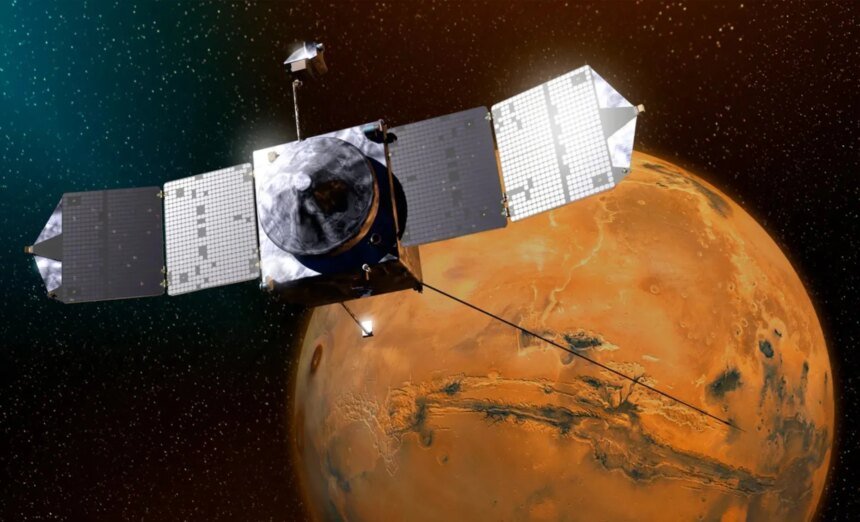
The US space agency NASA officially announced the loss of the famous Mars probe MAVEN, which performed vital scientific and communications missions on the Red Planet for a decade. The spacecraft’s tragedy began suddenly last December while it was on the far side of Mars from Earth.
The name “MAVEN” is an abbreviation for “Mission to Study Atmospheric Evolution and Loss of Volatiles on Mars” (Mars Atmosphere and Volatile Evolution)It was launched on November 18, 2013 aboard an Atlas 5 rocket from Cape Canaveral in Florida, and reached Mars orbit on September 22, 2014, that is, 10 months later.

Mission objective fHer most notable achievements
The MAVEN mission specialized in studying the upper atmosphere of Mars and understanding how the planet lost most of its atmosphere over billions of years, which helps scientists explain the transformation of Mars from a warmer and more humid world in the past to the cold and dry planet we see today.
Read also
list of 2 itemsend of list
Its most notable achievements were:
- Proving that the solar wind played a major role in stripping Mars of its atmosphere.
- Measure the rate of loss of gases from the atmosphere into space.
- Study of the Martian aurora.
- Providing important data to support subsequent missions to Mars.
By 2026, the mission will have spent more than 12 years in Mars orbit, far exceeding its original planned operational life.
The official announcement followed a preliminary report from the Orbital Anomaly Review Committee that the agency established in February 2026 to investigate the probe’s status. Recent data indicated that the probe was “rotating in an unexpected way” and that its “orbit path had changed,” which was confirmed when the Curiosity rover on Mars was unable to detect the probe in its sky.
Complex cosmic architecture thwarts rescue
During their troubleshooting attempts, NASA engineers encountered an astronomical obstacle known as solar-Martian conjunction, a phenomenon that occurs when Earth and Mars lie on opposite sides of the sun, completely blocking communications between Earth and its exploratory fleet there.

This cosmic interruption lasted from late December 2025 until mid-January 2026, and despite the resumption of attempts after that, NASA decided to announce the official end of the mission that was launched in November 2013, without waiting for a final investigation into the causes.
In this context, Louise Proctor, Director of NASA’s Planetary Science Division, said that the scientific data provided by MAVEN are key to knowing what type of radiation protection and safety measures we should take before sending humans to Mars, and this data will continue to provide valuable insights for decades to come.
Strong aftershocks shake the Martian communications network
The loss of Maven will not go unnoticed; Rather, it will have a major impact on the current fleet of vehicles due to its pivotal role in the “Mars Relay Network,” which is a partnership between NASA and the European Space Agency (ESA) to secure communications for rovers on the surface such as “Curiosity” and “Perseverance.”

Before its loss, the probe represented the second force in the network after the Trace Gas Orbiter, superior in workload to two other NASA vehicles, which means that its absence will put strong pressure on the remaining channels to transmit planetary surface data to Earth.
A historical scientific legacy that unlocks the secrets of the planet
Despite its sad ending, the probe achieved unprecedented success in dismantling the mystery of how Mars’ atmosphere turned into an extremely thin atmosphere, making it an uninhabitable planet. Along the way, MAVEN discovered that solar storms accelerate atmospheric erosion, mapped high-altitude winds, and observed a new type of aurora.
The probe also experienced extreme events, such as the global dust storm that ended the career of the Opportunity rover in 2018, and monitored the interaction of the atmosphere with the comet Siding Spring.
“The MAVEN mission has created a real breakthrough in our understanding of the Martian atmosphere and its evolution,” commented Shannon Currie, MAVEN principal investigator at the University of Colorado Boulder, with great pride. “This data has had a tremendous impact on the field, and our science team is extremely proud of all these amazing discoveries.”
What comes after this great loss?
In conclusion, the loss of Maven puts us in front of a double loss; The reader today realizes that this probe was not just a flying scientific laboratory studying the air and climate, but rather it was an essential and vital “communications tower,” without which the movement of robots on the surface of Mars might become more isolated and difficult.

The drama of intertwined space and physics is also evident in this ending, as the crisis revealed how complex astronomical engineering and cosmic phenomena – such as the sun’s occurrence as a barrier between the two planets – play a decisive and harsh role in cutting off rescue ropes and communication from advanced spacecraft worth millions of dollars.
Despite this absence, there remains great importance for the probe’s data in the future. If “MAVEN” has died physically and its astronomical journey has ended, it is its enormous digital and scientific legacy that will lead humanity towards the Red Planet, and precisely determine when and how the first human will walk on Mars in complete safety, based on the maps of protection from harmful radiation that the probe left behind.