On the upper floor of the headquarters of the “Basement” Cultural Foundation in the city of Taiz – specifically the Taiz Creative Center – music was quietly creeping between the seats, as if it were opening layers of silence one after another.
On the walls, the paintings extended like internal paths laden with questions, not to be read quickly, but rather to be discovered like a memory is discovered when it is suddenly restored.
There was no red carpet or noisy festive atmosphere, but the place was filled with attendees who came from behind the details of daily life to participate in an evening that combined visual art, music, and writing, as part of the activities of “European Days” and the Creativity Centers Project in Taiz. A city that has been living for years between the weight of reality and its constant attempts to open small windows towards beauty. Among the works that attracted visitors:

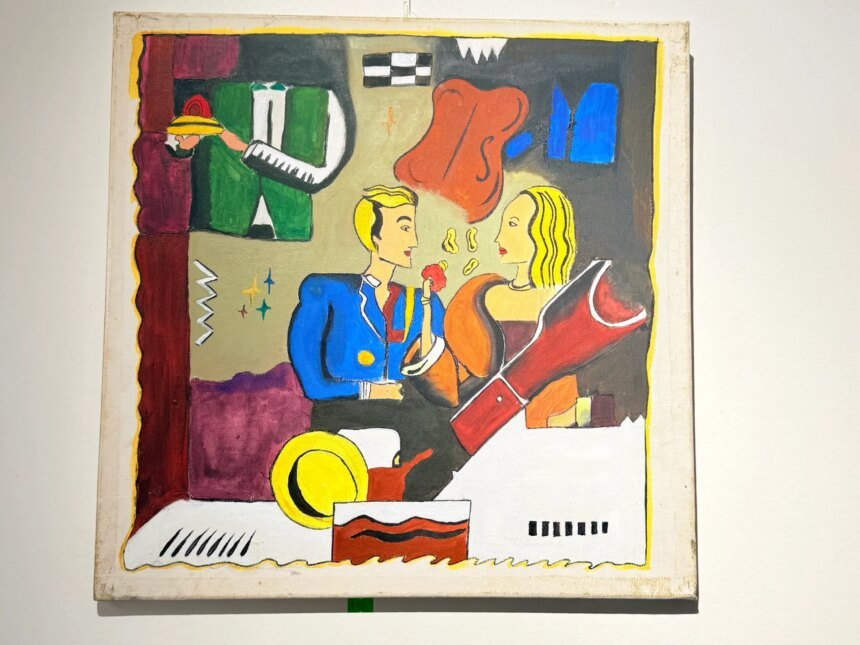
The “Story” exhibition by visual artist Hadeel Muhammad appeared, which seemed closer to an emotional notebook open on the walls, where her works were not presented as answers, but rather as spaces that allowed each spectator to reconstruct them from his own angle, as if the paintings were not complete except within the eyes of the one who saw them.
Colors as layers of experience
Inside the hall, the paintings were not viewed quickly; Many of the attendees stood in front of the same work for a long time, as if looking itself turned into an internal attempt to understand, while others contented themselves with silence, which here was an alternative to speech.
Artist Hadeel Muhammad told Al Jazeera Net: “The (Story) exhibition came from my desire to transform personal experience into a visual effect that can be shared,” explaining that the paintings emerged from accumulated emotional states related to fear, nostalgia, calm, and confusion, feelings that she sees as part of the details of daily life in the city.

Abstraction in my work was not a search for a different form, but rather an attempt to leave the space open for the recipient to participate in constructing meaning. The painting begins with a feeling, but it does not end there, but is completed when others see it
In some works, the colors seemed intertwined as if they were in a state of internal conflict not looking for a resolution, while in others they appeared calmer, as if they were moments of breathing within a space crowded with experience, a contrast that created a state of silent discussion among those present about the relationship between color, memory, and feeling.
Music as an extension of the visual state
Before the opening of the exhibition, music was an essential part of the scene, when the musician Shamous Rassam performed pieces on the piano, accompanied by the artist Muhammad Al-Sabri, at a moment when the hall seemed to breathe in one rhythm.
The musician Shamos Rassam explained to Al Jazeera Net that playing in artistic spaces like these differs from traditional halls, because the audience does not just watch or listen, but rather enters into a shared emotional state with what is presented before them, adding: “The music here does not work in isolation from the paintings, but rather juxtaposes with them in one space, as if each tone is trying to open a path towards a color or idea hanging on the wall.”
Ressam points out that the experience in Taiz has a clear specificity. People come to art burdened by their daily experiences, which makes the interaction more sincere and less artificial, stressing that the continuation of these activities gives artists the feeling that there are those who are still searching for art as an internal need, not a luxury.

Art as a space for life
For his part, the coordinator of the Taiz Creative Center, Jamal Al-Maqtari, believes that these activities are not presented as elite cultural events only, but rather as necessary spaces to restore human balance within the city, explaining to Al-Jazeera Net that the idea is based on making art a part of daily life, not an exceptional event separate from it.
Al-Maqtari adds that the experiment attempts to build a new relationship between the public and art based on interaction instead of silent reception, and on participation instead of just watching, noting that this type of event opens the door to a broader dialogue between generations and different interests within the city.
In the same context, writer and researcher Omran Al-Hammadi believes that what happens on such evenings reflects a real attempt to rebuild cultural memory in Taiz, stressing to Al-Jazeera Net that the city – despite everything it has gone through – still retains a latent cultural energy that appears in such initiatives.

Al-Hammadi continues: “Art in this context is no longer separate from reality, but has become an extension of it, so works tend to express the human being from within, daily anxiety, and attempts to understand the world without ready-made templates,” noting that the importance of these meetings lies in recreating a moment of human meeting around art, in a time when the distances between people have become greater than before.
An audience rediscovers the details
The evening witnessed a diverse attendance of university students, artists, activists, and those interested in cultural affairs, with notable women participating in interaction and discussion about the works. Salwa Saleh, one of the attendees, told Al Jazeera Net: “The paintings do not provide a single meaning, but rather open the door to multiple possibilities, and the experience made me look at art as an open question with no final answer.”

At the end of the evening, many of the attendees continued to wander among the works with remarkable slowness, as if they were postponing the moment of exiting the spiritual state of the place.
Outside, Taiz was regaining its usual daily rhythm. A tired city, but it still leaves a little space in its corners for something resembling light, even from afar.