Published On 4/6/2026
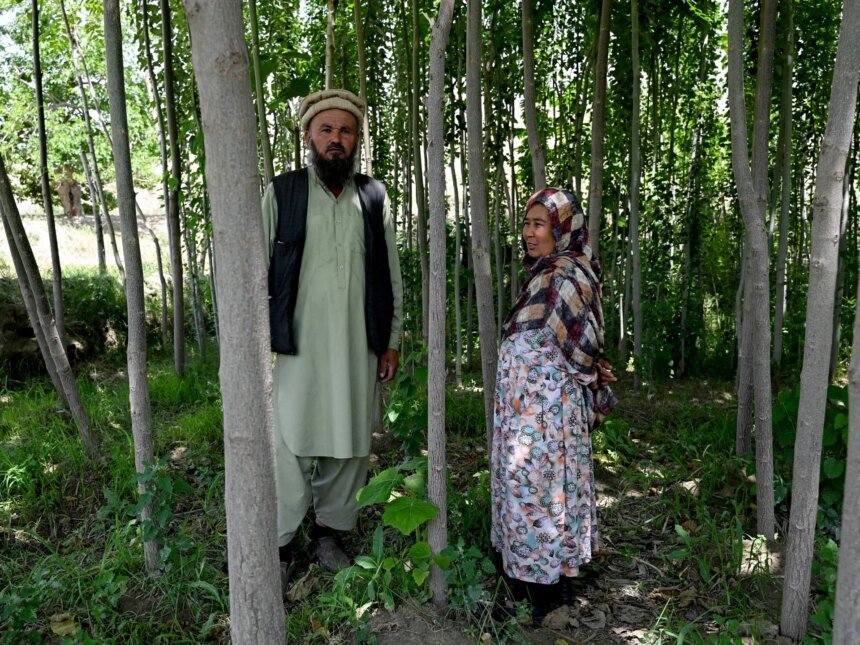
Under the shade of newly planted poplar trees in northeastern Afghanistan, Ghulam Ali Buya, the village chief of Char Bagh, is proud to see residents rediscovering the value of trees after years of wartime deforestation.
Ali Boya points to the barren mountains surrounding the mud houses of Char Bagh, saying, “There were forests of pistachio trees, and during conflicts and wars, these forests were destroyed. No one could stop the cutting of the trees.”
From the Soviet invasion in 1979 until the fall of the first Taliban government in 2001, about 50% of forest cover in Afghanistan was lost, according to Muhammad Nasir Shalizi, a researcher at North Carolina State University.
In eastern Afghanistan, timber smuggling into Pakistan led to widespread logging, while in the drier “pistachio belt” in the center and north of the country, residents used firewood for heating and cooking. But in the past two decades, deforestation has slowed “significantly,” Shalizi said.
According to the National Authority for Statistics and Information, the forest area has increased by 35% nationwide since 2011, although only 2.5% of Afghanistan was covered by forests in 2025, and this area is still shrinking in some areas.
But experts say local communities are working to improve forest cover. Both the US-backed Afghan government, which lasted until 2021, and the current Taliban administration after its return to power have supported afforestation campaigns.
In Char Bagh, the Aga Khan Development Network funded a square kilometer orchard, which includes poplar, paulownia, pomegranate and persimmon trees.

Lead by example
The land is owned by farmer Bas Begum Ahmadi, who hopes to sell fruit and home-made jam, and is also available to her community of 350 families.
This 45-year-old woman, who takes care of the trees with her husband to support their four children, says: “The presence of these trees makes me feel comfortable. My environment is green, and we breathe clean air.”
This small forest follows the principles of Japanese botanist Akira Miyawaki, with dense planting of mostly local species, of varying heights. It is noticeably cooler than the surrounding barren fields, and provides branches used as fuel for stoves and leaves used as fodder for livestock.
“Small forests restore ecosystems, improve soil fertility, help adapt to climate change, and support the livelihoods of local communities,” says Parisa Malekzada, Afghanistan agriculture coordinator for the organization, which has planted 500 small forests in seven provinces.
The forest, located next to the river, prevents soil erosion during floods and serves as a “role model,” says Boya. “Everyone comes to have a look, and they wish they had another one too.”
In Afghanistan, where many areas are difficult to reach and the state suffers from limited financial resources, community forest management is the most effective approach to reforestation, according to what experts told Agence France-Presse..

Protection and penalties
Afghan authorities have set a goal of planting 200 million trees between 2023 and 2030, relying in part on NGOs, the United Nations and the private sector.
“Last year, the target was 8 million trees, but in the end 17 million trees were planted,” said Ruhollah Amin, head of the climate change division at the Environmental Protection Agency, where he has worked for more than a decade.
According to Amin, the goal this year is 9 million trees. Challenges include selecting local species adapted to climate, water scarcity, and seedling damage by livestock.
Amin acknowledged that some forests suffered from “lack of care or water,” including a site where drought wiped out 70 percent of the planted pine trees.
In some areas, tribal councils protect forests and punish residents who damage them. In other areas, forest management associations run by elected villagers and farmers have been established.
The United Nations Food and Agriculture Organization has helped these associations plant five million trees since 2019, according to its head of climate change, Mohamed Safi.

The birds return
The Afghan government has established nurseries to grow local species in areas such as Paghman on state land on the outskirts of the capital, Kabul.
The head gardener, Mahmoud Khawajazadeh, carefully takes care of the almond, pine and walnut trees, in addition to the cedar trees, to distribute them throughout the country. He told Agence France-Presse, “If you only have one day left, plant a tree.”
In Charikar in northeastern Afghanistan, where thousands of seedlings were planted this year along streets, in parks and on hillsides, the municipality is witnessing a change in people’s outlook on trees. Ahmed Khaled Sabri, a resident, said he volunteered to help with farming “because it is good for the environment.”
Experts stressed the need to make more efforts to protect the remaining ancient forests, as well as plant more trees in forests instead of restricting them to urban areas.
Good efforts are being made, but there is still much to be done to combat the effects of global warming. In Char Bagh, Boya sees the trees having a positive impact on biodiversity, with the return of long-absent birds. He says: “Do not build a cage for birds, but rather plant a tree near your homes.”