
A prominent Lebanese politician close to Hezbollah called on President Trump on Monday to impose a new cease-fire in Lebanon, after Israel threatened fresh strikes on the outskirts of Beirut, the Lebanese capital.
The politician who has served as an emissary between Hezbollah and the United States, Nabih Berri, said in an interview with The New York Times that Hezbollah was open to a new “real cease-fire” and suggested that only Mr. Trump could press Israel to abide by one.
Later on Monday, Mr. Trump said on Truth Social that he had spoken with Prime Minister Benjamin Netanyahu of Israel and indirectly with Hezbollah. He said he had concluded that “Israel will not attack them, and they will not attack Israel.”
Hours later, Prime Minister Benjamin Netanyahu said in a statement that he told Mr. Trump that “if Hezbollah doesn’t cease its attacks on our cities and civilians — Israel will strike terror targets in Beirut. This position of ours remains.” He added that Israel planned to continue its military operations in southern Lebanon.
The statements suggested that Israel and Hezbollah would likely continue to exchange fire within Lebanon, but that Hezbollah would not attack Israeli territory and, in exchange, Israel would not attack Beirut.
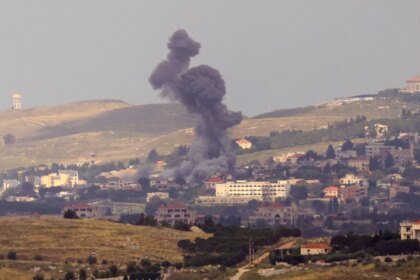
The flurry of diplomacy came as the already shaky truce between Hezbollah, the Iran-backed militant group and political party, and Israel teetered on the brink of complete collapse. While both Hezbollah and Israel have continued their attacks since that truce went into effect in April, over the past week the fighting has sharply escalated.
Israeli forces have pushed deeper into Lebanon, beyond the area they seized and occupied earlier in the war, while Hezbollah has continued to attack Israeli troops and targets in northern Israel.
The war has killed more than 3,200 Lebanese and 30 Israelis, according to the authorities in both countries.
In a further escalation on Monday, Mr. Netanyahu said that he had ordered attacks on Beirut’s southern suburbs, a densely populated area where Hezbollah holds sway and which Israel has mostly refrained from striking since the April truce.
That message sent thousands fleeing from the suburbs into central Beirut.
“No one can make a real cease-fire except for Trump,” said Mr. Berri, the speaker of the Lebanese Parliament. “This is the only way.”
The comments by Mr. Berri, who leads Lebanon’s other Shiite political party aside from Hezbollah, the Amal Movement, suggests that Hezbollah is eager to secure a new truce.
“If there is a serious cease-fire, I guarantee Hezbollah will be committed to it,” Mr. Berri said, adding that the message was coming directly from Hezbollah.
The Lebanese government and Israel are set to meet on Tuesday for their next round of U.S.-mediated talks in Washington aimed at defusing the conflict.
Secretary of State Marco Rubio has presented a new de-escalation proposal to President Joseph Aoun of Lebanon and Mr. Netanyahu, a U.S. official said on Sunday. Under the plan, Hezbollah would halt attacks on Israel as a first step, after which Israel would refrain from expanding its military campaign in and around Beirut, the official said. Israel’s stance on that proposal remained unclear.
The Lebanese Embassy in Washington said it had “received confirmation of Hezbollah’s agreement to the U.S. proposal, which calls for a reciprocal cessation of attacks.”
In recent weeks, Iran has also pushed to include an end to the fighting in Lebanon as part of a broader cease-fire deal with the United States over the American-Israeli war with Iran. But Mr. Berri suggested that Hezbollah could be open to a cease-fire that is not contingent on a wider U.S.-Iran agreement.
“A deal that is separate from Iran, or with Iran,” does not matter, he said. “We need a cease-fire. Israel wants to negotiate while it’s bombing and this is very costly for us.”
Hwaida Saad contributed reporting.