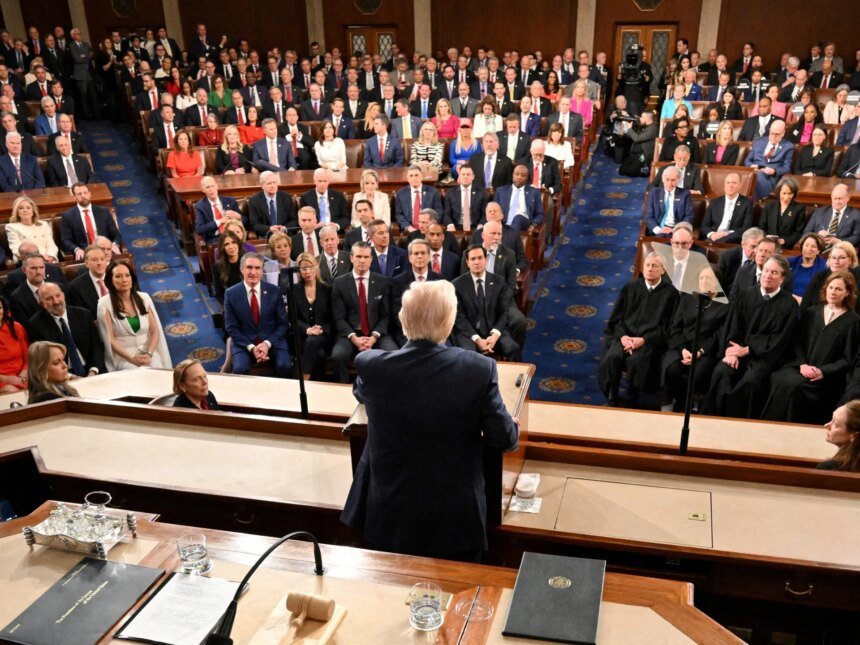
“As the clock approaches the first of next May, attention will shift from the fields of confrontation in the Middle East and the negotiating halls in Pakistan to the halls of Capitol Hill in Washington, where the US Congress is holding its sessions.
The reason is simply the expiration of the sixty-day deadline granted by the War Powers Act to the US administration before obtaining legislative authorization for military operations.
After weeks in which the biggest question was the extent of the American fleets’ ability to resolve the conflict with Tehran, the question in the next few days will become about the legitimacy of these fleets remaining in a state of clash without cover from the people’s representatives, if the current truce does not end with an agreement to end the war whose impact has spread beyond the region to cause confusion throughout the world.
In a political climate charged with polarization, US President Donald Trump finds himself facing two options: either convince a divided Congress of the necessity of getting involved in a wide regional war, or face a legislative “veto” that will have its effects.
These effects will not be limited to pulling the rug from under the feet of the generals in the field, but may also affect the fortunes of the Republican Party, to which Trump belongs, in the midterm congressional elections scheduled for next November.
In the pre-resolution atmosphere, it seems clear that the Trump administration is arming itself with the pretext of “defending imminent danger” as a legal pretext, and does not even hesitate to challenge the law, while opponents invoke bitter historical precedents from Vietnam to Iraq, warning of a “blank check” that may drag the country into an endless quagmire.
Does Congress have the political will and, most importantly, the ability to obstruct the course of the war? Or will “national security requirements” once again swallow the powers of lawmakers and give the White House an open mandate?
But what’s with the War Powers Act?
The password is the War Powers Act, which was a law issued in 1973, months after the end of the American war on Vietnam, and was aimed at affirming the constitutional role of Congress in sending American military forces to armed conflicts abroad, and this is according to the official text of the law.
It is a remarkable irony that the law faced a “veto” from then-President Richard Nixon, only to return to Congress, which overcame the president’s rejection by approving the law by a two-thirds majority.
The law then states that any use of force must automatically stop after 60 days unless Congress gives its approval, meaning that the president must withdraw US forces from participating in hostilities after 60 days, unless Congress declares war, authorizes a 60-day extension, or is physically unable to meet as a result of an armed attack on the United States.
The President may extend this period by 30 days if he submits to Congress written testimony proving the existence of “unavoidable military necessity” related to the safety of the armed forces.
How was the duration calculated?
The law talks about 60 days, and the American-Israeli war on Iran broke out on the morning of February 28, and this means mathematically that the deadline ends today, Tuesday, April 28. So what made the talk revolve around May 1?
The matter is simply that the calculation of the period began from the third day of the war, specifically the second of last March, which is the day on which President Trump officially informed Congress of his military action against Iran.
Over the course of these two months, the war went through three basic stages:
- From February 28 to March 15: The explosive phase, when the American-Israeli attacks were launched, and Iran responded to them with missile attacks targeting Israel and what it says are American interests in the region.
- From March 16 to April 10: The conflict turned into a battle to break the wills of the sea; While Tehran continued its closure of the Strait of Hormuz, which began with the first shot of the war, Washington moved from concentrated air strikes to imposing a comprehensive naval blockade on Iranian ports and stopping Iranian ships on the high seas, in a “desperate” attempt so far, to open a loophole in the wall of international navigation that has been completely paralyzed” in the Strait.
- April 8: Trump announced a truce that extended until today, and during that period, shipping traffic in the Strait of Hormuz remained closer to stopping than smoothing, and the Lebanese front also calmed down after Trump announced on April 16 a Lebanese-Israeli ceasefire agreement.

What does history say?
We return to the War Powers Act, where a report on the German website Deutsche Welle draws attention to the fact that the law has never been used to actually end a war, as “successive American presidents found ways to bypass the requirements for parliamentary approval,” which makes the current situation unprecedented in terms of its political severity.
The same report makes clear that Trump is not the first president to attempt to bypass the War Powers Act; In 2011, former President Barack Obama maintained US participation in the bombing of Libya for more than 60 days without authorization, considering that US forces “are not engaged in direct hostilities.”
This justification is one of the presidential tools to circumvent the authority of Congress by raising the question of the definition of “hostile acts” and their legal limits.
Before that, former President Bill Clinton ordered the bombing of Kosovo in 1999, and his administration considered that it had obtained implicit approval from Congress because it had passed legislation to finance this campaign within 60 days of its start.
The Trump administration also used a similar logic in previous operations against boats suspected of being linked to Venezuelan drug cartels, but the war on Iran is broader and more dangerous than a case like this.
Pessimistic forecast
The New York Times says that if Washington and Tehran do not reach an agreement to end the war before the deadline, all indications indicate that Trump and the Republican majority in the House of Representatives and the Senate will ignore the law, and to justify this they will likely resort to misleading legal arguments, which means referring the matter to the courts by filing lawsuits.
In a report highlighted on Tuesday, the famous American newspaper showed a pessimistic spirit in this regard, as it referred to precedents in which the courts considered such matters to be political matters that they could not decide on.
The newspaper cited several examples, including a case against former President Ronald Reagan in 1982, filed by members of Congress to challenge US military aid to El Salvador, and the case ended with the judiciary rejecting it.
In 2002, a federal court rejected a lawsuit to prevent President George W. Bush from invading Iraq, and considered that the issues raised were political matters that “beyond the federal court’s powers to decide.”
In 2011, a lawsuit was filed against the military operations ordered by former President Barack Obama in Libya as a violation of the law and the constitution, but a federal court rejected the lawsuit.
The New York Times considers that these decisions empty Congress’s powers to wage war. It says that in light of Congress’ inaction and the absence of judicial enforcement, there are practically no controls on the president’s ability to wage war unilaterally.
Rather, the newspaper goes further, warning that if the federal judiciary, including the Supreme Court, does not assume its responsibility in this matter, it will invalidate the principle of the American Constitution, which stipulates that two branches of government must participate when entering into a war.
- The newspaper cites statements by two of the most famous US presidents throughout its history:
George Washington during his presidency: “The Constitution gives Congress the power to declare war, so that no offensive campaign of any importance can be undertaken until they have deliberated upon the subject, and authorized such action.” - James Madison, while a member of Congress: “Those who are charged with the conduct of a war cannot, from the nature of things, be competent or trustworthy arbiters whether a war is to be commenced, continued, or terminated.”

What are the odds?
In general, Trump enjoys the support of Congress, given the majority that his Republican Party holds in the House of Representatives and the Senate.
During the past weeks, several attempts by Democrats in Congress to stop the war have failed. However, the pressure is not limited to the Democratic opponents, but rather from within the Republican Party itself, where the patience of some has begun to run out due to the fear that the war and its repercussions on oil and gas prices and inflation at home will lead to the party’s loss in the midterm elections scheduled for the end of the year.
The most prominent options of the US administration are as follows:
1- For the Trump administration to ask Congress for an additional period of 30 days, which is an action stipulated by law in the event that the matter is considered an “unavoidable military necessity.”
2- That the White House argues that the ceasefire that has been ongoing for about 3 weeks has ended the military operation and thus resets the legal deadline and begins the count again.
3- Challenging the constitutionality of the law itself.
In this context, Trump’s Vice President, J.D. Vance, said last January, after US forces kidnapped Venezuelan President Nicolas Maduro, that “the War Powers Act is essentially a formality and unconstitutional law.”
Similar statements were issued by Republican members of the Senate, with Lindsey Graham saying that he believes the law is unconstitutional, while Ron Johnson said that Trump should not allow this law to restrict his ability to remove the Iranian regime from power.
However, if Congress decides to decide on the matter, it is likely that it will not obstruct the Trump administration, given the Republican majority in both chambers, which does not seem likely to be breached.
American newspapers and news agencies agreed in stressing that the balance of power is still tilted in favor of the White House, while the door remains open to possible political surprises.
As the midterm elections approach next November, Congress faces a difficult equation between holding the president accountable and showing internal division in a time of war, and the reluctance of representatives to vote in favor of a very unpopular war, in addition to their fear of the increasing costs to taxpayers, the lack of clarity of the final goal, and the danger of the war expanding further.
But what about Iran’s position on all this?
Colleagues in the interviews section of Al Jazeera Net contacted Iranian political analyst Reza Ghubishawi, who summarized the matter from the Iranian point of view, stressing that officials in Tehran are not in a rush to reach an agreement, and they welcome the expiration of the sixty-day deadline because this increases pressure on the Trump administration.
Ghabishawi went on to point out the current situation in the Strait of Hormuz, which Iran is partially closing, while Washington responded with a naval blockade targeting ships linked to Iran, considering that it involves mutual pressure and each party is testing the other’s patience, and therefore the internal pressure on the Trump administration is in Iran’s interest.
Finally, what the American news site Axios referred to today remains what it described as “American fears of a frozen conflict with Iran without war or agreement.”
The website considered that the possibility of an end to the American-Israeli war on Iran does not seem imminent, and that there are fears that the United States will slide into a state of “frozen conflict” in which there is no war or agreement, noting that the war has entered a phase that closely resembles the “Cold War era.”
Axios quoted officials as saying that the United States entering into such a situation about 6 months before the midterm elections scheduled for next November 3, may represent the worst political and economic scenario for US President Donald Trump.