In a country that has long been proud of its culinary traditions and linguistic heritage, the table is no longer just a space for sharing, but has turned into a political “minefield” and a sharp indicator of divided identity.
Between halal chicken, roasted pig, couscous, and even the Arabic language, old battles are being renewed over what it means to be French in a society that has become more diverse than ever before.
Read also
list of 2 itemsend of list
The debate over food in France is strongly returning to the forefront of political debate as the presidential election approaches in 2027, but this time the issue is not only related to prices or purchasing power, but rather goes beyond that to deeper questions related to identity, belonging and integration.
In a report by the newspaper Le Tan, it becomes clear how daily meals and linguistic practices in France turn into tools of political polarization on the eve of these electoral entitlements.
The Swiss newspaper sheds light on what it describes as “the most sensitive issues in French political life,” noting that food has once again turned into an arena of confrontation between those who call for cultural pluralism in France and those who cling to a traditional image of national heritage.
Last weekend, Lotan says, former French Prime Minister and declared presidential candidate Gabriel Attal chose to appear in a rural setting in the Aubrac region, where he ate traditional food including meat, sausages and wine.

She added that through this event, the symbolism of “land and heritage” for which the late President Jacques Chirac was famous could be evoked.
However, this scene came in the context of a heated debate about food and identity, after two parallel debates that rocked the French arena:
- The first relates to the “Master Bullet” restaurant chain, which specializes in low-cost halal chicken.
- The second is linked to the “French Canon” banquets, which serve roasted pig and traditional farm products as a symbol of French heritage.
Lotan concludes from this that France now faces “two identities facing each other through the kitchen”: an open identity that accommodates Muslims and their eating habits, and another that adheres to foods prohibited by Islamic law while it considers them part of the national culture.
Lotin: France is faced with “two identities facing each other through the kitchen”: an open identity that accommodates Muslims and their eating habits, and another that adheres to foods prohibited by Islamic law while it considers them part of the national culture.
Sociologists believe that the politicization of food in France is not a passing matter, but rather part of the cultural structure of society.
In this context, the Lotan report quotes sociologist Claude Fischler, a researcher at the National Center for Scientific Research (CNRS), as saying: “There is no issue more political than food.”
Fischler explains that access to resources, sharing them, and determining who is entitled to benefit from them represent one of the foundations on which human societies are built.
He adds that food is “a global issue everywhere, but in France it is more central than in any other country,” attributing this to the special place that food occupies, as a social and family ritual, in French culture.
This was not the first time that food entered the heart of electoral battles. In the 2012 elections, a heated debate took place between the leader of the far-right at the time, Marine Le Pen, and the leader of the radical left, Jean-Luc Mélenchon, over halal meat.
The 2022 elections also witnessed a confrontation between communist candidate Fabien Roussel and environmentalist Sandrine Rousseau over barbecue culture and meat consumption.
Clash of identities
The current battle in the French identity kitchen is manifested through two contradictory models that represent a deep social and political rift, according to the magazine:
In the city of Saint-Ouen (north of Paris), a fast food restaurant chain, called “Master Poulet,” offers halal chicken at popular prices (about $4.3) per meal.
It has been criticized by Socialist Mayor Karim Bouamrane for allegedly “homogeneity of commerce” and problems with noise and odors.

But representatives and officials from the leftist “France Proud” party defended these restaurants, which attract young people and people with limited income thanks to their low prices.
Lotan believes that the real issue is not related to halal chicken as much as it is related to the ongoing debate about what is known as “improving popular neighborhoods” by replacing the indigenous population with wealthier social classes.
The newspaper also points out that the exclusionary view of restaurants that serve halal meat or kebab is part of a battle whose roots extend – according to Fischler – to the end of the eighties, when the National Front party (far-right) made kebab a political goal.
French canon
In stark contrast is the roast pig banquet organized by an events company funded by ultra-conservative billionaire Pierre-Edouard Sterien.
These banquets, which are supported by the National Front and offer pork and liquor at high prices (about $86) per seat, are accused by the left of being “anti-Muslim” and based on exclusion.
The Public Prosecution Office in Caen opened an investigation into one of these parties after reports of racist slogans and Nazi salutes.

One of these gatherings in the city of Caen sparked widespread controversy after the Public Prosecution opened an investigation into allegations that racist statements were issued and Nazi salutes were performed during a banquet.
Couscous and Arabic
Food was not the only arena of conflict. The language and cuisine coming from North Africa carry a long legacy of political and social tension.
The report confirms that the use of food in political conflicts is not new in France.
In 2010, activists from far-right groups organized what was known as “wine and sausage parties” in the Parisian neighborhood of Guts d’Or, which has a dense immigrant population, as a symbolic response to the Islamic presence in the neighborhood.
Years before that, kebab was the target of political campaigns led by far-right circles since the late 1980s, and some National Assembly candidates are still calling for restricting the spread of halal and oriental restaurants.
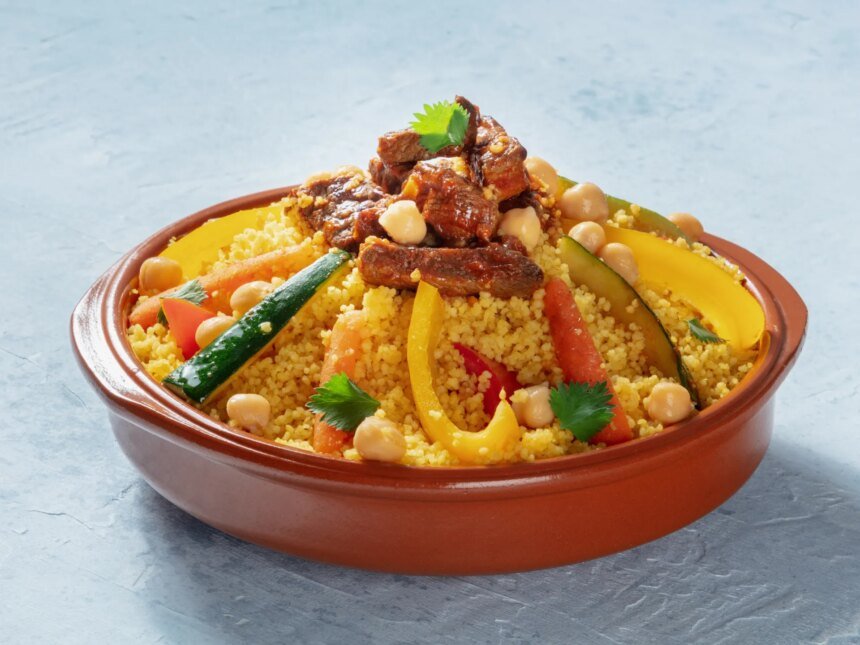
As for couscous, which has become one of the most popular dishes in France today, during the 1988 elections it turned into a tool for political satire when far-right supporters targeted Socialist President François Mitterrand with the slogan: “Liberty, Equality, Couscous,” in a sarcastic twist on the slogan of the French Republic (Liberty-Equality-Fraternity).
The controversy is not limited to food alone, but extends to the Arabic language itself as one of the most prominent symbols of the Maghreb presence in France.
In a testimony published by Lopes magazine, the young woman Lina, born in France to parents from Morocco and Algeria, narrates how she lived a complicated relationship with Arabic due to social pressures and stereotypes associated with immigrants.
“I used to see language and origins as something to be ashamed of,” she says, explaining that she used to ask her mother to speak French in front of her friends for fear of being seen as a “foreigner.”
But today she confirms that learning Arabic has become for her “a restoration of identity” and “a response to the rise of the extreme right,” adding: “We can be proud of being French and at the same time proud of our origins.”
This testimony reflects a broader shift among the children of the second and third generations of Maghreb immigrants, who have come to see Arabic, couscous, and inherited cultural customs as part of their complex French identity, not its opposite.
While the political class is preoccupied with the battles of halal chicken and roasted pig, it seems that the real issue lies in the search for a new formula for coexistence within a French society in which there are multiple identities and affiliations.
Historian Julia Tsirgo believes that these tensions over food, drink, and language reflect a deeper crisis facing the traditional French model.
She says that these tensions have increased over the last decade, with the growth of identity tendencies among politically opposing parties, but they agree – despite their different locations – to transform food and cultural practices into tools for defining and classifying groups.

In her view, the debate over halal, couscous, or the Arabic language is not really about food or language per se, but rather about larger questions about the place of cultural and religious diversity within contemporary France.
Thus, while the political class is preoccupied with the battles of halal chicken and roasted pig, it seems that the real issue lies in the search for a new formula for coexistence within a society in which there are multiple identities and affiliations.
Behind the noise of pots, plates of couscous, and debates about Arabic, there is a deeper battle taking place over France’s definition of itself in the twenty-first century.