Published on 5/31/2026
|
Last update: 07:51 (Mecca time)
The Pentagon is preparing to host a second meeting between representatives of the Lebanese and Israeli delegations the day after tomorrow, Tuesday, following the round of security talks on Friday, while the Israeli army announced the expansion of its ground operations in southern Lebanon.
The Pentagon said that the security meeting between the Israeli and Lebanese army missions, hosted by Undersecretary for Policy Affairs Elbridge Colby, was fruitful, but without indicating clear points of agreement or decisions.
The Pentagon stated that “the military talks focused on building practical frameworks for regional security and stability,” noting that the “tangible results” of the discussions will directly guide the negotiations between political leaders that the State Department will conduct during the next week.
The Lebanese delegation seeks to reach an agreement for a comprehensive ceasefire in the south, at a time when Israel rejected a Lebanese demand for its withdrawal as part of efforts to disarm Hezbollah, according to what the Israeli Broadcasting Corporation reported.

Lebanese goals
The Associated Press quoted a senior Lebanese military official as saying that the Lebanese delegation, headed by Brigadier General George Rizkallah, seeks to make the ceasefire “comprehensive” while demanding the reactivation of the committee supervising the implementation of the previous ceasefire agreement, which was sponsored by the United States of America and ended the war between Israel and Hezbollah in late 2024.
The official explained that the implementation of the agreement will be followed at a later stage by discussing issues such as the deployment of the Lebanese army on the border and the withdrawal of Israeli forces from southern Lebanon.
But diplomatic efforts in Washington so far have been met with continued violations by the Israeli army of the ceasefire agreement signed last April, which was extended until early July.
Lebanese Prime Minister Nawaf Salam described the recent Israeli military operations in the south of his country as a “dangerous and unprecedented escalation,” stressing that Tel Aviv is “pursuing a policy of comprehensive destruction and carrying out mass displacement” that goes beyond targeting specific areas to trying to impose a new field reality by force.
Salam added that the government is determined to protect the country in a way that prevents Lebanon from being turned into a “mailbox for regional messages,” declaring that the decision to go to negotiations represents “the most appropriate option because it is the least expensive path,” while stressing not to compromise on the national constants of complete withdrawal, the return of prisoners, and the return of the displaced to their land, stressing once again that “the decision on war and peace must be in the hands of the state.”
Extensive operation
On Sunday morning, an Israeli army spokeswoman announced the start of a large-scale military operation in the Beaufort Heights and the Wadi Saluki area in southern Lebanon. She said it aims to destroy military infrastructure and eliminate militants, within the framework of strengthening operational control in the region and removing what she described as a “direct threat” to the Galilee finger and the town of Metulla.
The spokeswoman added that the operation began a few days ago, with the participation of large ground forces under the command of the 36th Division, and under the guidance of the Military Intelligence Authority, to carry out offensive activity aimed at “expanding the front line of defense.”
It stated that Israeli forces crossed the Litani River and expanded their attacks against Hezbollah to the north of the river, noting that operations are currently expanding towards additional areas.
She also said that the forces are operating in the vicinity of Nabatieh, which she described as one of Hezbollah’s main power centers in southern Lebanon, stressing that the army is ready to expand the attack “as necessary.”
Continuous raids
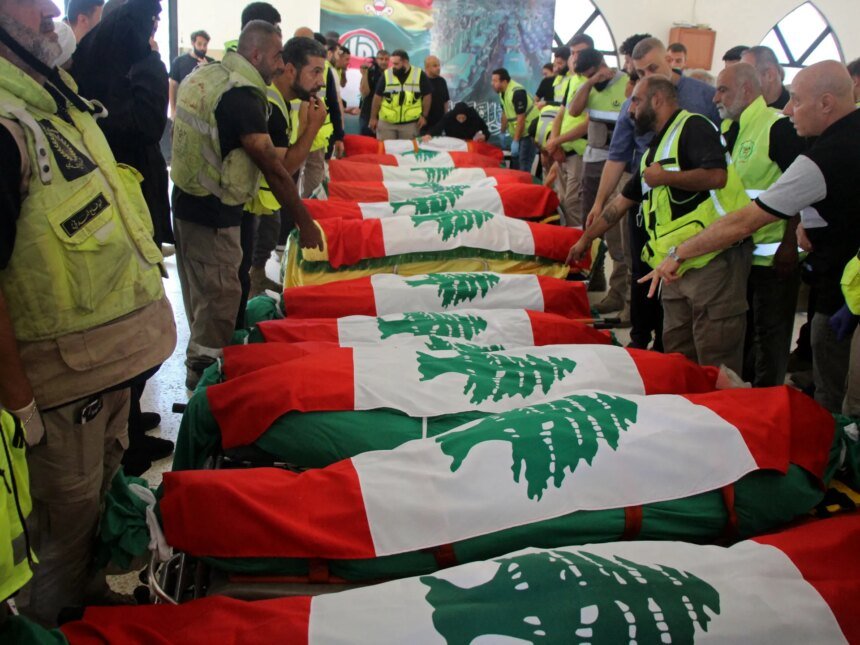
Meanwhile, on the fourth day of Eid al-Adha, 8 people were killed and 18 others were injured as a result of a series of Israeli air strikes and artillery shelling that caused devastation in several areas of southern Lebanon, while sirens sounded in Safed, northern Israel, for the first time in about a month and a half.
An Israeli raid that targeted a water path caused the death of a paramedic in the Islamic Message Scouts and the injury of 4 people, while a drone that targeted a house in the Marj neighborhood in the town of Ansar in the Nabatieh Governorate killed one person and his son and wounded 7 family members.
The Lebanese News Agency said that Al-Resala Society health ambulance teams recovered two martyrs from a building targeted by Israeli warplanes in Burj Al-Shamali, Tyre district.
Yesterday, Saturday, the Lebanese army announced that two soldiers were seriously injured after being targeted by an Israeli drone in the south.
A Lebanese military source told Anadolu Agency that “the Lebanese army evacuated its positions from villages and towns that had come under the control of Israeli forces, in order to preserve the safety of the soldiers, in light of the imbalance of power and the continuation of Israeli attacks that targeted security and military centers and elements, and caused casualties among the ranks of the soldiers.”
Hezbollah responds
In conjunction with the military escalation in Tel Aviv, Lebanese Hezbollah announced the implementation of 21 military operations on Saturday, including targeting 8 settlements and military bases in northern Israel, as well as carrying out ambushes for Israeli forces penetrating the south.
This came as part of several statements by the party, in which it said that its operations come “in defense of Lebanon and its people, and in response to the Israeli enemy’s violation of the ceasefire.”
In Israel, Israeli media said that the army was surprised by the volume of rocket launches from Lebanon, and by the wide scope of attacks coming from Lebanese territory.
She pointed out that dozens of rockets were launched over the weekend towards the towns of the north, while the attacks extended for the first time since the ceasefire took effect to the cities of Safed and Nahariya.

Ben Gvir as the destruction continues
Meanwhile, the Israeli municipality of Kiryat Shmona decided to suspend school hours and face-to-face education due to the escalation taking place with Hezbollah. The Home Front also issued new instructions, starting today, Sunday, to close all schools in the northern border towns of Meron and Nahariya, and to impose restrictions on gatherings.
Meanwhile, Israeli Minister of National Security Itamar Ben Gvir escalated his extremist tone towards Lebanon, calling for the continuation and expansion of military operations in the southern suburbs of Beirut, and rejecting any ceasefire arrangements.
Ben Gvir sent a direct message to Israeli Prime Minister Benjamin Netanyahu, asking him to take more severe steps in managing the confrontation with Hezbollah, stressing the need to continue military pressure and not accept a cessation of operations.
Since last March 2, Israel has launched an expanded aggression against Lebanon, leaving 3,371 dead and 10,129 injured, in addition to more than a million displaced, according to the latest official data.