Published on 5/30/2026
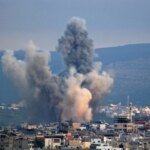
The scope of confrontations in southern Lebanon is expanding with the continuation of Israeli incursions north of the Litani River and the intensification of exchanges of strikes with Hezbollah, at a time when the military interpretation of the field indicates that the battle is no longer limited to border frictions or limited operations, but rather revolves around controlling high positions and strategic points that give a field advantage in any subsequent phase of the fighting.
Military and strategic expert, Brigadier General Elias Hanna, believes that the Israeli army is implementing a strategy based on three basic pillars:
- Incursion into Lebanese territory.
- Creating a depth of field that ensures freedom of movement for his forces.
- Targeting Hezbollah’s military infrastructure, especially the capabilities associated with drones, which have become one of the most prominent challenges facing the Israeli forces.
Hanna explained that Israel is no longer focusing only on the direct confrontation with Hezbollah fighters, but is also seeking to address what it considers a growing threat represented by drones, noting that the Israeli army has established a specialized unit to pursue the operators of these drones and track down their operating locations, in a step that reflects the extent of the anxiety caused by these combat means.
In the field, the Nabatieh region and its surroundings appear to be at the forefront of Israeli interest. According to military estimates, the current operations do not necessarily aim to storm the city of Nabatieh itself, given the large forces and long battles that this may require within populated areas. Rather, efforts are focused on controlling the hills and heights surrounding it.
Hanna points out that the most important axis for the Israeli forces extends through Zawtar al-Sharqiya, Qal’at Beaufort and Yahmar, all the way to the outskirts of Nabatieh, which are areas that provide high positions that allow supervision over large areas of southern Lebanon. This comes in line with what Israeli Prime Minister Benjamin Netanyahu said about seeking to control what he described as “ruling and controlling places.”
Beaufort Castle gains special importance in this context, as it oversees vital roads and axes linking several regions in the south, and also gives those who control it greater ability to monitor field movements in the vicinity of Nabatieh and the eastern sector of the region.
In parallel with this main axis, the military reading speaks of supporting axes that Israel seeks to activate to enhance its field deployment. The Dibbin axis stands out as one of the most important of these routes, as field reports and Hezbollah statements indicate the presence of ongoing clashes in the region, which reflects the presence of advanced Israeli forces in this sector.
Controlling strategic valleys
According to Hanna’s analysis, movement through Dibbin and Balat may later open the way to reach the areas of Al-Khardali and Kafr Tibnit, allowing the Israeli forces to expand the scope of supervision of vital roads and natural corridors that constitute strategic importance in any large-scale military operations.
Another axis also emerges, starting from Bint Jbeil towards Rashaf and Hadatha, as these areas represent high points that give a field advantage to the forces deployed there. The importance of this axis increases as it approaches Al-Ghandouriyah, which is a turning point that allows supervision of Wadi Al-Hujar, one of the most prominent sites that gained military fame during the 2006 war.
Hanna confirms that the obsession with controlling strategic valleys, such as Wadi Al-Hujair, Wadi Al-Saluki, and Wadi Hamul, is still strongly present in Israeli calculations, given the capabilities these areas provide for monitoring and controlling movement and supply lines.
On the other hand, Hezbollah continues to follow a different method of managing the battle, based on exhausting Israeli forces and avoiding a comprehensive confrontation or decisive battle. According to Hanna’s description, the party relies on a decentralized combat pattern that allows each sector to operate independently from the other sectors, thus reducing the impact of strikes and giving field units greater flexibility in movement and engagement.
The military expert explains that the fighters deployed in Nabatieh do not manage the same operations carried out in Rashaf or Tyre, but rather each region operates within an independent framework linked to a combat doctrine based on what is known as the “mosaic” principle, where units and capabilities are distributed over a wide geographical area that is difficult to deal with as a single front.
This strategy relies on a combination of drones, missiles, and anti-armor weapons, in addition to a human element with accurate knowledge of the nature of the land and its terrain, which gives Hezbollah the ability to continue clashing with invading Israeli forces despite the expansion of the operations.