Published on 5/30/2026
|
Last update: 18:14 (Mecca time)
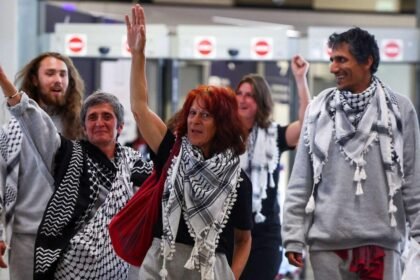
The arrest of the Israeli Muslim activist supporting the Palestinian cause, Zohar Regev, did not stop at the limits of imprisonment and trial, like other thousands of international solidarity activists whom they detained in bad conditions and assaulted. On the contrary, it highlights her story as an activist and Muslim who exposes Israel’s crimes publicly.
The Israeli occupation authorities arrested the activist in international waters in the Mediterranean, along with more than 420 international activists and activists, from more than 40 countries.
On May 19, the occupation authorities began a campaign against…To seize boats Global resilience fleet Which departed from the Turkish city of Marmaris in the middle of the month to break Siege Israeli imposed on Gaza Strip.
Zohar was subjected to different procedures than the rest of the activists, especially since she previously participated in the Al-Samoud Flotilla, and her appearance before the Ashkelon Magistrate’s Court following her arrest had a local and global impact, and last Tuesday the court decided to release her and deport her from Gaza for 60 days.
Violence Ben Ghafir
Activist Zohar Regev spoke to Al Jazeera about the recent arrest of her and the activists, in which the most prominent forms of violence were evident, not from the heavily armed soldiers and the repressive methods they used that amounted to harassment and sexual and physical assault, but rather with the extremist Israeli Minister of National Security, Itamar Ben Gvir, storming the prison where the activists were arrested and directly threatening them.
“It is shameful that the world is giving more attention to Ben Gvir’s humiliation of some international activists, while allowing him to get away with destroying Palestinian lives on a daily basis,” Regev says.
In a prison or “cage” made of containers, as she describes it, the Israeli activist was arrested and she thought that she would be safe from the bullets of Israeli soldiers that sometimes rained down on them, “but there was a woman who was injured by a rubber bullet a few minutes before I was brought into that place.”
She confirms her story by saying: “People were beaten, and others were subjected to humiliating behaviour.” As for her, in addition to pushing her forcefully, the soldier who was transporting her from the boat to the port was grabbing her neck very violently and pushing her down.

Israeli between Palestinians
Zohar adds that when the Israeli authorities were unable to accuse her that her presence in Israel was “illegal,” they were “forced to invent something else, and say that I tried to infiltrate a military zone without a permit, but even this accusation is baseless.”
Zohar Regev was born in 1972, and grew up in the kibbutz (agricultural settlement) of Kfar Hahoresh near the city of Nazareth, where she spent her early years.
Her living experience and contact with Palestinian communities formed an important part of her personal and intellectual path, as she lived for nearly two years in Bethlehem, during which time she converted to Islam, left Israel, and then moved to Spain in 2004.
How did you convert to Islam?
Regarding her step towards Islam, Regev says that she was never a religious Jew or even a believer, “but I communicated with people with a strong faith and they were living their faith, such as some Christian communities, or people I met through the Freedom Flotilla, and some of them were Muslims, and I found them to be amazing people because they were willing to turn their convictions into actions, sometimes more than other people who were doing so only for humanitarian reasons.”
She pointed to the role of people – whom she did not name – who spoke to her and tried to convince her that there was “a lot of work to be done at the heart level,” which was in line with her inclinations for justice, “which is what I also found in Islam,” the Israeli Muslim activist added.
Perhaps also because she is an “atypical Israeli,” as she describes herself, she was “lucky in a way to be raised in a family where it was clear that the occupation was wrong, even though I grew to understand that the roots ran deeper than just the 1967 occupation.”
She adds at the end of her talk about her family and her convictions: “The entire Zionist project is racist and harmful to Jews and anyone it touches, because it tries to solve a problem by granting privileges to one group at the expense of another, which is a recipe for eternal war.”