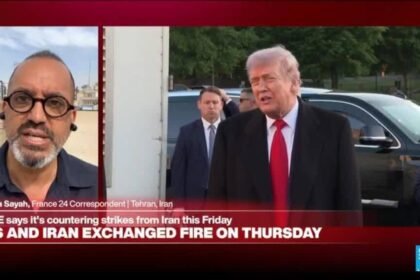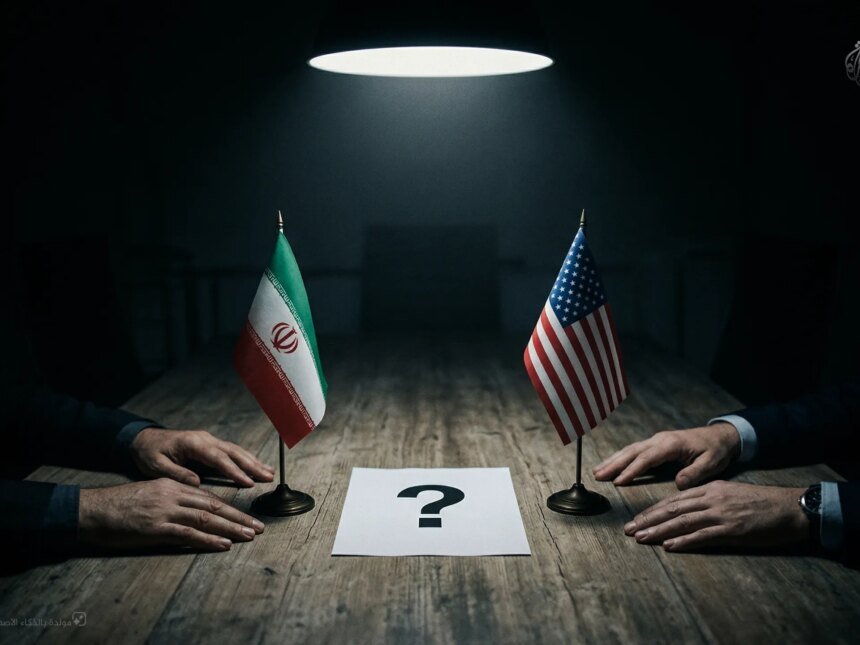
Despite the blockage of prospects in the diplomatic track, in order to establish an agreement between the United States and Iran under which the war would end permanently, analysts rule out the return of the two sides to fighting again.
In the latest updates, Reuters, citing an American official, revealed that President Donald Trump is dissatisfied with the latest Iranian proposal to settle the war that has been going on for two months, which has weakened hopes for reaching a solution.
Experts believe that the current impasse reflects a slowdown in negotiations and not a collapse, citing many examples in history that indicate that diplomacy rarely proceeds in a horizontal line, but is often characterized by stagnation, setbacks, and indirect interventions.
What is the current status of negotiations?
CNN quoted two sources as saying that President Trump presented his views during his meeting with senior national security officials regarding the Iranian file, after Iran presented a new proposal aimed at ending the war.
The network also quoted another source as confirming that “Trump is unlikely to accept the Iranian proposal,” while American officials considered that reopening the Strait of Hormuz – without settling the enrichment issues – could cause Washington to lose an essential pressure tool in the negotiations, according to the source.
Details of the Iranian proposal: The latest proposal from Tehran stipulates postponing discussion of the nuclear program until the end of the war and the settlement of disputes related to maritime shipping.
According to the Wall Street Journal, the Iranian offer proposes a three-stage plan, starting with the United States and Israel ending the war and providing guarantees that it will not resume.
The newspaper quoted informed officials as saying that Tehran had presented regional mediators with an offer to stop its attacks in the Strait of Hormuz, in exchange for a complete end to the war and the lifting of the American blockade on Iranian ports.
Hardening attitudes: Both Iran and the United States remain steadfast in their demands, especially regarding the nuclear program and control of the Strait of Hormuz.
Yesterday, Monday, Iranian Foreign Minister Abbas Araqchi held Washington responsible for the failure of the talks, saying – during his visit to Russia – that excessive American demands caused the failure of the previous round of negotiations, despite making progress.
Trump said on Saturday that he had canceled the visit of his envoys Steve Witkopf and Jared Kushner to Pakistan, and the next day, Trump said that Iran could call by phone if it wanted to negotiate an end to the war that began on February 28.
Trump told Fox News at the time, “They (Iran) know what the agreement should include. It’s very simple: They cannot have a nuclear weapon. Otherwise, there is no reason to meet.”
Iran has already expressed reluctance about participating in talks with the United States, with officials in Tehran stating that direct talks are not feasible at the moment, citing American measures, such as the naval blockade of the Strait of Hormuz, as ceasefire violations and obstacles to serious dialogue.
Iranian President Masoud Pezeshkian said, in a telephone conversation with Pakistani Prime Minister Shahbaz Sharif on Saturday, that his country would not enter into what he described as “imposed negotiations” under threat or siege.
Continuous endeavors
Despite the collapse of direct communication, diplomatic efforts continue through indirect channels.
According to the Iranian Fars News Agency, Tehran sent “written messages” to Washington through Pakistani intermediaries, specifying its red lines, including its positions on nuclear issues and the Strait of Hormuz.
Meanwhile, Araghchi has been engaged in an intense round of regional diplomacy, visiting Pakistan, Oman and Russia over the past three days.
“It is a good opportunity for us to consult with our Russian friends about the developments that occurred regarding the war during this period and what is happening now,” Araqchi said in an interview with Iran’s IRNA news agency from St. Petersburg.

“It takes years”
Although the gap between the positions of Tehran and Washington is still wide, the ceasefire between them is still largely in place, which indicates – in the eyes of observers – the two countries’ keenness not to return to an all-out war.
Emma Shortis, director of the International and Security Affairs Program at the Australia Institute, says there is room for progress in the negotiations, despite the stalemate, adding that serious diplomatic efforts “take years to build.”
Shortis explained to Al Jazeera that there are clear indications that there may be room for maneuver, especially with regard to the issue of uranium enrichment, but at the same time she warned that this depends on “volatile leaders who may change their minds at the last minute,” as she described it.
Trump had previously indicated a few days ago that canceling negotiations does not necessarily mean a return to actual fighting, and he spoke positively last Sunday about the new Iranian proposal, and also hinted at the possibility of some flexibility.
Shortis said that Trump is under enormous pressure internally, given that the war is very unpopular among Americans, adding, “With the continued effective closure of the Strait of Hormuz and its impact on gas prices in the United States, the pressure will continue to increase.”
Stalemate…neither peace nor war
Academic Rob Guest Pinfold, a lecturer at King’s College London, agrees with Shortis that diplomacy has not failed, but it faces what he described as “intractable divisions” between the two countries, stressing that both sides do not want to return to war.
As for Iran, Penfold considered that its calculations are affected by the amount of damage it has already suffered, adding, “Many of Iran’s assets have been damaged, and its army feels the need to recover. It wants some time to breathe.”
At the same time, the United States warns against being drawn back into a costly confrontation in the Gulf, in part because of Iran’s ability to impose a high price on the region and the global economy.
Regarding this point, Penfold confirms the success of Iran’s deterrence strategy, explaining, “Iran was able to cause enough chaos to affect the global economy by striking the Gulf states.”
The academic concluded that the current stalemate may continue and take hold within a semi-permanent ceasefire, considering that it is a fragile ceasefire, but it is heading towards becoming a fait accompli.
He said, “Neither party feels that the other party has the upper hand, but they both feel that they have the upper hand, so the result is this stalemate that is neither peace nor war.”
He expected this situation to continue for a long time, adding, “This is a dynamic that can continue almost indefinitely until one party is able to force the other to make concessions.”
Examples of previous negotiations… How did they end?
Successful negotiations to reach the 2015 Iran nuclear agreement, officially known as the Joint Comprehensive Plan of Action, took about two years and included informal secret talks coordinated and mediated by the Sultanate of Oman.
Trump withdrew from the agreement – which succeeded after long periods of stagnation and gradual progress – unilaterally in 2018 during his first term.
Director of the Council for Arab-British Understanding, Chris Doyle, said that all major negotiations to end wars have their own characteristics, citing the example of the 1973 Paris Peace Agreements between the United States and Vietnam.
Doyle describes the scene at the time on the island, saying, “Here you see parties that were in severe disagreement, trying to reach an agreement in which hostilities did not actually end, and there were also major differences,” noting that the negotiations that led to the agreements began in 1968.
However, although the United States effectively exited the war, immediate violations of the agreements occurred, and South Vietnam eventually fell to communist forces in 1975.
In this regard, Doyle warns that the opposing parties in any conflict may conclude deals, but ensuring their continuity is another matter.
In another example, early negotiations between Russia and Ukraine in 2022 raised hopes of reaching a settlement, but they ultimately collapsed. However, diplomatic communication did not stop completely, as smaller agreements were reached, which included the exchange of prisoners, the return of children to their country, and allowing the export of Ukrainian grain through the Black Sea.