Published on 4/25/2026
|
Last update: 19:04 (Mecca time)
While we consider space a hostile environment devoid of oxygen and filled with deadly radiation, there is an “elite” of terrestrial beings who have decided not to give up. These little travelers didn’t just survive, they turned their bodies into physics-defying biological laboratories.
In this report, we review 5 amazing stories of beings who went back and forth to cosmic hell, returning to us with secrets that may change our concept of the origin of life in the universe.
Read also
list of 2 itemsend of list
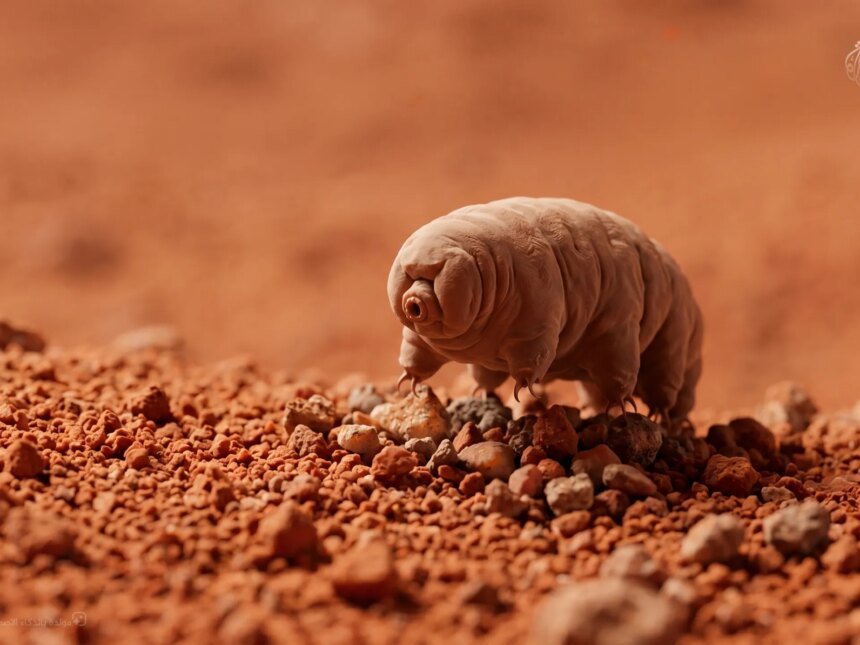
Water bear…the invincible astronaut
In September 2007, the European Space Agency placed thousands of “tardigrades” (Milnesium tardigradum) on the FOTON-M3 mission, in an experiment dubbed “TARDIS 2007”. These creatures were not inside a protected cabin, but were directly exposed to the vacuum of space and the burning ultraviolet rays of the sun.

The surprise upon returning was; While the radiation killed off individuals that were not protected by certain filters, the vast majority of groups that encountered the vacuum alone survived.
The experiment proved that this organism can reduce the percentage of water in its body to only 3%, entering a state of complete biochemical quiescence, which made it the first multicellular animal to survive in “open space” with all its harshness.
“Conan” bacteria… a living shield against radiation
Deinococcus radiodurans, also known as Conan’s bacteria, is the champion of radiation resistance.
In the Japanese Tanpopo experiment, which began in 2015 and continued until 2018, layers of these bacteria were placed in capsules outside the International Space Station.

Results published in 2020 revealed that colonies that were only one millimeter thick survived for three full years. Although the surface layer died, it sacrificed itself to form a “protective shield” for individuals in the deeper layers, which regained its vital activity upon its return to the laboratory, which reinforces the hypothesis of the ability of microbes to travel between planets via meteorites.
Lichens: potential invaders of Mars
Lichens are not just plants, they are an integrated ecosystem that has proven unprecedented resilience. In 2005, samples of map lichen (Rhizocarpon geographicum) in the LIFE 2005 experiment were sent into orbit for 15 days in an environment simulating the Martian atmosphere (low pressure, carbon dioxide, total vacuum, massive ultraviolet radiation, and large temperature fluctuations).
What is amazing about this experiment is that all individuals survived 100%, and did not stop photosynthesis once terrestrial conditions were restored. The secret of its strength lies in the fact that it is a “symbiotic organism”; They are a fungus that provides protection and structure, and an alga that provides nourishment through light.

This union is what allows it to survive in places where no other plant can, from the frozen Himalayas to outer space. This experiment confirmed that lichens are exceptional candidates to be the first “colonial” organisms that can live on the surface of Mars without the need for complex greenhouses.
Hamish larvae… sleeping in the heart of frost
In one of the longest Russian experiments aboard the International Space Station, African midge larvae (Polypedilum vanderplanki) spent more than a year (2013-2014) attached to the outer wall of the station in an experiment known as “space-midge” (Space-Midge 2014).
The word “Midge” is usually used in research as an abbreviation for the insect with a long name to facilitate media and press circulation.

These larvae were completely dehydrated and resembled “inanimate objects”, the stage in which they had the legendary ability to withstand harsh conditions. In space, I experienced terrifying temperature fluctuations ranging from minus 150 to plus 100 degrees Celsius.
Although not all larvae survived; Survival depends on the accuracy of the dehydration process before launch. A large percentage of them returned to life as soon as they touched water. This experiment proved that complex organisms, not just bacteria, can withstand long cosmic travel.
Nematodes…survivors of the ashes of “Columbia”
The story of Caenorhabditis elegans, or C. elegans, worms on board Columbia in February 2003 is most inspiring.
Despite the disaster that led to the shuttle crashing and burning, and its occupants, during reentry into the atmosphere, the experiment containers were found in Texas weeks later amid the charred wreckage.

The surprise was that the worms not only survived, but they reproduced and lived their fifth or sixth generation inside the containers. This tragic event unintentionally proved that life is strong enough to withstand the heat of atmospheric friction and collision with the Earth, which is the strongest practical evidence that life can be transmitted through celestial bodies.
Towards a new horizon of life
These small creatures not only teach us how to die, but how to triumph over life in the most difficult circumstances. The success of these experiments opens the doors of hope for “farming” Mars and ensuring long-term human journeys into the depths of the solar system.
Today, we do not look at space as a dark grave, but rather as a vast area through which the seeds of life may have crossed millions of years ago, waiting for humans to discover them or to transfer to them a trace of the earth’s greatness.
Do you think that discovering the ability of these creatures might change human future plans to build colonies on the moon or Mars?