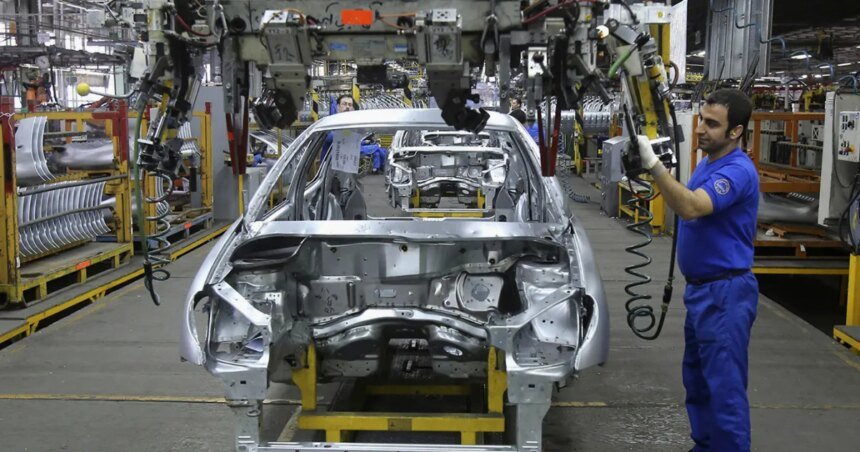
On the surface, the story seems to be a story of steel, but in industrial terms, it is a story of cars as well. The attack on steel facilities during the American-Israeli war on Iran not only struck the metal sector as a stand-alone sector, but also struck one of the most important manufacturing links in a country where cars are still one of the largest non-oil industries and the most intertwined with suppliers, assembly, and the local market.
When the flow of flat steel is disturbed, the effect does not appear first in factory raw materials, but rather in production lines that rely on sheets and coils before anything else.
The automobile industry in Iran is not a marginal industry, as data from the International Organization of Automobile Manufacturers shows that the country produced about 1,077,839 vehicles in 2024, but this number remains much lower than a historical peak of about 1.6 million vehicles years ago, which means that the sector operates today at a level about 32.6% lower than its previous peak.
The picture becomes clearer if one looks at the most recent figures within the local market. According to published data for the first 11 months of the Iranian year 1404 (which ended last March 20), the three largest companies, Iran Khodro, Saipa, and Fars Khodro, produced 735,334 passenger cars, a decline of 9.2% compared to the same period of the previous year.
This equates to a monthly average of approximately 66.8 thousand cars only, a number that reveals that the sector was already moving under pressure before the steel targeting factor came into the equation strongly.

From steel start the car
Specifically here the value of steel appears. The World Steel Association says that the average modern car uses about 900 kilograms of steel, and that it still constitutes more than 50% of the components of modern cars.
If this average is applied to Iran’s total production in 2024, this means a theoretical need of approximately 970 thousand tons of steel to manufacture vehicles in one year, and if it is applied to the production of the three major companies in 11 months of the Iranian year 1404, then we are facing approximately 662 thousand tons, and this means Any disruption in steel becomes an immediate threat to the auto industry.
But the problem is not with “steel” in general, but rather with a specific type of it, which is flat steel, the product that is used in frames, doors, roofs, basic car body parts, and structural components.
Therefore, the automobile industry is not only affected if the production of raw steel decreases, but specifically if the supply of specific coils and sheets that make up the body of the car itself is disturbed.

The sheets are not raw
The steel sector’s own figures illustrate this point. According to the World Steel Association, Iran produced about 31.8 million tons of crude steel in 2025, keeping it among the 10 largest producers in the world. But the large number here does not mean that throttling is not possible, because the automobile industry does not consume “raw steel” in its general form, but rather needs finished or semi-finished flat products that pass through rings that are more sensitive to failure.
This explains the importance of the Mubaraka Steel Company in particular, whose official data show that its slab production capacity is about 7.2 million tons annually, and that its hot rolling capacity is approximately 5.2 million tons, and that its products include sheets and coils used in automobile parts.
Here lies the choke point. When this link is damaged, the market faces not only a general shortage of a raw material, but also a disturbance in the material from which the car manufacturing process begins.

From containment to import
Official figures reveal that the crisis has exceeded the level of theoretical concern. This April, the Iranian Minister of Industry announced that he had granted Mobarakeh Steel Company a license to import hot paper, explaining that the goal was to cover the needs of more than 1,380 industrial units and 2,400 secondary units.
Merely returning to importing a product with this level of sensitivity means that the defect is no longer just a possibility, but has become a gap that is being prepared to be filled from abroad.
At the same time, reports issued from the meetings held between “Mubarakeh Steel” and “Iran Khodro” and “SAIPA” say that the company is working through supporting capacities and alternative lines to restore stability to production, and that “most” of the needs of automobile companies can be met, while keeping the option of compensation through another company or through import on the table if gaps appear.
It seemed that the market was no longer talking about a comfortable abundance, but rather about managing a potential shortage before it reached the assembly lines.

The market is waiting for the impact
So far, the numbers do not indicate an imminent complete shutdown of the auto industry in Iran. But there are fears that the impact will appear gradually, including pressure on production schedules, rearranging priorities between models and the use of inventory, and then burdening the market with a portion of the high cost of inputs if the disruption is prolonged.
This pattern of impact is not specific to Iran alone. Reuters this month reported warnings that the war has already raised the cost of fuel, shipping and inputs, and is beginning to put pressure on the auto industry in other markets as well.
But the fragility of the Iranian situation seems greater, because the sector is entering this stage while it is already below its historical peak, and because its actual production in the last Iranian year was declining before the main steel facilities were damaged.
Therefore, the question is no longer whether the Iranian automobile industry needs steel, as this is decided by numbers, but rather how long can the industry absorb the disruption of flat plates before the effect becomes clear in the production of fewer cars, slower delivery, and higher costs?
In the end, the car in Iran does not start from the engine or from the assembly line, but rather from the steel coil, and if this link is shaken, the impact will not remain within the steel factories alone, but will extend to the factory, the market, and the consumer together.