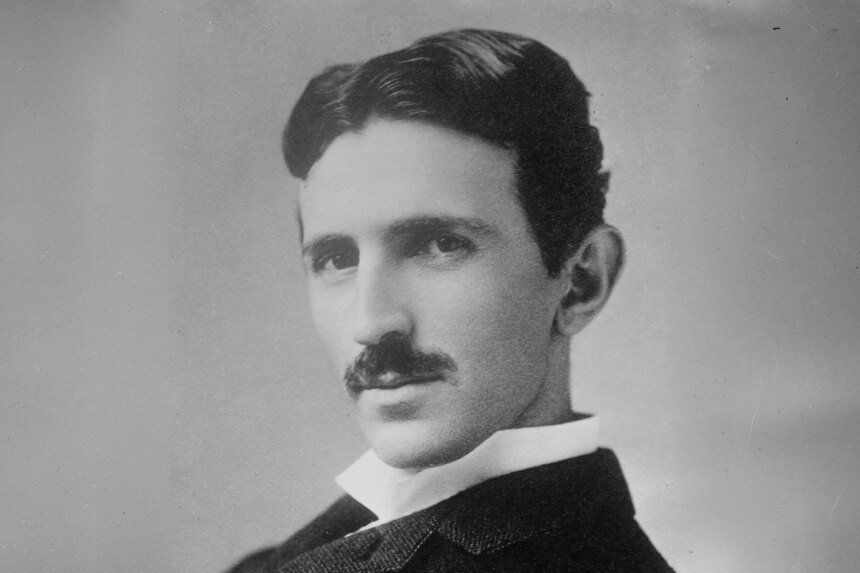
A Serbian-American electrical engineer and physicist, considered one of the most prominent pioneers of the modern electrical revolution. He is famous for his discovery of the rotating magnetic field, and his development of the alternating current system, which became the global standard for transmitting electrical energy with high efficiency. He was born in 1856 in Croatia, and died in 1943 in New York.
He is also credited with inventing the first practical application of the idea of remote control, which paved the way for the emergence of remote control technologies, drones, and others later.
He was nominated for the Nobel Prize in Physics but did not win it, and despite his exceptional scientific contributions, his last years were characterized by noticeable compulsive behaviors, especially with regard to cleanliness and numbers, which some researchers saw as an indication that he was suffering from obsessive-compulsive disorder.
Birth and upbringing
Historians differ on the date of Nikola Tesla’s birth between the ninth and tenth of July 1856, in the village of Smiljan in Croatia, which was then part of the Austro-Hungarian Empire, to a Serbian family, and he was the fourth of five children.
His father, Milutin Tesla, was a priest in the Serbian Orthodox Church, and he sought to direct his son towards church work. As for his mother, Georgina Diuka Mandic, she was a housewife. She did not receive a formal education, but she was distinguished by remarkable practical intelligence and the ability to invent simple household tools, which left a profound impact on Nicholas’ personality and contributed to the development of his early passion for invention.
In 1863, when he was seven years old, he experienced an early shock with the death of his brother following a horse-riding accident, which he witnessed, which left a clear imprint on his childhood, after which he tended to isolate himself and indulge in imagination and contemplation.
Study and training
Nikola Tesla received his primary education in the village of Smiljan near Gospić, then continued his studies in the city of Gospić until 1870, where he graduated superior to his peers. Since his early years, he attracted attention with his exceptional abilities in memorization and comprehension, and it was said that he mastered eight languages.
Tesla attended the Technical High School in Karlovac for three years, and there his passion for electrical science crystallized. However, his infection with cholera left him bedridden for nearly a year, which constituted a temporary obstacle in his educational career, before this crisis prompted his father to agree to him studying engineering instead of heading towards the priesthood.
In 1875, he entered the Graz Polytechnic Institute in Austria to study electrical engineering, and was introduced to the Grammy machine for the first time, which generated direct current and could also operate as an electric motor. This experiment raised a fundamental question in his mind about the feasibility of converting alternating current to direct current, instead of using it directly to operate motors, and despite his repeated attempts, he did not reach a decisive answer at that time.
Later, he moved to the University of Prague to study philosophy, but financial difficulties forced him to leave after one year. In 1881, he was appointed director of the Budapest Telephone Company, and he witnessed the decisive moment of inspiration in February 1882, when the idea of the induction motor came to him during an evening walk, so he quickly drew his plans in the sand, thus laying the foundation for an invention that had been occupying his mind for years.
In April of the same year, he moved to Paris to work for the Continental Edison Company, owned by the American inventor Thomas Edison, where he quickly emerged among the elite of engineers traveling throughout Europe. During a repair mission in Strasbourg in 1883, he used his spare time in a rented workshop to build the first practical model of an induction motor, which proved highly efficient in performance, as documented by Franklin Institute reports.

Scientific and practical experience
Nikola Tesla arrived in New York in 1884 and joined the Edison Company’s headquarters in Manhattan as an engineer. During this stage, his high efficiency and diligence caught the attention of Edison, who expressed his admiration for his technical abilities.
Stories indicate that Edison promised him a large financial reward for developing direct current generators, and after months of intense work, Tesla succeeded in providing effective improvements. However, the surprise came when he demanded the reward, as he was informed that the promise was an “American joke,” which led to tension in the relationship between him and Edison, which ended with Tesla’s resignation.
After that, he went on to establish the Tesla Electric Lighting and Manufacturing Company in partnership with a number of investors, but sharp disputes arose between them that ended with the financiers taking control of the company and his patents, leaving him without financial resources. As a result, he was forced to work digging trenches in the winter of 1886 to secure his livelihood.
Despite this setback, Tesla did not abandon his scientific path, as he later succeeded in attracting new investors to support his research in the field of alternating current. In the period between 1887 and 1888, he achieved a qualitative leap by obtaining a large number of patents in the field of electricity, more than thirty patents, which paved the way for establishing the alternating current system as a strategic option in energy transmission.
Despite launching campaigns to discredit alternating current, including Edison’s attempt to link it to death sentences by electric chair and the harm it causes, the competition was decided in favor of Tesla and his alternating current, after his remarkable success in lighting the World’s Fair in Chicago in 1893, and operating the Niagara Falls project to transmit electricity to the city of Buffalo, which is approximately 35 kilometers away, in 1896.

Most notable inventions
In 1898, Tesla demonstrated a radio-controlled model boat in New York’s Madison Square Garden, one of the first real-life applications of remote control systems.
In the period 1899-1900, he established an experimental station in Colorado Springs, in which he demonstrated the possibility of using the earth as an electrical conductor, and succeeded in lighting lamps wirelessly, in addition to generating artificial lightning.
In 1900, he began work on an ambitious project to build the Wardenclyffe wireless transmission tower on Long Island. However, the withdrawal of the financier and the cessation of financial payments led to the project faltering in 1905, in what is considered one of the most notable failures in his scientific career, despite his pioneering ambition.
Nikola Tesla made pivotal contributions that formed the basis of modern electrical and communications systems, most notably the development of the multi-phase alternating current system, which allowed for the transmission and distribution of electricity with high efficiency over long distances, in addition to his innovation of the induction motor that worked with alternating current without the need for a transformer, which reduced breakdowns and raised the efficiency of industrial and domestic use.
He also designed what became known as the “Tesla coil” to generate high voltages and frequencies, which opened the way for technologies in communications and electronics.
In the field of lighting, he presented early models of fluorescent and neon lighting based on high-frequency currents, as a more efficient alternative to traditional lighting.
In scientific research, he contributed to the early development of X-ray applications with early warnings of their health risks. He was also one of the pioneers of radio technology and made fundamental contributions to wireless transmission, in addition to inventing one of the first remote control systems via radio waves, which represented the cornerstone of modern automation technologies, i.e. automation.

Awards and honors
Nikola Tesla received wide scientific appreciation, culminating in a number of international honors and awards, and documents from the Nikola Tesla Museum in Belgrade indicate that he received nine prominent honors in the period between 1892 and 1939.
In 1892, he was awarded the Order of Saint Sava, second class, by decision of King Alexander I of Serbia, during his visit to Belgrade, in recognition of his scientific contributions. In 1894, he received the Elliot Cresson Gold Medal from the Franklin Institute, in honor of his research into high-frequency alternating currents.
The Encyclopedia Britannica indicated the circulation of unconfirmed reports – which later turned out to be inaccurate – about the nomination of Tesla and Edison for the Nobel Prize in Physics in 1915, but documents from the Franklin Institute reported a story that the Nobel Committee announced in 1912 that Tesla and Edison had won the prize, but it was ultimately awarded to Gustav Dahlen, because Tesla rejected the prize because he refused to be associated with Edison’s name, considering himself a discovered scientist and not just an application developer. It is a novel that has remained the subject of historical controversy.
In 1917, Tesla was awarded the Edison Medal from the American Institute of Electrical Engineers, in recognition of his contributions to the development of electrical systems. In 1934, he received the John Scott Medal from the city of Philadelphia, in honor of his role in developing the rotating magnetic field and the induction motor.
In addition, Tesla received 13 honorary doctorates from prestigious universities around the world, as documented in the book “Nikola Tesla’s Certificates and Diplomas” issued by the Nikola Tesla Museum in Belgrade, an indication of the high scientific standing he enjoyed at the international level.

Illness, death and inheritance
The last years of Tesla’s life witnessed a noticeable decline in his health, coupled with relative isolation and increasing financial pressures. He stayed in a New York hotel, away from the scientific movement that characterized his career in its early stages.
His personality during that period was characterized by some unconventional behaviors, including extreme sensitivity to cleanliness, strict adherence to a precise daily routine, in addition to frequent interest in certain numerical patterns. He was also known for his attachment to pigeons. At the end of his life, he had a white dove that he cared for, and he was emotionally attached to it in a remarkable way. Some researchers believe that these traits may intersect with characteristics associated with obsessive-compulsive disorder.
On January 7, 1943, Nikola Tesla was found dead in his room in a New York hotel as a result of a severe heart attack, at the age of 86.
Following his death, the FBI confiscated his papers and the contents of his safe, as part of security considerations related to the circumstances of World War II, before some of these documents were reorganized and preserved within archives and specialized scientific institutions.
Later, Tesla’s name turned into a global symbol in the fields of science and technology, and his name was given to the unit for measuring magnetic flux density “Tesla”, and the electric car company “Tesla” also bore his name, which became one of the most prominent modern technology companies in the world. Belgrade Airport was also named after him, along with many museums and research centers around the world, which established his presence as one of the most prominent symbols of innovation in modern history.