Published on 4/25/2026
On the fortieth anniversary of the Chernobyl disaster, some major French newspapers unanimously agreed that the accident was no longer just a chapter of the European nuclear past, but rather turned into an open mirror to the present, as there is war, memory, and an energy future that is still subject to debate.
Le Figaro focused on the strategic and energy dimension of the disaster, presenting Chernobyl as a turning point that did not stop nuclear expansion, but rather reshaped it.
Read also
list of 2 itemsend of list
Fabrice Naudi-Langlois’s editorial points out a remarkable paradox: despite the existence of dozens of new nuclear projects, the image of the radioactive cloud of Chernobyl still dominates French consciousness, even if no one has officially declared it.
40 years after the disaster, about 415 nuclear reactors are still producing electricity around the world
He explains that 40 years after the disaster, about 415 nuclear reactors are still producing electricity around the world, and more importantly, according to him, 72 more reactors are under construction, as well as many small power station projects.
At the conclusion of his article, the author praises nuclear energy, saying that it provides countries that master it, such as France, with protection from other risks, such as dependence on foreign hydrocarbons and climate change.
On the other hand, Liberation took a sharper angle, linking the legacy of 1986 with the current geopolitical reality. The disaster was no longer a closed nuclear event, but rather became part of the Russian war on Ukraine.
The newspaper indicates that the modern protective dome of the fourth reactor was attacked by a drone in February 2025, resulting in damage and a fire that lasted weeks, which Greenpeace considered a danger that could result in the release of radioactive materials.
The newspaper quotes Belgian nuclear safety expert Jan van de Put as saying, “The air strike that targeted Chernobyl in 2025 occurred the night before the opening of the Munich Security Conference.”
He commented by saying that what happened could have been described as “nuclear terrorism. For us, what happened was an absolutely illogical act. As for the Russians, this is a calculated step. They are seeking to achieve political gains, or perhaps to obtain a life insurance policy, as a symbol of immunity against defeat,” as he put it.

Politicization of nuclear security
Liberation considers what is happening to be a politicization of nuclear security and a means to turn it into a pressure tool in war, as the radiological danger becomes part of the military equation.
In another article in Le Figaro newspaper, its correspondent, Vincent Joly, chose the title when talking about this issue: “$500 million losses and an exhausted containment system: in the depths of Chernobyl, where Russia has reopened the wounds of the disaster.”
He pointed out in his report that since the massive explosion that occurred in 1986, Reactor No. 4 has not been dismantled yet, and the new sarcophagus is still damaged as a result of a Russian drone that penetrated it last year, explaining that engineers and technicians are monitoring this damaged structure in the heart of the site.
In his last article, the reporter warned against delaying in dealing with this damaged structure and against waiting. He said, “We must stop considering this issue a tragedy of the past, and consider it from today a problem of the future.”
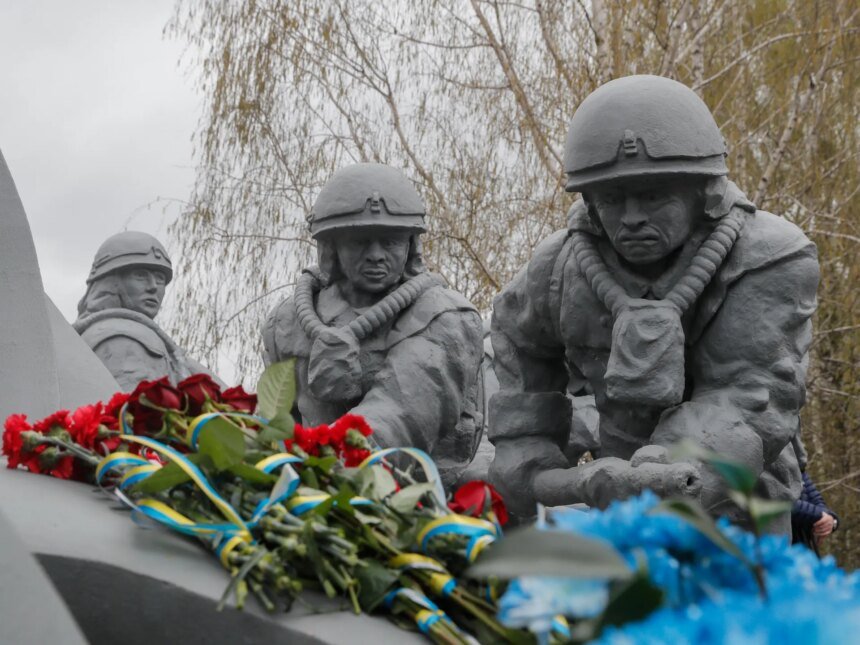
As for Le Monde, it chose to descend to a more humane level, reminding that behind the numbers and concrete structures there are thousands of forgotten stories, and recalling, in a report from Kazakhstan, the experience of the “liquidators” who were sent from various republics of the Soviet Union, including more than 30,000 Kazakhs.
Kalmykov: The atom was meant for peaceful uses, but man always acts before he thinks
“The atom was supposed to be for peaceful uses, but man always acts before he thinks,” says Dmitry Kalmykov, director of the Karaganda Museum for Chernobyl Victims.
The report reveals how these workers faced radiation without adequate protection, as protective equipment did not arrive until weeks later.
Then many of them returned to their homelands to find that their own memory had become marginalized, and that their compensation had been reduced to weak levels after the collapse of the Soviet Union.

While Le Figaro sees Chernobyl as a starting point for a global debate on nuclear energy between climate necessity and risks, Liberation considers it to have become a symbol of the era of “politicized nuclear” in modern warfare.
As for Le Monde, she notes that the essence of the story is still human, pointing out that there are thousands of people who carried radiation in their bodies without adequate recognition in official memory.
It seems that Chernobyl, after forty years, is no longer just a geographical location or a nuclear accident, but has become an ongoing question about the limits of technology, about the use of danger in politics, and about the world’s ability to do justice to those who stood in the face of the “invisible enemy.”