Published on 4/25/2026
In the village of Nabaa al-Tayeb in the Hama countryside in central Syria, and from inside the house of Amjad Youssef, the first accused of committing the “Solidarity Massacre.” The lens of the “Syria Now” platform wandered, revealing new details about the life of those whose arrest the Syrians described as “the new liberation.”
Footage of the house showed that Youssef deliberately covered the windows of the room he was in so that no one from the area would discover him, while the “Syria Now” correspondent confirmed – quoting from the residents of the area – that the “Solidarity Butcher” had not appeared on the streets before.
The people of the region suggested that Amjad Youssef had taken refuge in the mountains near the house (the Latakia mountain massif with Hama), and he would go down to his house at night, away from people’s eyes.
The correspondent of the “Syria Now” platform stated that Youssef chose an isolated house surrounded by trees, which allowed him the possibility of secretly sneaking from the mountain to the house and vice versa.
He also pointed out that 4 bags of tobacco, each weighing 5 kilograms, were found in Amjad Yousef’s room, pointing out that the room was completely devoid of the smell of smoke, which indicates that Amjad was climbing the mountain with the tobacco, according to his family.
The moment of arrest
Yesterday, Friday, Syrian Interior Minister Anas Al-Khattab announced the arrest of Amjad Yousef, the first accused of committing the Tadamon neighborhood massacre in Damascus in 2013, saying – in a blog post on his account on the
The letter also said that Amjad Youssef “was not the first criminal to fall into our custody, and he will not be the last, God willing. We will continue to work to pursue the criminals and prosecute them one by one, to bring them to justice so that they may receive punishment for what they have committed.” He added, “We renew our pledge to our families, the families of the victims and the bereaved, that we will spare no effort in this matter until the last criminal among them.”
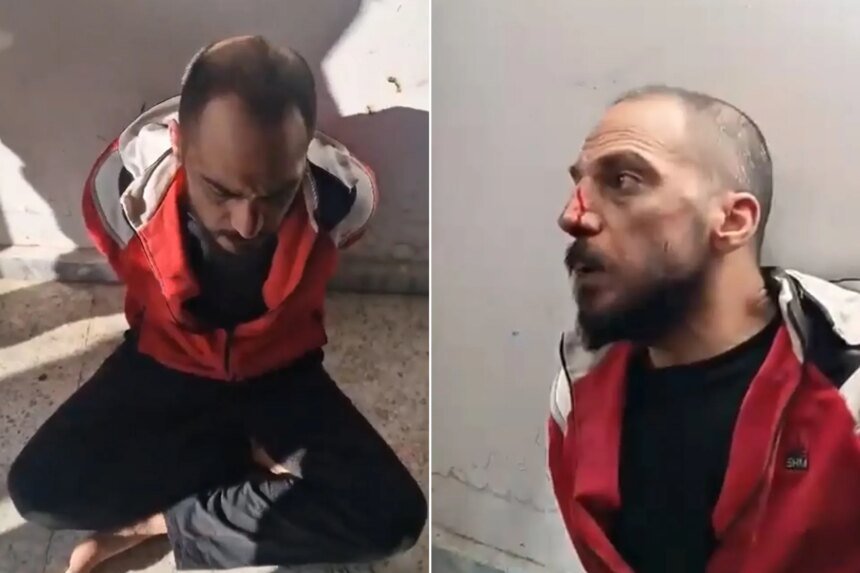
A video clip published by the Syrian Ministry of Interior showed the moment the “Butcher of Solidarity” was arrested. The Ministry revealed that the arrest operation came after months of careful security monitoring and follow-up, which intensified in its final stage about a month before the operation was carried out, when his location was roughly determined in the village of Nabaa al-Tayeb in the Hama countryside.
Syrian Interior Ministry spokesman Nour al-Din al-Baba confirmed – in an interview with Al Jazeera – that the arrest of the first accused of committing the Tadamon neighborhood massacre, Amjad Yousef, was based on field information, and did not result in any loss of life, revealing that his trial will be public.
According to the Syrian spokesman, Amjad Youssef has been hiding – since the fall of the ousted regime in late 2024 – relying on networks, some of which are local, and some of which have an external connection to the former regime. He was also constantly changing his place of residence and relying on those who were with him among the pillars of the ousted regime, in addition to a change in his personal features.
He pointed out that the investigation into Amjad Youssef is proceeding at a rapid pace, considering that it is a “very deep well” of information regarding the Tadamon neighborhood massacre, saying that his file will be referred – after completing the security investigations – to the Ministry of Justice and the General Authority for Transitional Justice so that the judiciary can take its course.
Face to face before the Minister of Interior
In this context, video clips showed Syrian Interior Minister Anas Khattab confronting the accused, Amjad Youssef, and telling him, “Don’t you have children? Do you have a heart?” Then Youssef replied: “Yes, I have a girl and a boy.”
The Syrian Minister of the Interior addressed the accused, Amjad Youssef, saying: “Don’t you have the heart to kill people in this way?!” In reference to the passage related to Joseph committing the massacre.
He added, “What you did was not the action of someone taking revenge, but rather someone who had no humanity.”
Extreme joy and painful memories
Following the announcement of the news of Amjad Youssef’s arrest, the people of many Syrian cities and villages came out in joy and rejoicing in what they described as the “new day of liberation,” demanding at the same time a fair trial and retribution from the “criminal” who slaughtered their children before their eyes.
But among the scenes of zooming in, distributing sweets, and launching fireworks, another sound emerged in the scene, as the families of the victims of the “Solidarity Massacre” had a new memory date.
Many of the victims’ families – in interviews with the “Syria Now” platform – recalled memories of the massacre, remembering their children and their families who were its victims.
Who is Amjad Youssef and what happened in the Tadamon massacre?
In 2013, a horrific massacre occurred on Nisreen Street in the Al-Tadamon neighborhood adjacent to the Yarmouk camp for Palestinian refugees in the capital, Damascus, and its details were not revealed until about 9 years later, when the British newspaper “The Guardian” – on April 27, 2022 – published a video clip, which it said was leaked by a recruit in a militia loyal to the Syrian regime.
The video showed members of the Syrian regime executing 41 civilians, including 7 women and a number of children.
The clip shows members wearing military uniform asking civilians to run in the street after making them believe that there was a sniper watching the place, asking them to hurry to escape his fire, while their hands were tied behind their backs and their eyes were blindfolded.
As soon as the victims started running, the officers opened fire on them with AK-47 rifles, except for an elderly man who was slaughtered with a sharp instrument.
The video also showed that detainees who were stopped at security checkpoints in the area were taken to a deep pit, approximately 10 feet deep, prepared in advance, where they were executed by firing squad, then their bodies were piled on top of each other, before car tires and wood were thrown on top of them, gasoline was poured over them, and they were burned within about 25 minutes.
According to the Guardian investigation, most of the victims were young and middle-aged, in addition to women, children and the elderly.
The video reached a member of the regime forces after he was asked to repair a laptop computer, only to find the clip inside a hidden folder on the device.
According to the same investigation, the officer leaked the video to the Syrian activist Ansar Shahoud, and to Professor Ugur Umit Angur, who works at the Holocaust and Genocide Center at the University of Amsterdam, where they worked on tracking the case for about 3 years until they were able to identify the person who appeared supervising the implementation of the executions. The investigation said that his name was Amjad Youssef.
After the fall of Bashar al-Assad’s regime at the end of 2024, Amjad Youssef became one of the most prominent defendants in the Tadamon massacre wanted for the crimes attributed to him.