Published On 4/24/2026
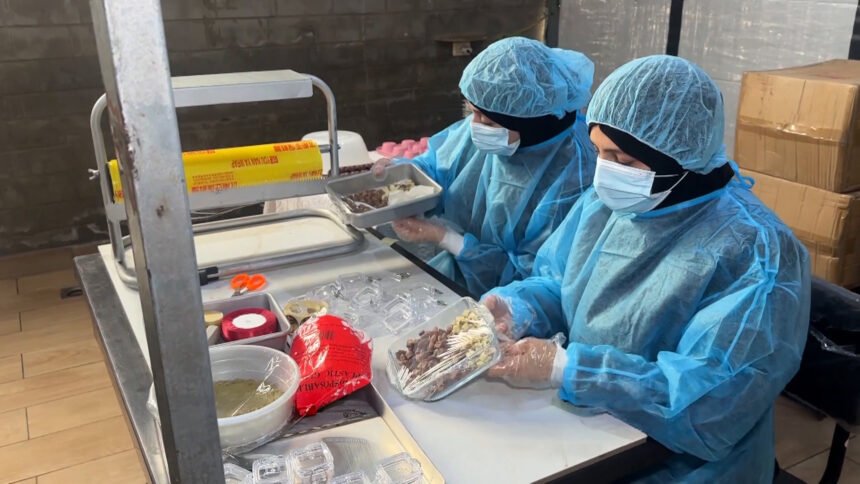
In a modest tent inside one of the displacement camps in Gaza City, women who have lost almost everything are trying to rearrange the rest of their lives and start over in a reality that lacks the most basic ingredients.
There, where the effects of war are mixed with questions of survival, individual attempts emerge to create hope out of nothing, despite the lack of tools and capital, and the absence of any guarantee of continuity.
Al Jazeera correspondent Nour Khaled describes this scene with heavy questions:
- How can we rebuild what no longer exists?
- How do you start new projects without capabilities?
- Will what is built today not be erased tomorrow?
Questions that reflect the situation of women who lost their jobs during the Israeli war on the Gaza Strip, but who insist on resuming their journey.
Among these stories, the story of Israa Abu Al-Qumsan stands out, who Al Jazeera met inside her tent, where she was trying to regain her project, which she lost twice.
Israa says that her journey with work began in 2012, before her employer was targeted in 2014, forcing her to work from home until she was able to build a new customer base. Later, she opened a store in 2020, but it was destroyed again in 2023 at the beginning of the war.
Despite the repeated losses, Israa did not give up her profession, but rather tried again, driven by the urgent need for a source of income. She explains that relying on aid is no longer a sufficient option, in light of its irregularity, stressing that her project was and remains her only source of livelihood, and that continuing with it is a necessity, not an option.
Starting from scratch
Israa’s story is not an exception, but is repeated in similar detail by many women in Gaza. Jihan, whose store was completely destroyed during the war, finds herself facing similar challenges today, as she tries to restart her project despite the difficulties.
Jihan says that her store, which was the family’s source of livelihood, was burned and destroyed, forcing her to start from scratch. She points out that the return was not easy, in light of the complications related to the closure of the crossings and the difficulty of entering raw materials, but she confirms that the insistence on restoring work still exists, and that she is gradually seeking to return to what she was.
From one tent to another, these stories are repeated, as the women of Gaza seek to restore what was destroyed, not only their projects, but also the details of their daily lives. Despite the harsh reality and the continuing repercussions of the war, they continue to search for ways to live and cling to what remains of hope in an environment still burdened by the effects of destruction.
In this scene, Jihan and Israa’s attempts seem only examples of broader stories of women who refuse to surrender, fight a daily battle for survival, and rebuild a life that has lost its features under the weight of war.