Published On 4/24/2026
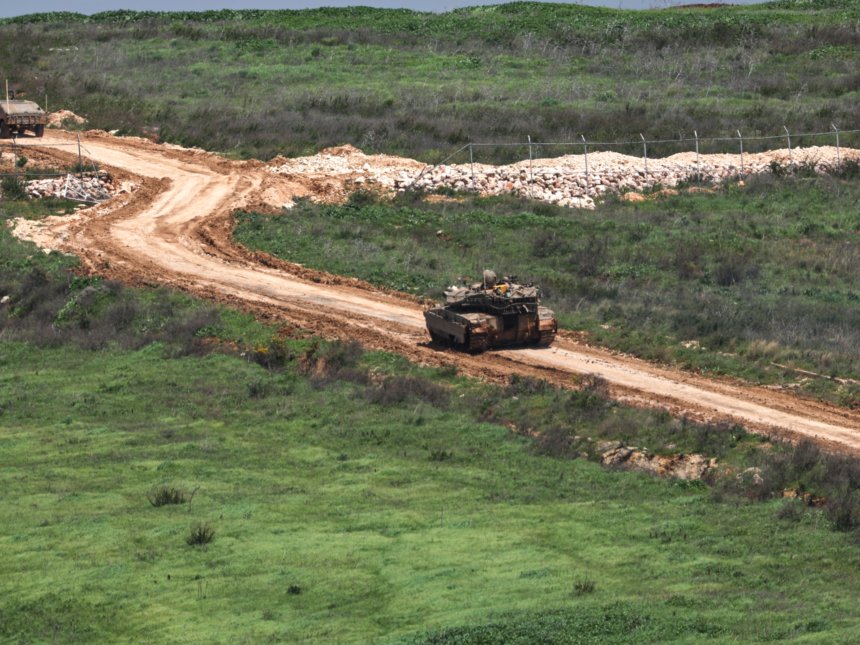
South Lebanon is witnessing a continuing military escalation by Israel, despite the truce taking effect, as air strikes overlap with bombing and bombing operations targeting civilian infrastructure in a number of border towns.
These developments come at a time when field changes on the ground are accelerating, indicating an operational path that goes beyond traditional strikes towards reshaping the geographical and demographic reality in the region.
In his presentation on Al Jazeera’s interactive screen, Suhaib Al-Assa explained that what is happening represents a new pattern established by the Israeli occupation, similar to what it did in the Gaza Strip, referring to what was published by the Yedioth Ahronoth newspaper about what it described as a new “yellow line” that Israel is drawing in southern Lebanon.
Al-Assa explained that this line extends from the northeastern border with Syria, passing through Hasbaya, Marjayoun, and Khiam, reaching the front edge at a depth of between 5 and 10 kilometers, with a similar extension on the western coast at the beaches of Bayada and Naqoura. He pointed out that this region is treated as a buffer zone that Israel seeks to stabilize on the ground.
He stressed that the military operations are particularly concentrated in the central sector, especially in Bint Jbeil and its surroundings, where the Israeli army is carrying out extensive bombing and bombing operations, which also affected the towns of Al-Tiri, Beit Lev and Aita Al-Shaab, in addition to areas in the eastern sector such as Al-Khiyam and Al-Taybeh.
Al-Assa pointed out that the current stage is witnessing a transition to the process of systematic destruction and blowing up of homes, reviewing comparative pictures of the city of Bint Jbeil between the years 2024, 2025 and 2026, which showed a significant escalation in the extent of destruction, especially in the center of the city.
He pointed out that the occupation is trying to create a new geographical reality, after imposing a demographic reality by preventing residents from returning to their villages. He explained that about 55 to 60 Lebanese villages have become prohibited areas for their residents, which reinforces efforts to form a population-free buffer zone.
He added that this trend includes various sectors of the south, from Taybeh, Marjayoun, and Khiam in the east, to Bint Jbeil, Aita al-Shaab, al-Tiri, and Beit Lev in the center, within the framework of what he described as a long-term change in the shape of the region and the course of the war.
Bint Jbeil…a strategic node
For his part, Colonel Nidal Abu Zeid, the military and strategic expert, provided an analytical reading of the scene, explaining that Bint Jbeil represents a “major strategic center in southern Lebanon,” describing it as a gateway to the second line of villages.
He explained that the importance of the city stems from its location linking several axes, including Shamaa and Qantara, all the way to Khiam, which makes it a focal point for control in the south. He added that Israel’s announcement of its deployment in about 20 points in southern Lebanon falls within what is known militarily as “holding the governing areas,” that is, controlling the high hills that provide an advantage in monitoring and managing fires.
He explained that controlling these hills allows Israeli forces to monitor the northern areas of the buffer zone, secure the colonies in the south, in addition to enhancing reconnaissance capabilities.
Regarding the continuation of the confrontations, Abu Zeid indicated that the occupation “paid a heavy bill in manpower and machinery,” explaining that this was due to the pattern of fighting it faced in the south.
He added that “mechanical and human erosion” resulted from a retrogressive defensive method adopted by Hezbollah, saying that this method “was based on exchanging geography for losses,” as some areas were abandoned in exchange for inflicting losses on the ranks of Israeli forces.
He also pointed out that some of the occupation’s losses after the ceasefire were due to what are known as “Booby Traps”, which are primitive traps planted in buildings and corridors, which lead to deaths and injuries among the ranks of the advancing forces.
Negotiating with fire and imposing a new security reality
In a reading of the relationship between the military and political track, Abu Zeid said that Israel “wants to negotiate with fire” by imposing a new security reality in southern Lebanon, which includes geographical change through destruction, and demographic change through the displacement of the population to the north of the Litani.
He explained that the so-called red and yellow lines fall within the concepts of “area of interest” and “area of influence” in military doctrine, which are areas where priority is given to fire and intelligence gathering.
Abu Zeid pointed out that the recent operations witnessed a great momentum of fire, in parallel with the push of elite units, including the 98th Parachute Division, two parachute brigades, and a commando brigade, in addition to 3 special forces battalions (Aguz, Duvdevan, and Maglan), while the armored divisions were withdrawn.
He explained that these forces are carrying out combing and searching operations, supported by intense artillery, in a remarkable shift in the nature of operations.
“Roim” artillery…a new weapon in the field
Abu Zeid revealed the use of the “Royem” artillery for the first time in southern Lebanon, which is a modern system developed by the Rafael Company.
He explained that this artillery is characterized by being mobile and operating with a smaller number of personnel compared to traditional artillery, with a caliber of 155 mm, which gives it high firepower and flexibility of movement, allowing it to fire and then change its position quickly to avoid targeting.
He added that these batteries are stationed in the area between Rmeish and Bayyada, but they do not remain stationary, but rather move according to the priorities of the targets and intelligence data.
Abu Zeid concluded his analysis by pointing out that deploying this artillery inside Lebanese territory achieves two main goals:
- Reducing dependence on the Air Force and providing it with other possibilities for operations, which may include distant theaters such as Iran.
- Providing greater fire momentum, as artillery fires exceed air power in some cases.