
Published On 4/22/2026
|
Last update: 14:49 (Mecca time)
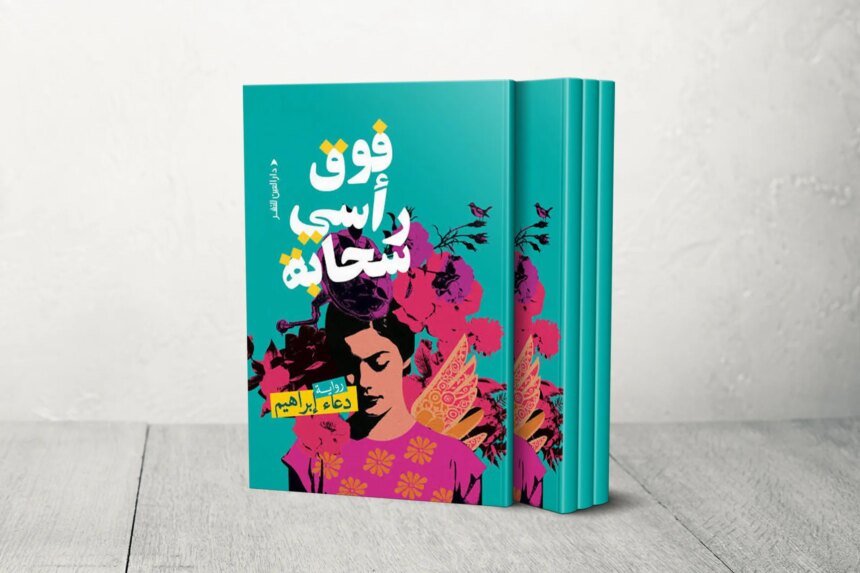
The novel (A Cloud Above My Head) by the Egyptian writer and doctor Doaa Ibrahim reached the short list for the International Prize for Arabic Fiction, competing with five other Arab novels, one of which is Egyptian, (The Origin of Species) by the writer Ahmed Abdel Latif.
The story of the novel, which takes place in two different places and times, revolves aroundEgypt Japan) revolves around the story of serial killer Noha, who works as a head nurse in a government hospital in Alexandria, where she exploits her job to kill her opponents by injecting them with a needle containing a liquid that kills them instantly.
Read also
list of 2 itemsend of list
This reminds us of the character (Omama) in the novel (IQ84) by the Japanese writer Haruki Murukami, the fitness trainer who kills her victims by pricking them with a needle that causes them to have a stroke. However, Omama is a hired killer, but Noha is not like that, but the path of her life and the aggression she was exposed to since her childhood led her to kill everyone who harmed her, except for the biggest culprit against her, which is her uncle, who raped her when she was twelve years old and became pregnant by him. She had an abortion, but on the contrary, she agreed to kill many people except him, and she cried for him when he died.
Stockholm syndrome
This reminds us of Stockholm Syndrome, in which the victim becomes attached to her executioner, and even though he is the cause of her psychological and physical calamity, she excludes him from the act of killing. Did she love him, I wonder? Through her conversations about him, this becomes clear.
“The existence around which my life revolves” is the one who was violating her body in her private room to the sound of the recitation of the Holy Qur’an, with a clear duality in his personality.
Not only that, but she considered herself guilty when she asked him, “Are you going to tell my grandmother about this?” He answers her, “If you hear the words and remain sane, you will not know anything.” Whoever follows Noha’s character can analyze why she did not consider her uncle guilty, but rather her mother and father who abandoned her when she was a child, so she became easy prey for this predatory monster, so she kills them later. Her father left her and her mother when she was a young child and immigrated to Japan permanently for the sake of his lover, and her mother spent her time in multiple suspicious marriages moving between The arms of many men, like a prostitute who neglected her daughter, who lived in her grandmother’s house and many other houses because her stepfathers did not want her.
I found her, her rapist uncle, living with her, and she was helpless. In front of her, he was treating his niece as his daughter, and in the room he assaulted her whenever he wanted. This uncle who died smiling on his bed as if he had done nothing, and Noha cried for him ironically and was sad for him. With his death, her fate changed. After she had wanted to study medicine, she gave up this desire and studied nursing and was appointed to a government hospital and became the kind nurse loved by everyone, especially the families of the patients. It occurs to someone that this smiling, kind white angel hides a dangerous criminal inside him, so she is promoted and becomes the head nurse in the hospital, beginning her new journey with murder.
The raven and Cain
But she does not consider herself guilty, for she is doing her duty. This is what her friend, the crow, tells her, who says to her, “There is no escape, my love,” who must die today. This is the same crow that used to tell the hero of Haruki Murokami’s novel (Kafka on the Shore) what he should do, as he guided and helped him, and it is the same crow that one day guided Cain to the burial place of his brother Abel, who killed him. Cain himself is Noha’s lover and committed his crime against his brother for her sake like this. Tell us later.
Death injection
Noha’s first victim is her mother. The crow tells her that she will die today, so she refuses to give her the pill that protects her from a stroke. When they take her to the hospital, she injects her with a clear liquid that leads to her death. As for her second victim, he is the hospital janitor who harasses her and touches her body whenever he encounters her. She resents him and decides to kill him, so she also injects him with a death injection, killing him. As for her third victim, he is the evil child (as she calls him), the hospital inmate who He mocks the nurses and cries on purpose so that his family will scold the nurses and scream at them, so she kills him as well. As for the fourth victim, he is one of the patients who tried to harass her repeatedly.
As for her fifth victim, he is outside the borders of the country, in Japan specifically, and he is her father, where she decides to leave Egypt and travel to him. He receives her and employs her in the restaurant he owns. She meets the restaurant manager (Tomoda-san), shares a residence with her, and they become close friends. They tell her one day that her father suffered a stroke in his foot and was taken to the hospital. The crow tells her that he will die today, but she does not have the liquid with which to inject her victims, so she injects him with an air needle, “50 milligrams of air is enough to kill a person,” but her father He smiles a loving smile at her as she injects him with the needle, causing her to cry.
“Tears flowed from my eyes when I thought that he had reconciled with me and forgiven me. I do not want anyone to forgive me.”
Then he dies and becomes her last victim and the last crime she commits. She then continues her life in Japan with Tomoda-san, who falls in love with her, but it is a one-sided love. Noha meets a sixty-year-old man and begins to love him, which arouses Tomoda’s jealousy. She decides to commit suicide because Noha rejects her, so she throws herself out the window and dies.
Irony and divine punishment
“She realized that the situation was bigger than her children’s travel and her longing for them. She realized that there was a cloud over her head.” This is the first time that this phrase appears on the lips of the heroine after whom the novel is named. She accuses Noha of killing her and goes to prison. Here lies the irony in the novel. The only crime she did not commit was that she went to prison for it, as if it were a divine punishment for the crimes she had committed previously.
Prison in Japan is the worst place a person can enter, despite the civilizational progress that the people of that country have achieved. Inside, the accused is subjected to various types of psychological and physical torture in order to confess to his crime, even if he is innocent.
But Noha no longer cares about this torture that she is being subjected to by the interrogator, so she enjoys pain and it makes her happy. She has turned into a masochistic personality, “Pain is comfortable and deadly, it gives you a rare numbness.” She continues talking to herself while under the feet of the interrogator who is torturing her, “Life is very harmful. I wish I were in your place, wearing your shoes, kicking criminals like me and cursing them, but unfortunately I was born with a cloud above my head, no bright, caring sun.” This will be the second time. That you pronounce this phrase.
The cloud in the title takes on the meaning of calamities and difficulties, as it obscures the sun from the eyes of this girl whose father’s absence, mother’s neglect, and uncle’s rape have turned her into a human monster who no longer cares about the pain of others or her own pain. She says in another clip while sitting in front of the investigator who holds a cigarette in his hand and holds it close to her to frighten her, “I am waiting for the moment when he extinguishes it inside me, a moment of pain capable of melting my nerves, as if the pain has a brute force in terrifying me, and then in making me smile, and I get high, waiting for the new threat.” Thus, we discover the side that Noha has reached psychologically.
She would later be sentenced to twenty years in prison, after which she would be found innocent, having been punished for all the crimes she committed thanks to a single crime she did not commit. Therefore, Doaa Ibrahim dedicated this novel in her opening to the Japanese boxer (Iwawa Hakamada), who was accused of murder, sentenced to death, and remained on death row for 48 years, only to be released and acquitted at the age of seventy-eight.
Multiple voices and solid language
Doaa Ibrahim presented her novel in a carefully crafted and woven language. It was eloquent and without affectation, according to a slow, escalating narrative that gradually matures until we reach successive climaxes to present us with a complex, complex, and psychologically deep character. The narrator said of her, “The heroine’s complex psychological state caused me some symptoms of anxiety, such as headaches, tension, and neck pain, especially while writing the physical assault and the dungeon scenes.” Despite that, she did not describe her as mad or schizophrenic, but rather left it to the reader to discover and notice that.
There were also multiple voices in the novel. In addition to Noha’s voice, there was the voice of the crow that told her who would die, which was her inner voice, which was embodied in the form of a crow that only she could see, and the voice of Cain, the first killer in history, whom she considered her lover. We were faced with a semi-polyphonic novel, as the writer used free association or stream of consciousness, as the American psychologist and philosopher William James calls it. The heroine narrates a situation that happened to her in Komomato, Japan, reminding her of situations that happened to her in Alexandria, recalling her memories in it, in which she later returns to The new place she describes indicates an internal fragmentation that afflicts the heroine, and the writer also used the flashback technique in many places.
The place is a hero
Doaa Ibrahim gave great importance to the place in which the events of her novel take place, especially in the part related to Japan, when the novel’s heroine, Noha, set off there. She gave a large space of narrative to describe that country, its places, the kindness of its people, their discipline, and their commitment to the laws. Everything changed for her, and she felt ashamed of the abundance of love that these people gave her. They always smiled in her face, so she noticed a big difference in the interaction between them and the people of her country of origin, Egypt.
She also did not forget to mention Earthquakes The many things that afflict Japan and the description of the swaying of buildings and people watching them emphasize the uniqueness of that country from this aspect. This topic was as if it was forced into force to impose a realism on the text that the novel does not need at all. It is primarily a psychological detective novel that shows the motives of her character that led her to the path of crime. She turned from a victim into an executioner who wanted to take revenge on everyone who harmed her. It was a novel about revenge and injustice in which the writer shed light on incest, the many harassments that women are exposed to in her society, and abortions. Its Danger to Women was a bold and profound novel that reserved for its author an important place in modern Arabic literature. It was a strong beginning for her and established her as a talented new name.
* Syrian writer and art critic