Tehran- In a popular café in the Iranit neighborhood, south of Tehran, its doors seemed almost closed. Its owner, Reza (45 years old), said, “Because of the war, you can consider the café closed… Only the mafia game hall is still open and has its customers.” Then he pointed with his hand to a back room from which the voices of the People’s and Mafia teams could be heard, searching for the deceiver and the innocent.
For his part, Arash (36 years old) told Al Jazeera Net that he and his friends frequent this hall to get away from war news for a while. He added, “In this game we are looking for deceitful traitors who work for the enemy. It is a parody of what is happening in reality. If it were not for betrayal, the enemy would not have been able to liquidate many political and military leaders in a short period.”
On the tenth day of the armistice between US andIranAl Jazeera Net traveled throughout the capital, from its popular south to its political center, all the way to its upscale north, to monitor aspects of life in its cafés, signs of public opinion, and the talk there about the war.
After 40 days of joint American and Israeli bombing of the city, Looks like the capital’s cafes Tehran As a mirror of the situation of the Iranian street, which is diverse in classes, divided in opinions, and uneven in its dealings with the war.

Discussion forum
Arash continues, “In the mafia game, we know that the traitor is just a representative role that ends with the end of the round. But in our real lives, accusations of treason do not stop, and the search for the real mafia that stands behind our country’s weakness in the face of attacks has become a daily obsession… Here, at least, we laugh and scream and accuse each other without accountability… Outside these walls, the war has closed many doors, but it has opened the Iranians’ appetite to search for new traitors every day.”
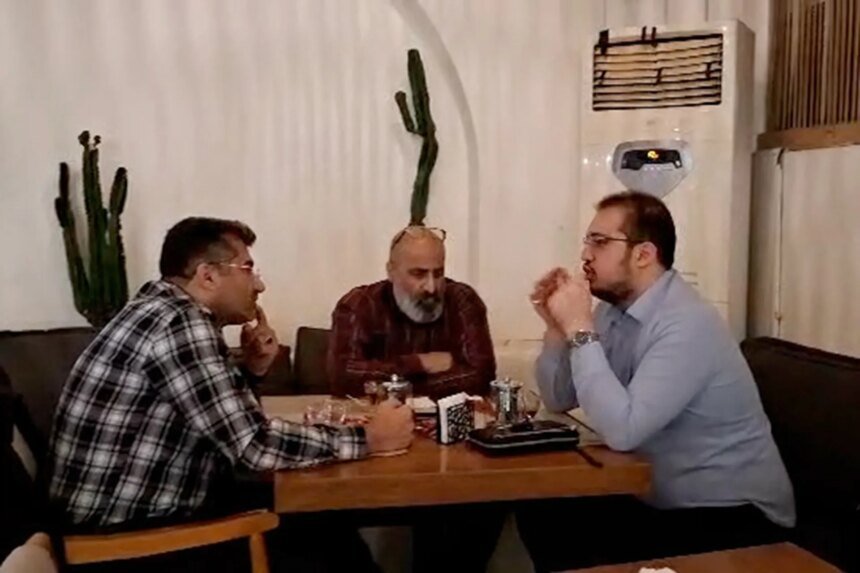
In Wink Square in the center of the city, specifically on “Barzel Gharbi” Street, a small café turns into a political forum and an arena for heated discussions. The young man, “Babak” (29 years old), the oldest worker in the café, told Al Jazeera Net, “For more than a month, the talk here has not stopped about the war… as an elite group of intellectuals, academics, and former politicians gather to discuss its developments.”
In one of the corners of the café, someone opened a picture of a girl without a veil, wearing light makeup and wearing a military uniform with a hat bearing the slogan on top of it. Revolutionary Guard On his phone, it becomes the focus of a heated discussion about profound transformations in the Iranian power structure.
The second said, “This is not just a passing image. It is a significant sign of the change in the balance of power during the era of the new Supreme Leader. What we see today is a clear rise of the Revolutionary Guard bloc at the expense of the clergy.”
The third shares his opinion by saying that the Guard is today redefining force from the perspective of national security and defending the country against external threats. It seeks to bring all Iranians together under the umbrella of national defense, explaining that “during the coming era, it will open the door to the possibility of achieving greater freedom in dress and a diversity of lifestyles for Iranian women, because its priority today is national cohesion and confronting the external enemy, and not imposing a unified way of life based on jurisprudential references alone.”

The concept of courage
In the opposite corner was the political activist and advisor to the former Iranian president Mahmoud Ahmadinejad,Abdul Redha Daori, He speaks to a number of academics about a different concept of courage, which is not related to the flames of battle but rather to the consequences of difficult decisions in peacetime, in an attempt to redefine the concept of “heroism” in the context of the raging war between his country and the American-Israeli duo.
Dauri said, “It is always easy to talk about courage on the battlefield because the image of a leader who enters danger with his soldiers creates an immortal hero of him…but there is another type of courage that is not seen or understood, and is often met with insults and accusations. It is courage in making peace. The courage of those who bear the description of cowards, surrenderers, and traitors, just to save their people from the fire of war.”
He cited two examples from history to illustrate this “bitter” contradiction:
- the first: he “Neville Chamberlainthe former British Prime Minister, who abdicated and signed the Munich Agreement with Adolf Hitler To avoid an outbreak World War IIPoliticians and the press at the time described him as the red hen that knelt before the Nazi dictator.
- the second: he “Imam Khomeini Founder of the Islamic Republic, after 8 years of war with Iraq, and while many of his leaders and supporters were demanding the continuation of the war until the overthrow of the regime Saddam HusseinHe drank the cup of poison, and accepted UN Resolution 598. On that day, accusations of surrendering to America and ignoring the blood of the martyrs were attached to him and his limbs. But he said calmly: Accepting the decision is in the country’s interest, and I drink it like a cup of poison.”
Dauri considered that “the courage of peace is the most lasting, even if it is the least celebrated at the time, because courage in making peace is superior to courage in waging war.” He hoped that his country’s negotiating delegation in Islamabad would take bold decisions that would be immortalized in history.

Nuclear program controversy
At the same table, the discussion turned into a debate about… Iranian nuclear program The reasons for Tehran not changing the religious fatwa prohibiting the manufacture of a nuclear bomb to enhance deterrence, Dr. Muhammad Hussein Shakouri attributes this to political issues.
He explained: “If Tehran announced now that it would change its fatwa, the countries opposing the American-Israeli war might turn against it, and might even join the hostile front. This is why we see that not raising the previous threats is political wisdom, not weakness. Opening this discussion now will isolate Iran internationally, and this is what it does not want in the midst of an existential battle.”
In Shukuri’s opinion, the opportunity to make the bomb was lost 20 years ago with the tightening of international control, making it almost impossible to move towards making it without being discovered. He added: “Some call for adopting a policy of nuclear ambiguity, but the reality is that this policy no longer creates deterrence, especially in a country that has been widely infiltrated by enemy spies.”
As for the current talks and Tehran’s insistence on keeping 400 kilograms of 60% enriched uranium as a negotiating card, he believes that this is “Iranian intelligence” despite the fact that its nuclear facilities have been bombed, because this amount is “the only remaining pressure card, and if it abandoned it, what would it negotiate to lift the sanctions?”, indicating that his country is using highly enriched uranium as a trump card to force the other party to make concessions.
The Iranian academic concludes that the clerical wing was “the real obstacle to making the bomb in his country, because if the military establishment had possessed nuclear weapons, it would have held the keys to it, which would have given it enormous power at the expense of the clergy.”
Youth opinions
In the upscale neighborhoods of northern Tehran, the streets seem crowded, and the cafes are crowded with customers, the majority of whom are young. On the famous Fareshteh Street, we met Baran (32 years old), a software engineer. She said: “We come here to forget the war for a little bit. But we cannot stop talking about it. We wonder: When will it end? What will our tomorrow be like? Will we be able to travel? Will we lose our jobs?”
She added with a sad smile to Al Jazeera Net: “The atmosphere here is better than in the south of the city, but the fear is the same. The difference is that we hide our fear behind our smiles and cups of cappuccino.”
As for her friend Arash (28 years old), a doctoral student, he said: “My friends in the south of the city are suffering more. Here, the financial situation is a little better, but the psychological suffering is the same. Politics is the talk of the hour everywhere, and Netanyahu, Trump, and Khamenei are at the center of citizens’ conversations.”
It is clear from our tour of Tehran, which is still experiencing an atmosphere of existential war, that a segment of citizens find in its cafés an outlet and a mirror for their divisions, hopes and fears, as their conversations range between despair and hope, and the concerns of the street are revealed on its tables as a complex mixture of patriotism, suffering and a deep desire for a decent life and a secure future.