

With US President Donald Trump announcing his intention to lift the CAATSA (Countering America’s Adversaries Through Sanctions Act) sanctions imposed on Turkey and considering the possibility of selling F-35 fighters, one of the most complex issues of dispute between Ankara and Washington returns to the forefront.
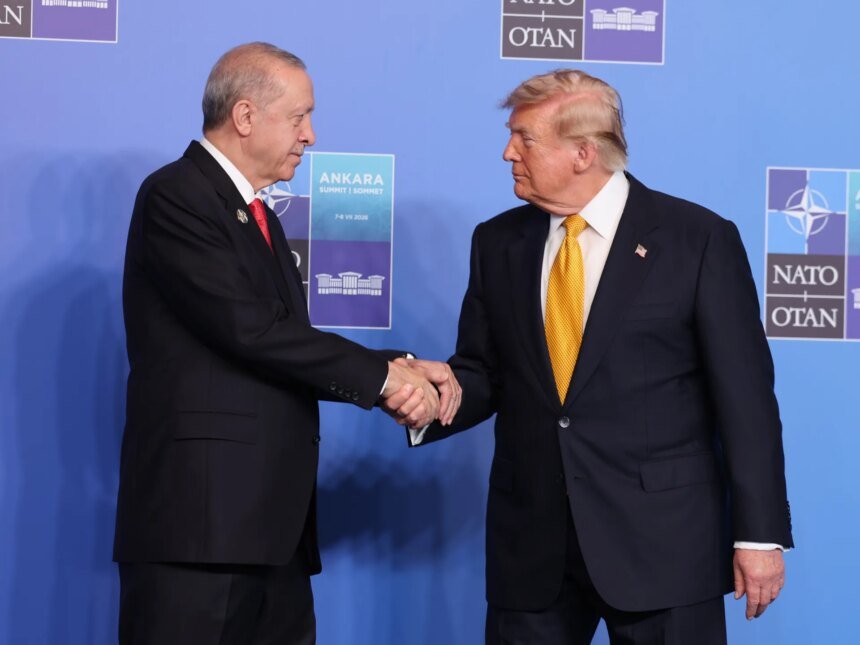
While the Turkish press talks about a political shift that may open a new page in bilateral relations, American voices warn that the path is still fraught with legal and political obstacles within Congress, after Trump’s statements he made during his visit to Ankara to participate in the North Atlantic Treaty Organization (NATO) summit.
Read also
list of 2 itemsend of list
These developments come after years of tension between the two countries against the backdrop of Turkey’s purchase of the Russian S-400 air defense system, which prompted Washington in 2020 to impose sanctions on it under the CAATSA law and exclude it from the F-35 fighter program.
Will Turkish-American relations enter a new phase after Trump’s promises? What are the legal restrictions governing the lifting of CAATSA sanctions and the reopening of the F-35 fighter file? To what extent can the US President overcome congressional opposition and turn his pledges into practical steps?
New stage
The Turkish press believes that Trump’s statements regarding the Katsa sanctions and F-35 fighter jets reflect a shift in Washington’s approach to the relationship with Ankara after years of tension.
In an article in the Turkish newspaper Milliyet, writer Deniz Kelisoglu believes that the most prominent aspect of Trump’s statements is his assertion at the highest level that “Washington does not want to impose sanctions on its friends,” considering that this is a strong political message that deserves to be stopped.
In a related context, writer Gokce Aytulu says in the Turkish newspaper Hurriyet that Trump’s announcement of his intention to lift the CAATSA sanctions represents an “important turning point” in relations between the two countries, and also constitutes a necessary step to reopen the F-35 fighter file.
The writer points out that the sanctions were imposed on Turkey because of its purchase of the Russian S-400 air defense system, and that their lifting was conditional on Ankara abandoning this system, adding that current indicators suggest that the two sides have reached an understanding regarding this file.
Aytolo points out that the CAATSA sanctions were also the reason for Turkey’s exclusion from the F-35 fighter program, explaining that the two files are legally separate but politically interconnected, and that lifting the sanctions may remove one of the most prominent obstacles to resuming the sale of aircraft.
The legal way
Despite the optimism reflected in the Turkish press, it indicates at the same time that lifting the Katsa sanctions goes through a complex legal and political path within the United States.
Kelisoglu explains that the US President has the authority to grant an exemption from the CAATSA sanctions, which is a constitutional mechanism that allows the application of some restrictions to be temporarily suspended if the American national interest requires it.
However, using this authority – as the article explains – requires the president to provide strong justifications to Congress, along with a detailed report proving the cessation of military cooperation between Turkey and Russia, but the duration of this exemption is usually limited to between 120 and 180 days.
According to the author, the biggest obstacle is the National Defense Authorization Law, which prohibits the sale of F-35 fighters to countries that possess the S-400 system, noting that exceeding this restriction requires either amending the law or sending the S-400 systems to another country or returning them.
Despite these obstacles, Kilislioğlu believes that “President Trump’s strong political will appears to be the main driver in pushing this path forward.”
In this context, Aytulu points out that the decisive point for Turkey is to complete this path before the American midterm elections, because the possibility of the Republican Party losing its majority in Congress is “not insignificant.”

Congressional opposition
A report by the American website The Hill highlights the political challenges facing Trump’s promises, noting that he is facing increasing pressure from members of the Republican Party who refuse to return Turkey to the F-35 fighter program as long as it retains the Russian S-400 air defense system.
The report indicates that the Trump administration has already given the green light to sell the F-110 engines that Turkey is seeking to obtain for use in its local fighter project, the Qaan, which is the first locally manufactured Turkish fighter. Its development project was launched in 2016 as part of Ankara’s efforts to enhance self-sufficiency in the defense industries.
The report also quoted US Vice President J.D. Vance as saying – last month – that the Pentagon is reviewing how to sell F-35 fighters to Turkey, adding that Secretary of Defense Pete Hegseth and his team are currently studying this file, because there are matters that must be verified in order to comply with American law.
On the other hand, members of Congress from both the Republican and Democratic parties are warning against proceeding with the sale of F-35 fighters to Turkey, as they sent a joint letter to the US President in which they expressed their “deep concern” about any attempt to complete this deal, according to The Hill website.
Democratic Representative Brad Sherman, a member of the Subcommittee on Middle East and North Africa Affairs of the House Foreign Affairs Committee, said – speaking to the website – that he does not believe that the president can bypass Congress in the issue of selling F-35 fighters.
Sherman confirms that the law is “very clear”, and that the sale of these fighters remains “illegal” as long as Turkey maintains the S-400 system, also expressing their concern about the sale of F-110 engines.
The Hill website quoted J. bad. Lentznich, former national security advisor to Republican Senator Thom Tillis, said that Turkey’s transfer of the S-400 system to a warehouse does not represent a solution, because the problem is not limited to launching missiles, but rather includes the system’s capabilities to track and collect technical data on advanced NATO aircraft.
But Lentznich warns of a greater risk that the United States will push Turkey towards its adversaries in its quest to obtain more military components, saying that the sanctions imposed because of the F-35 program are still in place and that Turkey is still dissatisfied with them.
The former advisor concludes his speech by saying, “As Türkiye continues to develop its own fighter, the question arises: Do we want to sell engines to it, or do we want it to turn to China or Russia?”