

The Israeli occupation returned the people of the Gaza Strip to the letter of their ancestors and primitive uses that people thought remained in the memory of old homes, after closing the crossings and preventing the entry of the most basic necessities of life.
In a small workshop in the town of Al-Zawaida in the middle of the Gaza Strip, the sound of the pottery machine is the first thing that greets the interior, and the smell of clay fills the place, while jugs, plates, jars, cooking pots, and a bathroom chair are lined up, along with clay bricks that gradually rise to create a small room in which a displaced family can regain some protection and dignity.
After losing his home and the pottery factory that his family inherited about a century ago in the Daraj neighborhood in Gaza City, Jaafar Atallah revived his ancestors’ profession in his new place of displacement in the middle of the Gaza Strip. He transformed clay from water and food containers into sanitary and housing alternatives imposed by people’s needs, and today he is working on building an entire house of straw and clay.
Clay…a century-old profession
Jaafar Atallah was displaced from the Daraj neighborhood in Gaza City to the center of the Strip, after the Israeli occupation invaded his residential area and factory.
Jaafar says, “We lost the factory, the house, the machines, the molds, the ovens, and the inventory, and we started from scratch in the place of displacement.” There, in the old factory, he learned as a child how to tame clay with his hands, and with the collapse of the house and the factory, the man lost his workplace and his professional family memory in one moment.
He added, saddened by the loss, “I learned to make pottery when I was seven years old, and it is a profession that we inherited from our ancestors about 100 years ago.”

Jaafar moves between piles of clay and wooden blocks with his hands covered in clay up to his wrists. He lifts a piece and adjusts its edge, then sets it aside among dozens of pieces waiting to dry in the sun. In his movement, the experience of a career that he started as a child, then returned to from scratch after losing his factory and home, appears.
Jaafar started working from people’s need for a cup of water, a jug, a plate, and a cooking pot, then daily questions led him to more sensitive needs: How does the family maintain its privacy? How does she protect her children from cold, dust and rodents?
“Today, people ask for what they need in life, from a cup of water to a bathroom chair, and then we came to the idea of the mud room,” Jaafar says, patting his hands on a lump of clay in front of him.
The difficult reality of living
Three years passed on sandy streets crowded with tents, shawls and worn-out fabrics wrapped around people, and long nights of sleeplessness, fear, and rodents.
In the midst of this reality, the solid wall has become a daily requirement, and the small room has become a practical dream made by hands from clay, one brick upon another, so that a person can find a place to lean his back after a day open to dust and crowding.
In the market, obtaining some health supplies has become dependent on price and ability to access them. Jaafar says that a bathroom chair, which was sold before the war for about 600 shekels (about 200 dollars), today has reached more than 1,400 shekels (about 466 dollars), if available, which is an amount that exceeds the capacity of many families who live on aid or what remains of their savings. Therefore, clay, with the local industry it provides, has become an urgent way to provide alternatives that suit people’s needs.

From the pottery machine on which Jaafar Atallah made living utensils, to the bricks from which a small room rose, Al Jazeera Net followed over the course of a week the stages of this experiment, from sifting and preparing the clay, to shaping and drying the molds, until a clay room was completed that preserved a measure of the dignity of the Palestinian in Gaza.
Mudroom of 16 square metres
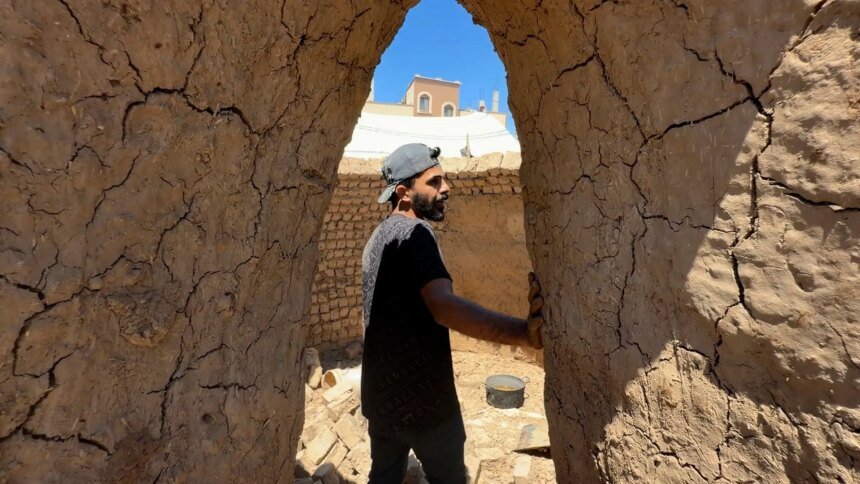
Jaafar explains the method of work as he points to the ground on which a room will be built, measuring 4 meters in length and 4 meters in width. He installs a piece of iron in the center of the space, and extends a rope from it, which he uses to draw the circle of the room and define its first borders.
After determining the area, the work stages begin by obtaining clay soil and submerging it with water until it is saturated and softened, then it is taken out and kneaded with straw material, which gives it hardness and cohesion and helps it resist cracking.
The clay is then passed through wooden molds to take the shape of the brick stone, then it is spread out in an open place and covered to protect it from dust and weather fluctuations, and left in the sun for 4 or 5 days until it dries and solidifies.
With the bricks ready, Jaafar digs an outer perimeter two bricks wide, then fills it with pure clay to protect the building’s foundation from winter water. Then he begins arranging the bricks, layer upon layer, according to the initial plan of the calculated area.
During construction, Jaafar uses whatever alternatives he has at his disposal, and to form the arch of the window, he places an old car tire inside the hole in the wall, then carefully stacks clay and bricks around it until the hole takes its fixed shape.
Over the course of 7 days of work and covering, it remains to build the roof of the room, and according to Jaafar, building the room requires ten days of continuous work, between soaking the clay, kneading it, drying it, and compacting it.
Most of the mud room’s walls rise gradually, and as the bricks rise in a circular manner, the opening at the top narrows little by little until the roof is nearly complete.
Inside, the room seems quieter than a tent and more stable in the face of air and dust. Jaafar says that the mud gives it coolness in the summer and warmth in the winter, while giving its occupant an enclosed space, a wall against which to lean his back, and a minimum of privacy.
He continues about the idea of the room, “If clay can make a jug and a pot, it can also make a room that protects people and gives them a place to lean on.”

Two hours of electricity
Jaafar Atallah starts his work early. He enters the workshop with his hands ready to clay before the heat of the day gets too hot. The regularity of his day remains linked to the electricity that only reaches the workshop for about two hours throughout the day. During these two hours, the machine moves quickly, and Jaafar races against time to complete the largest amount of pieces. Then the place calms down when the power is cut off, and basic stages of production stop with it.
Jaafar says, “I start my work at six in the morning. I am ready for the clay and the orders, and then I keep waiting for the electricity. The machine waits for the electricity more than my hand waits.”
Between an active start to the day at dawn and limited hours of electricity, orders pile up. Jaafar says, “Every time the electricity stops, the workshop’s ability to meet people’s needs stops, and the craft suffers a financial loss, especially since some requests are related to necessary supplies inside tents and displacement centers.”
The cost of work increases from its primary source: clay. According to Jaafar, a truck carrying about 12,000 kilograms was purchased before the war for about 500 shekels (about 166 dollars), while its price today exceeds 1,000 dollars, after the Israeli occupation prevented the entry of fuel and car oils necessary for the movement of trucks. Thus, transporting the clay to the workshop became an expensive journey, before Jaafar began soaking, kneading, and shaping it into the moulds.
This increase was reflected in every piece of pottery that came out of Jaafar’s hands. Today’s jug, plate, bowl, and toilet seat carry the cost of high mud, arduous transportation, scarce electricity, and hard-to-reach materials.
According to his estimate, the prices of pottery products have increased by more than 50% compared to before the war, while people are accepting them as daily alternatives to the basics of life they have lost.

Cost of steel wall
The height of the room is about two and a half metres. It is a small space according to the calculations of ordinary homes, but spacious according to the calculations of a tent and a displacement. The family members inside it can stand and move and place some basic needs, and in its walls they find what they have been missing for a long time, which are clear boundaries of the place, a fixed ceiling, and a solid wall that reduces the harshness of living among curtains and fabrics.
The cost of one room is about $3,000, which is a heavy sum for families exhausted by war and high prices. With the heavy amount, people began to accept her request, because the need for a closed room took precedence over many needs.
Jaafar says that in recent days he has received increasing inquiries from displaced people about the possibility of building similar rooms near their tents, especially after the completion of the first model, and with the expansion of interest in the idea, he began to aspire to a bigger step, which is to build a complete mud house that includes two rooms, a kitchen, and a bathroom, with the inside of it completing what the house needs in terms of supplies made of clay, from water and food tools to sanitary equipment, in an attempt to transform the ancient craft into a complete living system that suits the reality of people in displacement.
A family that has lived for years inside a tent knows the value of the wall, and understands the meaning of having a place that preserves its privacy, protects its children from dust, cold, and rodents, and gives them a measure of safe housing.
Jaafar says that the demand for mud rooms has begun to increase with the expansion of the suffering of the displaced and the scarcity of building materials and their high prices. He believes that the idea has gone beyond the limits of individual experience to a general need imposed by the circumstances of war. The clay that started out as a cup of water, a jug, a plate, and a bathroom chair, has today become a room with an area of 16 square metres, through which people are trying to restore part of the meaning of the house.
Jaafar concludes, saying, “The mud room has become a need for people. They are looking for a closed place after years of tents, and for a wall that preserves the family and its dignity.”