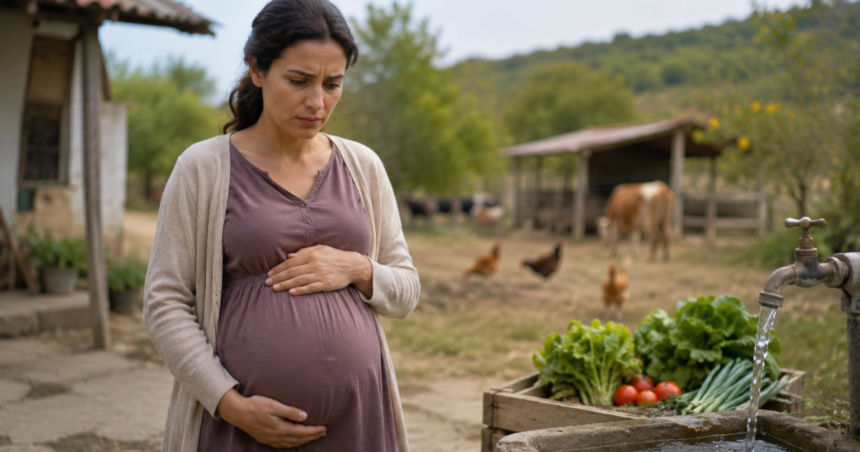
Reem did not expect that the nurse’s question after coming out of a sudden miscarriage would be: “Are there cats around you?” The question seemed strange to her, as she does not raise or deal with cats. But Reem, who lives in a rural area, lives on a small farm that includes poultry and livestock, and her family, like many others, suffers from frequent water outages and poor hygiene and sanitation services.
Later, the question began to take on a different meaning. The Toxoplasma parasite, also known as toxoplasmosis, does not always need a cat inside the house to reach humans. It may be enough to have contaminated water, vegetables that were not washed well, meat that was not cooked enough, or soil that carried the parasite’s eggs and then found their way onto food or hands.
This hidden nature of the disease, its widespread spread, and its danger to pregnant women and patients with weakened immunity and vision, prompted a group of experts to demand that toxoplasmosis be included in the World Health Organization’s list of neglected tropical diseases, so that it receives funding, research, and health interventions that are commensurate with its true burden. This call was published in a study in the journal PLOS Neglected Tropical Diseases on June 25, 2026.
A common but forgotten parasite
Toxoplasmosis is a parasitic disease caused by a microorganism called Toxoplasma gondii. In most cases, the infected person does not feel anything, or the disease experiences mild flu-like symptoms, and then the parasite enters a dormant state inside the body’s tissues.
But its seriousness is not measured by passing symptoms alone. The infection may become devastating if it infects a woman for the first time during pregnancy, or if the parasite becomes active in a person with severely weakened immunity, or if it infects the eye and causes inflammation and scars in the retina that may lead to deterioration of vision.
The study indicates that toxoplasmosis is one of the most common parasitic diseases among humans, and that it represents one of the important causes of intraocular eye infections globally, yet it still has a limited presence on public health agendas and research funding.

Why do you always mention cats?
Toxoplasmosis gained its fame from its association with cats, to the point that many people began to reduce the disease to cat owners only. But the picture is more complex.
Cats, along with the feline family such as lions and tigers, are the ultimate host of the parasite. That is, organisms in whose intestines the parasite can reproduce sexually. The parasite’s eggs are then excreted in the feces, contaminating the soil, water, or crops.
As for humans, sheep, cows, goats, poultry, rodents, and other mammals and birds, they are intermediate hosts. She may carry the parasite in her tissues without showing clear symptoms, and from here it is transmitted to humans through other paths that are not directly related to the presence of a cat inside the house.
Dr. Magdy Abbas Ali, a consultant for fevers and endemic diseases, explains that “a person may become infected without ever seeing a cat in his life,” noting that transmission of the parasite often occurs through eating undercooked meat that contains parasite vesicles, or eating vegetables and fruits that grew in contaminated soil and were not washed carefully, or drinking untreated water that carries the parasite’s eggs.
According to the study, the parasite is transmitted to humans mainly through raw or undercooked meat containing tissue cysts, or through water and fresh products contaminated with eggs shed by the final feline host.
When the disease is silent inside the body
The irony of toxoplasmosis is that it may be calm most of the time, and violent when it finds the right opportunity. After the initial infection, the immune system often succeeds in controlling it, but does not completely expel it from the body. The parasite remains embedded in the muscles, brain, or other tissues, in a state of latency that may last a lifetime.
Dr. Magdy explains to Al Jazeera Net that most cases “pass without symptoms, or appear in the form of mild flu-like symptoms, and then the parasite enters a dormant phase, where it infects the muscles and brain without causing obvious harm.”
But this silence is conditional on the safety of immunity. If a person is exposed to severe immune weakness, as happens in some cancer patients during chemotherapy, AIDS patients, or those who have undergone organ transplants and are taking immunosuppressive medications, the parasite may become active again and attack the central nervous system, causing encephalitis.
Dr. Magdy stresses that mild or non-severe immune weakness, such as anemia or some common health problems, does not necessarily mean reactivation of the parasite.

Pregnant women…the danger of the first infection
Pregnant women remain one of the most sensitive groups to toxoplasmosis, but the risk is not related to any old infection, as many believe. The biggest fear is when a woman becomes infected for the first time during pregnancy, as the parasite can cross the placenta and reach the fetus.
In this case, the disease may lead to miscarriage, fetal death, or the birth of a child suffering from neurological damage or visual problems that may appear early or develop later in childhood and adolescence. The study indicates that transmission of the parasite through the placenta from a recently infected mother may lead to miscarriage or long-term neurological and visual impairment.
Therefore, the common association between toxoplasmosis and “recurrent miscarriage” needs medical adjustment. The presence of antibodies due to an old infection does not usually mean that the current pregnancy is at risk, and does not justify treatment alone. The real concern is primary infection during pregnancy, which is why early screening and antenatal care are especially important in high-risk areas.
Does every infected person need treatment?
Most people with toxoplasmosis do not need drug treatment, because the immune system controls the infection in most cases. But treatment becomes necessary in specific cases, especially when the eye is infected, or congenital infection in children, or patients with severely weakened immunity, or during pregnancy, depending on the timing of the infection and the doctor’s discretion.
In cases of retinitis, the parasite may lead to scarring, severe visual impairment, or even blindness, which makes rapid therapeutic intervention important to reduce the damage. Immunodeficiency patients also need treatment and careful follow-up, because the parasite may reactivate even after the acute attack is controlled.
To date, there is no licensed vaccine for humans against toxoplasmosis, which experts consider a manifestation of research neglect of the disease. The study indicates that recognizing it as a neglected tropical disease may open the door to greater funding for prevention, diagnosis, treatment, and health capacity building.
Poor people get sick
Toxoplasmosis does not stop at the borders of medicine, but extends to social justice. Poor communities bear the brunt, because they are often less able to ensure safe water, good sanitation, regular pregnancy care, early screening, and food safe from contamination.
The study shows that a higher risk of infection is associated with environments with limited access to safe water, poor sanitation, uneven food safety, and poor health care services, especially in Latin America, the Middle East, Africa, and other low-resource regions. Warm temperatures, humidity and rain also contribute to the survival of parasite eggs for a longer period in the environment and the contamination of soil, water and fresh produce.
Here the disease turns into an episode of poverty. A mother who does not receive an early examination may give birth to a child who suffers from a permanent visual or neurological disability. The family bears the cost of long treatment, frequent visits to hospitals, and loss of income and educational and practical opportunities. The study describes this as a trap similar to that caused by other neglected tropical diseases, where disability swallows up family resources and reproduces their social and economic fragility.
The financing comparison reveals the extent of marginalization. According to the study, between 2018 and 2024, toxoplasmosis research received the equivalent of $177 per disability-adjusted life year, compared to $283 for trachoma and $337 for Chagas disease, which are recognized neglected tropical diseases.

Why do experts want to include it among neglected diseases?
The World Health Organization defines neglected tropical diseases as a group of diseases caused by a variety of organisms, including parasites, bacteria, viruses, fungi and toxins, and are associated with severe health, social and economic consequences. They are often spread among poor communities in tropical regions, although some of them extend geographically on a broader scale.
According to the organization, these diseases affect more than a billion people, and are linked to the environment, animal reservoirs, and complex life cycles, which makes controlling them a public health challenge.
Experts believe that toxoplasmosis meets these criteria: it occurs in poor environments, causes long-term consequences, is preventable, is underfunded and under-attended, and requires a response beyond that of the physician alone.
Toxoplasmosis cannot be controlled from the obstetrics and gynecology clinic alone, nor from the eye clinic alone. The problem begins with the intersection of humans, animals, food, water, and the environment. This is why the study calls for adopting a “One Health” approach, which links human and veterinary medicine, agriculture, the environment, and food safety.
In practice, this means improving pregnancy screening and prenatal care, ensuring safe drinking water, tightening food safety, washing vegetables and fruits well, cooking meat adequately, enhancing biosecurity on farms, safely managing animal waste and slaughterhouses, and regulated dealing with feral cats without intimidation or demonization of domestic cats.
Reem has overcome the pain of losing a fetus, but she still hopes that other women will know what she did not know: that the danger does not always start from a cat in the house, but rather it may come from polluted water, poor soil, meat that is not cooked enough, or a health system that does not see disease until after the loss occurs.
Toxoplasmosis is not a loud disease, but it leaves profound effects when it affects the most vulnerable: an unborn fetus, an eye that loses its ability to see, or a poor family that enters a long cycle of care. Hence, the demand to remove it from neglect seems to be more than a scientific demand. It is a call for justice for those who pay the price of the disease in silence.