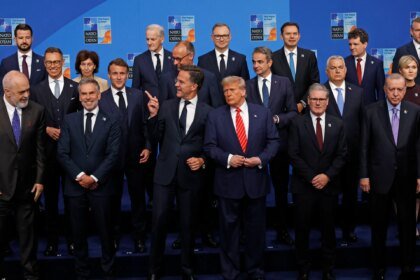


When analysts agree that the main threats it mobilizes for are different among its members, and the disagreement extends to who will pay the bill for arming its forces, they warn of the danger of the current scene raging in the Strait of Hormuz, and concern increases when strategies within the alliance differ regarding the way to deal with the issue of securing navigation in Hormuz and dealing with Iranian responses.
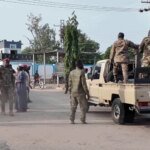
andAnalysts said – in various statements to Al Jazeera Net – This discrepancy exploded at the most dangerous possible time. While the NATO summit in Ankara was trying to show the alliance’s unity, the US military announced yesterday, Wednesday, that it had launched strikes on more than 80 Iranian targets in response to attacks that targeted 3 ships in the Strait of Hormuz. On the other hand, the Iranian Revolutionary Guard announced the targeting of dozens of American military facilities in Bahrain and Kuwait in response to those strikes.
Also on the sidelines of the summit, US President Donald Trump on Wednesday did not rule out launching a new strike against Iran tonight, saying that “our attack on Iran may be major,” and added another threat that he may seize the Iranian island of Khark, destroy electricity and water stations, and reimpose the naval blockade.
In the midst of this escalation, two issues emerged that are no less sensitive than the war itself:
- Who will bear the NATO arms bill in light of Trump’s continued pressure to raise defense spending to 5% of GDP?
- Who will send its ships to the fiery waters of Hormuz after every American-Iranian escalation and the cessation of 20% of the world’s oil?
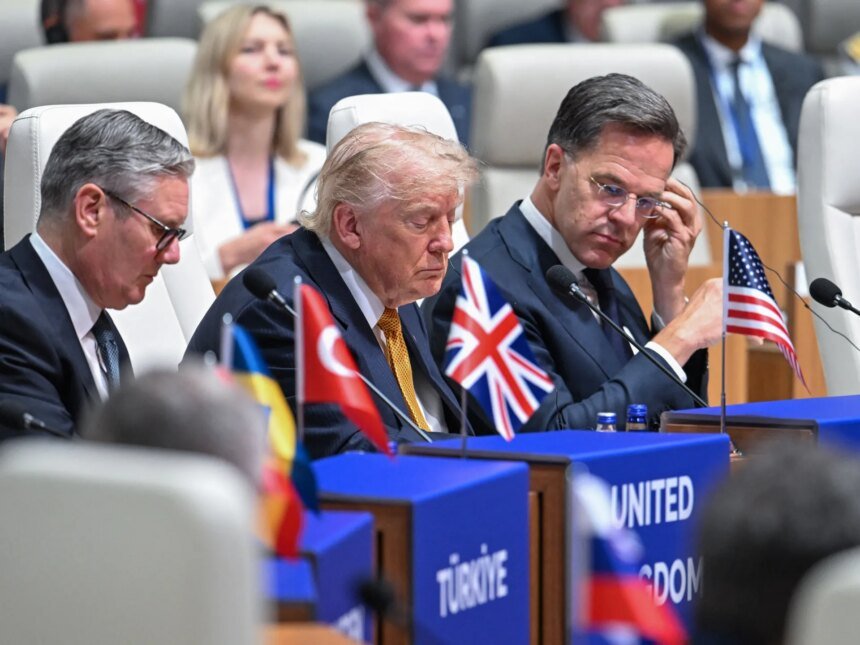
NATO Secretary-General Mark Rutte resolved part of the controversy when he announced – during the exchange of strikes on both sides of the Gulf – his support for the American response, stressing the readiness of NATO countries to send minesweeping ships to the strait.
But this announcement did not hide the fact that today NATO was facing a test for which it was not prepared: How does he balance a war he didn’t want to fight with an American ally who would accept nothing less than full engagement in the conflict?

Who is NATO mobilizing financially and militarily?
It brings together 4 different analytical voices: former Pentagon official David De Roche, professor of political science and international relations at the University of Birmingham, Scott Lucas, expert in strategic affairs and maritime security, Major General Muhammad Abdel Wahed, and a researcher specializing in Iranian and Gulf affairs, Reda Ghobishawi. However, today NATO is mobilizing to confront multiple threats whose priority order does not enjoy consensus among its members.
Des Roches arranges the debate priorities from his perspective, whereby Russia becomes “primarily” what the alliance is mobilizing for, and everything else is “secondary” to it.
As for Abdul Wahed, he goes for a different dismantling, as at the top of Trump’s list of priorities is China and the Pacific Ocean, followed by defending American territory, then sharing burdens “because he does not want to bear the cost of wars alone,” while Russia is classified for him as a “manageable and containable threat” and nothing more.
On the other hand, Europe sees – according to Abdel Wahed – that the Ukrainian war is its first existential priority, and that supporting the eastern wing facing Russia is a security issue that cannot be postponed.
Lucas goes on to abstract the names and positions, as the real dispute is not between Europe and America, but rather between Europe and the “Trump camp,” which is no longer an ally in the true sense, because “it does not believe in alliance with any party.”
Therefore, the professor of political science and international relations advises the Europeans to build their independent defense capabilities, while keeping the lines of communication open with the American army and American intelligence, instead of betting entirely on an “unreliable” administration, according to him.
The final statement of the Ankara summit today tried not to show this discrepancy, stressing the continued development of the alliance’s military capabilities and air and missile defense systems, and renewing support for Ukraine with military aid worth 70 billion euros during the year 2026.
However, this formal consensus does not hide – according to Abdel Wahed – that the discrepancy “does not reach the point of complete division” because the two parties “deal with it through mutual accommodation,” not through an actual settlement of priorities.
Funding crisis… Who pays NATO’s bills?
NATO data reveals the size of the gap between members shouldering military spending bills. Only 5 members are expected to achieve the goal of spending 3.5% of their GDP in 2026, while other countries’ spending will remain at about 2%. Indeed, it is expected that the budgets of 3 countries will fall below this threshold.
Before the summit, Rutte uploaded a graph he called “Trump Trillion,” showing that additional European spending since 2017 was approaching that number. But Trump wanted more than numbers on paper, and demanded that the allies raise their defense spending to 5% of their gross domestic product, considering that this alone would be enough to reduce Europe’s dependence on American forces.
De Roches describes this goal as “difficult to achieve,” not only because of a lack of political will, but also because Europe “has suffered from a lack of defense investment for many generations,” while its societies have extensive social welfare systems that are difficult to touch politically without a heavy electoral cost.
Abdul Wahid agrees with this opinion when he describes NATO’s position on Trump as “pragmatic and accommodating.” The alliance seeks to preserve American interests without completely slipping behind Trump’s desires, while Rutte continues to play the role of a “bridge” who publicly praises Trump while quietly pushing members to increase their spending.
Lucas believes that members will deal with this issue through a double game: Rutte and Turkish President Recep Tayyip Erdogan publicly praise Trump, while other countries present themselves as “responsible” by threatening to increase their funding, without fully complying with a ceiling that many consider politically and economically unattainable in the near term.

Hormuz…a continuing and rolling crisis
There is no disagreement among the four analysts about the status of the Strait of Hormuz, but the whole disagreement lies in how to deal with it, as there are 20 million barrels of oil crossing the Strait every day, which explains why 135 countries signed a UN resolution calling for the reopening of the Strait and condemning Iranian actions in it, but the consensus on its importance turns into a stark contradiction when it comes to action on the ground.
The former official in the US Department of Defense diagnoses this contradiction by saying that Europe is “existentially dependent” on Hormuz for energy and trade, but it “does not consider it an issue that it has the ability to solve on its own,” because the war essentially broke out without consulting it, and it does not want to become a party to an anti-Iran coalition.
As for Reda Ghubishawi, he believes that the scene is actually moving on the ground, as France and Britain are working “quietly and without media noise” to form a military coalition to keep the strait open, which practically means “entering into a military confrontation with Iran,” which considers the management of the strait a purely sovereign matter and rejects any external interference in it.
This is exactly what was evident yesterday when Belgian Foreign Minister Maxime Prévot announced to Al Jazeera that his country was preparing to deploy minesweepers in Hormuz as part of a mission led by Britain and France, coinciding with the US Army’s announcement of launching strikes on more than 80 Iranian targets in response to the targeting of 3 ships in the Strait, and the Iranian Revolutionary Guard’s announcement of its response by targeting US military installations in Bahrain and Kuwait.
The researcher on Iranian and Gulf affairs also warns that the European contradiction between refusing to engage in war and insisting on keeping the strait open “creates a state of instability that may lead to an unintended slide toward confrontation.”
The political science professor agrees with this warning, but sets a crucial condition: forces cannot be sent to the strait “before a permanent ceasefire is reached that does not carry the risk of renewed hostilities,” which is exactly what was not achieved after yesterday’s strikes.
As for the expert in strategic affairs and maritime security, it is likely that the ceiling of the European contribution at this stage will be logistical and intelligence support, and not direct military involvement, as “most European countries see that this is not their war and prefer diplomatic solutions.”
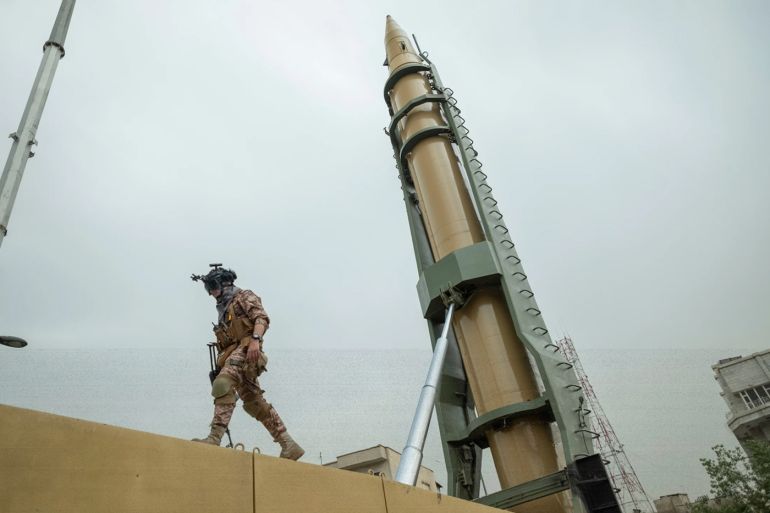
Hormuz and the Iranian warning
At a time when the Europeans are moving cautiously towards Hormuz, Tehran has vowed to respond to any involvement, and Ali Akbar Velayati, advisor to the Iranian leader, said yesterday, Tuesday, that “American moves will push the region towards the fire,” stressing that “the axis of resistance will not remain silent in the face of adventures with its hand on the trigger.”
Ghubishawi takes this threat seriously, warning that Iran may target European naval vessels directly, or expand its operations against European forces in the region through allied parties, and may even target major European economic interests in the Gulf – from energy to aviation and technology – as “legitimate targets” if Tehran feels that Europe threatens its security.
The Iranian analyst links this potential expansion in the scope of the confrontation to a deeper scenario: that Trump will gradually seek to reduce direct American involvement in the Hormuz crisis in exchange for expanding the European role, in line with his statements that Washington “does not need” the Strait as much as Europe needs it.
Major General Abdul Wahed does not stray far from this assessment when he describes yesterday’s strikes as “expected and will continue” to exhaust Iran’s military capabilities, but he points out that their timing during the summit itself “made the Hormuz file a very sensitive issue,” as if Trump wanted to remind the Europeans of his true agenda at the moment they were trying to show the unity of the alliance.
The question that follows from this is: Did Trump succeed in dragging NATO into a confrontation that he did not want?
Here, Gbeshawi answers cautiously: “To a large extent, yes,” based on Rutte’s public support for American strikes and NATO’s willingness to send minesweepers.
But Abdul Wahed reads the matter differently, as he sees it as a tactical success, not a strategic one, because NATO “refused from the beginning to get involved in military operations against Iran,” and any future participation will remain restricted to logistical and intelligence support far from the direct battlefield.
Between these two estimates, the only certainty remains that NATO is entering an unprecedented testing phase: threats with varying priorities, funding that has not yet been decided, and a strait that turns every day into a more burning arena.
While Trump threatens a “major” strike tonight, and Tehran warns that any support for Washington is a “legitimate goal,” the alliance stands on the brink of an engagement where no one knows how it will begin or how it will end.