


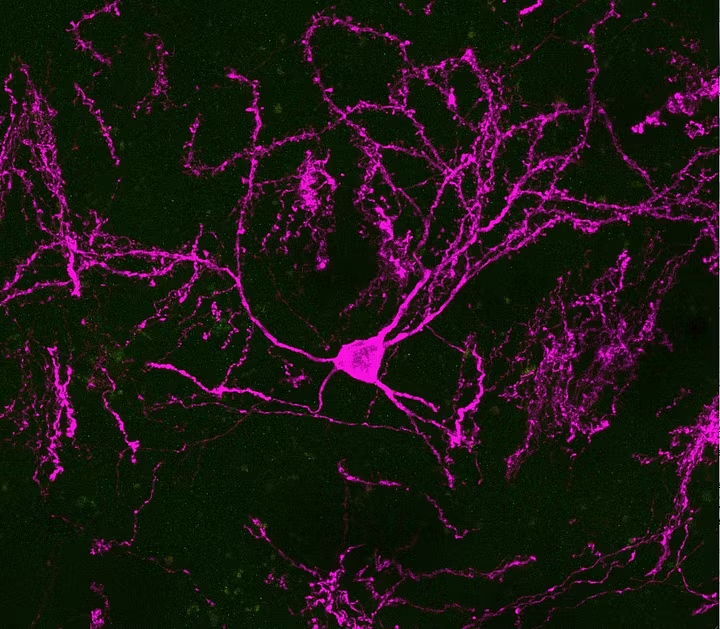


A dopamine neuron that has matured. It is such a type of cell that was transplanted into eight test subjects in a new study on Parkinson’s disease. However, the cell in the picture has not been used in those cases. Photo: Parmar lab, Lund University.
New research offers hope for a treatment for Parkinson’s disease, where sufferers could regain some lost functions.
– The goal is for the treatment to be able to be given within healthcare, says Gesine Paul-Visse, one of the researchers behind the study.
In part of a new study conducted at Lund University, eight Parkinson’s sufferers have had stem cell-based dopamine cells transplanted. The majority of test subjects were able to reduce their Parkinson’s medication twelve months after treatment. The test subjects also showed no signs of serious side effects such as tumor formation, which is considered the biggest safety risk with the procedure.
– The transplanted cells seem to have survived, which is very promising. It is the first time that we have evidence that the cells can survive in the human brain and continue to develop, says Gesine Paul-Visse, professor of basic neurological psychiatric research and senior physician in neurology at Lund University and Skåne University Hospital.
May take at least ten years
Parkinson’s disease is characterized by the gradual loss of dopamine-producing neurons in the brain. It leads to stiffness, tremors and movement difficulties.
The hope is that the cells will be able to mature further and eventually replace part of the function lost in Parkinson’s, but cannot slow down the entire disease process.
Those who participated in the study had a moderately advanced stage of the disease. One of the patients died of a lung infection that was not linked to the cell preparation. The people examined received the preparation in two different doses.
The study will continue for another two years. The patients must also be followed long-term and phase two and phase three studies need to be done with more patients.
– It will probably take at least ten years before the treatment can be given in the healthcare system. Before that, we need robust data showing both safety and sufficient efficacy.
Continued research needs to answer which dose is optimal, how large a clinical effect the treatment can produce and whether it can compete with other treatments.
The treatments for Parkinson’s available today can relieve symptoms but do not replace lost dopamine cells in the brain.
“Fantastic that things are moving forward”
Can this be called the biggest milestone in Parkinson’s that has been made in recent years?
– I would actually say that. In Parkinson’s treatment, we have had important improvements in drugs and different forms of administration for how to give the drugs, but few truly new treatment concepts. It’s great that it’s moving forward. It is the biggest thing I have been part of in my medical career.
Parkinson’s disease
Parkinson’s disease is a nerve disease that makes it difficult for the brain to control the nerve signals that control the body’s movements. It happens when the cells that make dopamine, a neurotransmitter that the brain uses to send signals between brain cells, are destroyed.
Typical symptoms are tremors, stiff muscles and reduced mobility. The very first signs of Parkinson’s can be noticed many years before the motor symptoms and can include a reduced sense of smell, constipation, depression and REM sleep disorder.
It is most common in people over 65, but can be noticed earlier. In Sweden, there are roughly 20,000 people who have the disease.
There is currently no cure, but there are effective treatments that help the symptoms.
Source: 1177, Parkinson’s Association
This is how the treatment goes:
The study mentioned in the article is called STEM-PD and is led by Lund University in collaboration with Skåne University Hospital, Cambridge University Hospital and University College London.
The stem cell-based dopamine cells are produced under controlled conditions in a laboratory. When the cells reach the right development time, they are frozen and stored in a cell bank. At the time of surgery, the cells are thawed, washed and prepared for transplantation. They are then injected with a very thin needle into the area of the brain where they are to work.
After the operation, the patients are treated with immunosuppressive drugs for a limited period of one year.
Source: Gesine Paul-Visse.
Do you have jewelry lying around that you never use? Order a free Golden Letter!